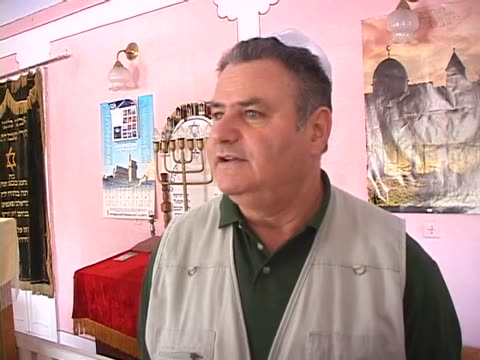
Rapoport, the president of the Jewish community in Orhei, provides information about the history of the community. The majority, roughly seventy percent, of the population was Jewish before the war. He addresses prewar religous life and mentions figures from the Orhei. Rapoport then talks about contemporary religious life.
From the machine transcript
Rapoport introduces himself as president of the Jewish community of Orhei. He describes the town's old Jewish population before the war, now reduced to very few Jews, and the many synagogues in the town and district. He mentions local benefactors and a textile factory, then explains that keeping the synagogue open for a minyan is important and that it is supported by the Joint. Kerler asks about the number of Jews before the war.
Also names benefactors and a textile factory, and the Joint's support of the synagogue.
Rapoport talks about prewar Jewish life and then provides personal information, as well as talks about his family. He was born 1945. His father and brother were imprisoned in the Domanyovka concentration camp, near Zaporozhye. Rapoport had four half-sisters and one half-brother. His grandparents and sisters were killed during World War II in camps. His mother was imprisoned in the Rîbniţa ghetto.
From the machine transcript
Rapoport states that Jews made up more than seventy percent of the town's population before the war, and answers a question about non-Jews who spoke Yiddish. He gives his birth year as 1945, after the war, and speaks about his father, who was taken to a concentration camp (Domanyovka) with a brother, and about four sisters he never saw. He mentions his father's name and role as synagogue warden and his mother's time in the Rîbniţa ghetto. Kerler asks where he learned Yiddish.
Adds the question of non-Jews speaking Yiddish and his father's role as synagogue warden.
Rapoport talks about life after the war. His family was sent to Siberia (Irkutsk district) in 1949, as part of Stalin's antisemitic measures. His family returned in 1956. Rapoport maintains that he learned Yiddish in Siberia. He then talks about life after their return in 1956. Rapoport's father taught him how to pray.
From the machine transcript
Rapoport tells how the family was deported to Siberia, in the Irkutsk region, in June 1949, accusing the authorities of treating his father as a wealthy man, and says he learned Yiddish there among other deported families. They returned in 1956 and lost their property, but lived a hard life. His father taught him to read Hebrew prayers and put on tefillin and prayed daily. Asked about songs, Rapoport says he sang Yiddish songs on the transport but remembers none now.
Adds learning Moldovan in Siberia and his singing of Yiddish songs on the transport.
Rapoport talks about religious life post-Soviet Moldova. Then the camera collects footage of the synagogue. Outside, Rapoport gives a tour of the former Jewish neighborhood. Rapoport worked as a regional economic planner. The team then concludes the interview and the camera collects outside footage of the synagogue.
From the machine transcript
Rapoport speaks about the revival of Jewish religious life in Moldova, including the first returned synagogue buildings, and the old synagogue and the central Jewish street with its small houses and the former Jewish hospital. He answers Kerler's questions about the age of the old synagogue and says he worked as head of an economic planning department, with ties to the hospital. He closes by thanking the interviewers.
Adds Kerler's questions about the old synagogue and hospital and the closing thanks.