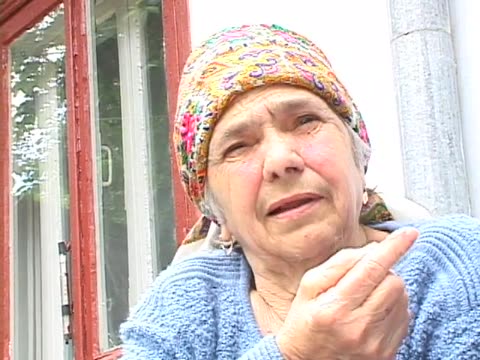
R., nee Gluzman, talks about prewar life in Soroca and her family. Her father was born in Dumbrăveni and was a tailor. She grew up with two brothers and one sister. During her childhood, her family moved to Soroca to provide good school education for her brother. She then provides personal information. Her sister moved with their mother to Israel.
From the machine transcript
She gives her name as Ruderman, Lea, and her father's name as Moshe Gluzman. She gives her parents' names and approximate birth years. The father was a tailor from Dumbrăveni, learned, and spoke Yiddish, Hebrew and Romanian; he was Sabbath-observant and prayed in the synagogue. The family moved to Soroca partly for her brother's schooling. Her sister Esther lives in Karmiel, Israel, and her mother died there.
The first minutes contain a mislabelled speaker and the interviewer asking her address and the Yiddish name of her mother.
R. talks about her school education. She attended a Romanian school and studied with a private religious tutor. R. recalls how her father read Yiddish journals and books at home, which were delivered by the mailman.
From the machine transcript
She talks about her schooling: Romanian school, and a private melamed who came to the house to teach Yiddish. Her father read Yiddish newspapers and books, delivered by the postman. She also mentions her sister and brother, and her brother's later studies in Russian after the Soviets came.
The catalogue sentence matches; the transcript adds the Russian-language schooling after the Soviet arrival.
R. talks about her family. She describes her family's fate during the war and talks about life after the war. In particular, R. explains how she got in touch with her siblings.
From the machine transcript
She speaks about her relatives: her grandmother Itte, her maternal grandmother (name unclear, perhaps Freyde) who died in a camp, and her father and brother who were taken to the front. She recounts how, after the war, a neighbor's soldier son helped trace the family. She describes her letter-writing to find her brother Shlomo and his address in Russia, and the answers she received, including from an official source. The interviewer asks her age at the start of the war.
The transcript shows her grandmothers and the account of the search via a neighbor's son and inquiries.
R. discusses life during the war. They were imprisoned in a ghetto in the Bershadskiy Rayon. She recalls how her sister and mother were taken to forced labor. They reached the ghetto via Cosăuţi and Yampil. R. continues that they had to return to Soroca and then worked in the woods, near Alexandru cel Bun, for two weeks. Through various stopovers, R. explains, they reached Vertiujeni. She recalls episodes about daily life and forced marches to Yampil and Vertiujeni. She then describes her arrival in Vertiujeni.
From the machine transcript
She describes the deportation: being driven through villages and along roads, with the mother and sister taken to forced labor. They were held in a ghetto in a village in the Bershad' area, passed through Yampil, and spent two weeks working in the woods. She recalls hunger, a collective march, sleeping in crowded rooms, and gleaning wheat. Kerler asks the meaning of the word for huts.
The transcript adds Kerler's questions on the meaning of a word for huts (kalibes) and a word for branches.
R. talks about her family and continues with her daily experiences during the war.
From the machine transcript
She continues about the war years: her siblings Esther, Shlomo and the youngest sister, the cold, her grandmother who died in the camp, and her illness without medicine. Kerler asks whether songs were sung then.
R. talks about her family. Her mother was a seamstress and helped out her father. She then discusses her childhood memories of Jewish Soroca. Her brother attended a Tarbut school. R. mentions the Jewish youth organization "Gordonye."
From the machine transcript
She talks about her mother's trade as a seamstress and how the parents lived. Asked about Soroca childhood, she describes the town's Jewish life, the religious observance, her brother's Tarbut school, a Jewish youth organization (Gordonia), and Christians living among Jews, some of whom spoke Yiddish.
The transcript also covers non-Jewish neighbors and a Yiddish-speaking Christian question.
R. discusses holiday celebration before the war. When R. talks about Sabbath celebrations, she recalls a non-Jewish woman heating their oven during the winter. She then talks about her education and life today.
From the machine transcript
She recalls prewar holidays and Sabbath in her parents' home, including a Christian woman who came in winter to heat the oven, and her mother baking bread. Asked about her studies before the war, she says she learned a little and then forgot much, though she can still read and write Yiddish.
R. addresses reading Yiddish literature after the war, before talking about prewar religious life in Soroca. She mentions different synagogues, including the cobbler, tailor, carpenter and Great Synagogue. According to R., only the Great Synagogue remained after the war.
From the machine transcript
She mentions reading Yiddish books and newspapers after the war. She describes the synagogues of prewar Soroca: the Great Synagogue and those of the tailors, shoemakers and carpenters, saying that after the war only the Great Synagogue remained.
The transcript adds a book (author uncertain) she recalls reading.
R. talks about life during the war. She explains how she was forced into the Great Synagogue, where the local Jewish community had to assemble.
From the machine transcript
She recalls being driven into the Great Synagogue during the war and held on the upper floor, including at night.
R. addresses prayers and holiday celebration, as well as talks about food customs. She then mentions Purim celebrations and more food customs.
From the machine transcript
Kerler asks about prayers she learned from her mother, and she recalls Sabbath preparation, challah, Sabbath fish, and fasting. She mentions the Purim customs: sending gifts and making filled pastries (flodn), and children going from house to house. Kerler asks about Purim plays and how the pastry is made. She also mentions Passover baking.
R. talks about life and holiday celebration before the war. She also recalls performances by Sidi Tal after the war and a prewar stage production of Tevye the Milkman in 1940. R. recalls arranged marriages before the war and talks about life at home.
From the machine transcript
She talks about the prewar High Holidays and Simchat Torah in Soroca, and recalls a Yiddish theater performance of Tevye the Dairyman in 1940. After the war, a touring troupe including Sidi Tal and Dina Zlatiyaner (?) performed. She comments on a prewar writer's account of arranged marriages and matchmakers. Kerler asks about libraries, and she describes the Yiddish papers and books her father had at home.
The transcript adds High Holiday customs, matchmaking and her father's reading, as well as the question about libraries.
R. answers questions about cultural terminology. She then talks about studying with a private religious tutor at home, before discussing postwar cultural life.
From the machine transcript
She answers questions about the meaning of expressions such as a good Jew and a Hebrew term. She then describes the private tutor who taught her at home, with notebooks and arithmetic. She recalls the postwar Russian-language touring troupe of Dina Zlatiyaner, which performed songs in Russian and Moldovan. Kerler asks about conversion to Judaism.
R. discusses folk customs and holiday celebration before and after the war. She then briefly talks about life today and prewar Jewish life in Soroca.
From the machine transcript
She talks about customs such as striking Haman at Purim, a postwar encounter in a synagogue in Odessa (?), and the Rosh Hashanah custom of casting crumbs into water (tashlikh). She mentions kosher butchers before the war and the mixed streets of Jews and Christians in Soroca, as well as her present life.