People › Maina Isaakovna Milevskaya › conversation

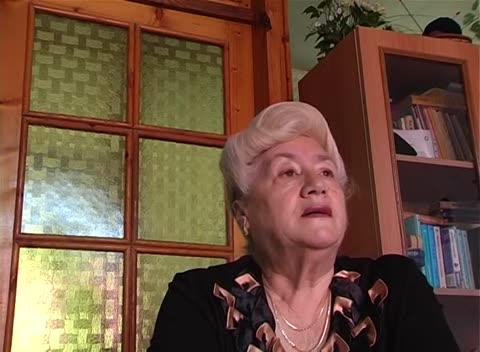
Maina Isaakovna Milevskaya

Bilhorod-Dnistrovs'kyy 1 June 2006 Interviewed by Dov-Ber Kerler 46 min · 1 part on 1 tape
Loading the player…
  1. MDV 213 0:00–46:13 · 46 min · not online — MCO
Passages

0:00

The team arrives at the local synagogue and community center. Then the formal interview with Milevskaya begins. She talks about her family and life today. Milevskaya has children in America and Israel. She also discusses the use of the Yiddish language in her family, as well as the local contemporary Jewish community.

From the machine transcript

Milevskaya speaks mostly in Russian about her family: a daughter in Odesa, a son in Israel, and children in the US (Philadelphia). She discusses Yiddish in her family: her mother read it well, her officer husband speaks English fluently but not Yiddish, and she speaks Yiddish with her sister in Israel. She and Lemster go through the few Yiddish speakers among the community members (including Pinkus, Ida Lazarevna, Ilya Evseevich, Borodina in Artsyz, Sofia Lvovna and Teitel Dora), and she mentions a visit to Sofia Lvovna.

names the individual Yiddish speakers among the community members

5:56

Milevskaya speaks about her family, before returning to community members.

From the machine transcript

Milevskaya says her Yiddish is poor and that her sister studied Yiddish in Israel. Kerler and Lemster ask who else speaks Yiddish: Teitel, Dora and Sofia Bengard, with ages of about 75 and 70, and someone in Artsyz who is about 85. She then talks about her husband's military training and tank service, and the interviewers ask about other elderly people.

names the community members and gives her husband's army career

10:31

Milevskaya provides personal information and speaks about her life after the war. She was a midwife. Milevskaya also speaks about her family. Her father was the director of a beer factory in Pervomayskoye and her mother was a German-language teacher. Milevskaya states that she only spoke Yiddish with her grandparents.

From the machine transcript

Milevskaya gives personal information: she was a midwife for 30 years and has lived in the town for 38 years. She was born in Pervomaysk; her father Itsik was director of the beer factory there, famed for its Golta beer, and her mother Golda (née Shekhtman) taught German. She spoke Yiddish only with her grandparents. Her grandfather read prayers and the Torah, and the family was evacuated to Tatarstan; her grandfather worked at a poultry plant, and on the family's return a neighbour was surprised to see them.

14:22

Milevskaya briefly addresses her family's return after the war and the encounter with their neighbor. She then returns to discussing her family. Her father grew up in an orphanage. Milevskaya moved with her husband to Bilhorod-Dnistrovskyy in 1970.

From the machine transcript

Milevskaya briefly describes the family's return after the war: her grandfather was invited back to the poultry plant. Her father grew up in an orphanage and was taken in by relatives. He knew Yiddish, studied, and was a wise man whom Jews in Pervomaysk consulted. She moved to Bilhorod-Dnistrovskyy in 1970 after her husband's service in the Far East on the Chinese border, and her children finished school and university there.

17:04

Milevskaya talks about the contemporary local community.

From the machine transcript

Milevskaya describes the local Jewish community: about 120 people receive assistance, of whom about 50 are Jews. Some stay for reasons of health or because their children live nearby, and mixed marriages are common. She mentions her daughter in Odesa, her son's three children in Israel, and her grandchildren's army service. Kerler then asks if she remembers a story or song from her grandmother.

19:29

Milevskaya speaks about her family and remembers her mother's singing, as well as snippets of a Yiddish song. She also addresses her life today.

From the machine transcript

Milevskaya remembers her mother's lovely singing of sad Jewish songs, which made her cry as a child, and she recalls fragments of a song. She says Yiddish is forgotten for lack of anyone to speak it with. She mentions Yiddish books received from the Hesed in Odesa.

adds Hesed books in Odesa and the loss of Yiddish for lack of speakers

22:04

Milevskaya talks about her grandparents' observance and remembers her grandmother's cooking. She also addresses holiday celebration.

From the machine transcript

Milevskaya recalls her pious grandfather, who prayed constantly with a Torah or prayer book and a black velvet bag embroidered by her grandmother, now with her sister in Israel. She remembers her grandmother baking matzo a month before Passover and making potato latkes, and her mother's subscription to a Yiddish journal from Moscow. She also mentions school antisemitism and the former rabbi Fishl who celebrated all the holidays and has since left for Odesa.

adds the Yiddish journal, school antisemitism and the departed rabbi

28:23

Milevskaya addresses her life during World War II. She evacuated with her mother, siblings and grandparents on a train toward Balta. She then talks about her family's return to her hometown. Milevskaya's father served in the Red Army and went all the way to Berlin. She also discusses her family.

From the machine transcript

Milevskaya recalls the war: the family fled Pervomaysk by freight car as the poultry plant arranged, crossing toward Golta amid German bombing, and the Germans took the town soon after. They returned in 1944, her mother collecting fragments of shell around the house. Her father returned from the front in autumn 1945, having reached Berlin, and told of Malaya Zemlya and Buchenwald. She also mentions her mother's work as a German interpreter, her sister's later move to Israel, and her son's emigration in 1991.

adds her father's route to Berlin and her mother's work as an interpreter

36:16

Milevskaya talks about community members and life today. She also recalls former members of the community and talks about the beer factory her father worked at.

From the machine transcript

Milevskaya talks about elderly community members, many unable to speak Yiddish, and about young people having left for America and Israel. She describes former ghetto prisoners, including Ida Lazarevna (recently buried) and a woman held in the Savran camp under Romanian rule, and Pogrebinsky's family who hid in a tree and now live in Germany. The remaining speech covers the town's population and the geography of Pervomaysk, Golta, Bohopil and Olviopol, and the beer factory is mentioned. Arrangements for a visit to Sofia Lvovna follow.

adds Ida Lazarevna's burial, hiding in a tree, and the geography of Pervomaysk