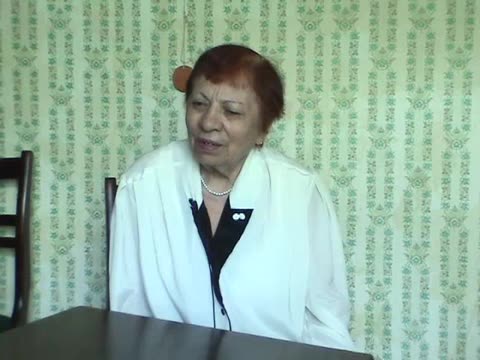
Klichinskaia provides personal information.
From the machine transcript
Kerler opens the recording with the date and place, Bender. Klichinskaia gives her birthplace as Bender and her birth year as 1926, and confirms that she lived there before the war. She then gives her official Russian name and patronymic.
Klichinskaia talks about her family. Her father was born in Western Ukraine and worked as a cooper. She grew up with four siblings.
From the machine transcript
Klichinskaia names her father Nakhum, a cooper who was born in western Ukraine, and says the town is not clear to her. The talk turns to the Yiddish and Russian word for his trade. Her mother Brane kept house, and there were five children. She names her grandfathers Berl and Gersh and her grandmothers Khaye and Khane, and says her father and grandfather were observant, laying tefillin.
Klichinskaia talks about her military service as a nurse for seven years that began in 1942. During the war, she worked in different countries, including Germany, Austria and Czechoslovakia.
From the machine transcript
Klichinskaia says she worked in a hospital for six years during the war, and the transcript does not clearly confirm the catalogue's seven years. Kerler mentions that his mother also served in the army, and asks whether she knew her. The countries she worked in are not clear in this passage.
The transcript shows a mostly personal exchange in which Kerler talks about his own mother's service.
Klichinskaia talks about her family and holiday celebration, in particular Passover. She also addresses prewar religious life and occupational structure in Tighina.
From the machine transcript
Klichinskaia recalls her grandfather's stories and the Passover table, where the children said the four questions. She mentions holiday food and going to synagogue at Rosh Hashanah and Yom Kippur. She describes the many prayer houses in Bender and the poor and the rich in town. She mentions a charitable society and names her siblings and the origin of their names. She says there were five children.
Also covers synagogues and wealth and poverty in town, and the naming of her siblings after relatives.
Klichinskaia talks about her life during the war. She evacuated to the Stalingrad region. She and her mother worked at a hospital.
From the machine transcript
Klichinskaia says the family was evacuated to the Stalingrad region, where she and her mother worked in a hospital. She was 15 when the war began. At home they spoke Yiddish, but in evacuation they no longer did, and her father put on tefillin out of sight. She mentions her sister Adl, who had an operation.
Also covers language use at home and in evacuation, and her father's hidden prayer.
Klichinskaia discusses her childhood memories.
From the machine transcript
Kerler asks for childhood memories and songs. Klichinskaia recalls songs sung in childhood, but offers a medley, and Kerler asks her to sing one song at a time.
Klichinskaia sings a Yiddish song "Sorele" that is about longing for a loved one, she remembers from her childhood.
From the machine transcript
Klichinskaia sings a medley of Yiddish songs from her childhood, beginning with the love song about Sorele and followed by songs about making a living, a dark-haired young man and troubles. Kerler stops her to ask about the words and has her repeat parts. She says she learned them from her mother.
Besides Sorele, she sings several other songs in the same medley.
Klichinskaia sings another Yididsh song from her childhood about loving a girl.
From the machine transcript
Klichinskaia sings another Yiddish childhood song about falling in love with a pretty girl and entering a small house. Kerler comments and she adds a few remarks. Kerler then turns to her life in Bender before the war.
Klichinskaia discusses her childhood memories. She attended a Romanian school for four years. She then explains the second song.
From the machine transcript
Klichinskaia says she attended a Romanian school for four years. Her brothers went to the talmud torah while the girls did not, and her father spoke Yiddish at home. She and Kerler then discuss the meaning of a line of the song she has just sung, which she describes as a humorous song.
Includes talk about Yiddish at home and the talmud torah, and an explanation of the song's wording.
Klichinskaia recalls prewar performances by Sidi Tal. She then sings the well-known Yiddish "Nokh a lid" (Another song), before singing a Yiddish drinking song.
From the machine transcript
Klichinskaia recalls that the singer Sidi Tal came to perform in Bender before the war. She sings a Yiddish song about a tavern and a glass, and a drinking song about a glass of wine. She mentions that a woman she knew took songs from small songbooks, and Kerler says he is looking for songs not found in booklets.
Kerler asks for songs not from songbooks, and she also talks about singing at Sabbath.
Klichinskaia sings the well-known Yiddish wedding song "Makhteyniste mayne" (My mother-in-law). She then discusses traditional weddings.
From the machine transcript
Klichinskaia sings a Yiddish wedding song about the mother-in-law, saying it is sung at weddings. Kerler asks about Jewish weddings, and she recalls dancing and a rabbi placed in the middle. She does not recall a badkhn or a wedding jester.
Beyond the song, she answers Kerler's questions about wedding customs, including whether there was a badkhn.
Klichinskaia talks about Purim celebrations, including food customs, before the war. She then sings Yiddish Purim songs and recalls the beginning of a well-known Purim shpiel, before Klichinskaia sings the Yiddish song "Dire gelt" (rent money).
From the machine transcript
Kerler asks about Purim. Klichinskaia mentions baked goods and a small rhyme about hamantashn, but does not remember the word purim-shpil and recalls only a little of the children's masks and greetings. She sings the song about rent money ("Dire gelt").
Includes Purim food and a children's rhyme, and the rent-money song.
Klichinskaia discusses childhood games.
From the machine transcript
Kerler asks what the children played when she was a child. She and Kerler talk about blind man's buff and a game with kremenis (?). She does not remember what language they played in. Kerler asks for another song from those years.
Klichinskaia sings the Yiddish song "Lomir zikh iberbetn" (Let's make up).
From the machine transcript
Klichinskaia sings the Yiddish song "Lomir zikh iberbetn", about making up, with verses about the samovar and oranges. She says another woman she knew used to sing a version of it, and Kerler praises it.
Klichinskaia discusses food customs, particularly gefilte fish. She then shares her recipe for gefilte fish.
From the machine transcript
Kerler asks about the taste of her mother's gefilte fish. Klichinskaia says it was lightly salted and peppered, and then gives her recipe step by step, with fish, onions, a roll, spices and potatoes. She mentions that the cutlets are fried and then stewed in the oven.
Klichinskaia answers dialectological questions from the AHEYM Yiddish linguistic questionnaire. She then addresses prewar cultural and social life.
From the machine transcript
Kerler asks how roses or flowers were said in Bender Yiddish, and the discussion goes back and forth between rozes and blumen. Kerler asks which organizations besides Sidi Tal performed, and she mentions the Jewish sports club Maccabi.
The first half is dialect elicitation about the word for flowers; the second mentions the Maccabi.
Klichinskaia briefly talks about her life during the war in evacuation. She then addresses her life after the war. She was trained as a tailor. She also recalls a tuberculosis outbreak at a Prague hospital in 1946, where she worked as a nurse.
From the machine transcript
Klichinskaia recalls that her father died in evacuation and her mother and sister returned, while she stayed in the army hospital. She was trained as a tailor, and served as a nurse in Prague, where patients came from concentration camps, including those with tuberculosis. Much is in Russian. She says she returned to Bender in 1948 (?), and recalls escorting a transport of patients.
The transcript adds the Prague hospital with patients from the camps and her escorting a transport, with most of the talk in Russian.
Klichinskaia explains in Russian her return and family life after the war.
From the machine transcript
Speaking Russian, Klichinskaia says she worked as a nurse in Vienna for two more years. Her mother and sister came back, her father having been buried in evacuation. She returned to Bender, where times were hard and there was no work, and she had her mother admitted to hospital. Her mother lived another forty years.
Content mostly from the Russian reading; the Yiddish line is gibberish.
Klichinskaia talks about Jewish life before and after the war under Soviet occupation.
From the machine transcript
Kerler asks what she wants remembered about Bender. Klichinskaia says there were many poor people under the Romanians, and things were better under Soviet rule. Her father worked in a cooperative whose owner was Jewish, so he did not work on Saturday. Her grandfather died in June.
Beyond Jewish life under the Soviets, it covers the poverty of Bender under Romania and her father's Sabbath observance.
Klichinskaia mentions folk customs and how people would come to her mother who practiced the custom of averting the evil eye.
From the machine transcript
Klichinskaia mentions her mother's practice of curing the evil eye with spoken formulas, and describes breaking an egg into a glass of water. She tells how the eyes seen in the water were interpreted, and Kerler asks for the Yiddish word for "such".
Klichinskaia answers dialectological questions from the AHEYM Yiddish linguistic questionnaire. She then sings again the Yiddish love song "Sorele."
From the machine transcript
Klichinskaia and Kerler discuss the dialect word for "such" or "such kind of" (a mine / takiye) in the phrase "such eyes". Kerler then asks her to sing again the love song about Sorele and the other songs of the medley, which she does.
The dialect questioning is about one word, followed by the repeated medley.
Klichinskaia talks about life today and her family. Her sister lived in Israel for three years. Klichinskaia raised a son.
From the machine transcript
Klichinskaia talks about her health, including eye operations, and says that she has few people to speak Yiddish with. Her sister lived in Israel for three years and returned, and she mentions her sister's operation. She has a son, who understands Yiddish but does not speak it. Kerler mentions his mother's army service and her work in a sanatorium.
The passage covers her health, her son and Yiddish today, plus Kerler's remarks about his own mother.
Klichinskaia sings again the second Yiddish love song, before she sings a song in Russian about the war.
From the machine transcript
At Kerler's request Klichinskaia sings again the second love song, about falling for a pretty girl. Kerler asks for another song, and she says she also sang in the hospital and sings a Russian song about a girl soldier.
Klichinskaia sings a song in Russian about the strong female soldier.
From the machine transcript
Klichinskaia sings a Russian wartime song about a girl soldier who fights beside the men, as a pilot and a machine-gunner, and is proudly called a beloved soldier-girl. After the song Kerler thanks her and the recording is wound up.
Closing remarks by Kerler after the song.
The camera collects footage of Transnistria/Moldova.
From the machine transcript
Camera footage from a drive through fields and villages in Moldova/Transnistria. Kerler and a second man talk in Russian about the landscape, the quiet, and a border crossing with customs and registration problems. They mention a river, the Kamenka (?), to be crossed before the cemetery, and some ruined buildings.