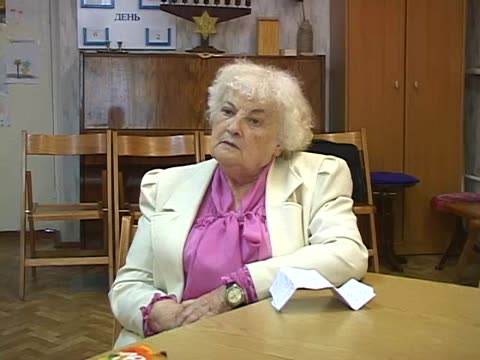
People › Mania (Malke) Izrailevna Grinberg › conversation

Mania (Malke) Izrailevna Grinberg

Bender 5 June 2006 Interviewed by Dov-Ber Kerler, Moisei Lemster 18 min · 1 part on 1 tape two sources agree
Loading the player…
  1. MDV 220 2:19–20:31 · 18 min · archive.org · a part of the tape
Passages

2:19

The formal interview with Grinberg begins. She provides personal information and talks about her family. Throughout his life, her father was employed by wealthy Jewish men and worked as a merchant. Her mother was born in Baranderivka 8:47. Grinberg grew up with a sister, who lives in Australia.

From the machine transcript

The formal interview with Grinberg begins with Lemster giving the date and place. Grinberg says she lived with her parents in Talmaz until the war and gives her father's name. He was poor and worked for a rich man in the cabbage trade, and buyers came from Romania. She speaks of her mother's name and dates, her gymnasium schooling and piety, and her grandparents, whom she does not remember. She has one sister, who lives in Australia.

Adds Talmaz as her home and the father's cabbage work for a rich employer; the mother's birthplace is not clear in the transcript.

10:07

Grinberg talks about her life after the war. She worked at the State Bank.

From the machine transcript

Grinberg says that she was thirteen during the war. After the war she worked at the State Bank and has two diplomas. She mentions that she is now on a pension.

Adds her two diplomas and her pension.

10:52

Grinberg discusses her childhood memories. She attended a Moldavian school.

From the machine transcript

Lemster asks about Grinberg's childhood. She recalls illness as a child and that she attended a Moldovan school, where she spoke Moldovan and had no one to speak Yiddish with. Asked how she lived with her parents and what she played with friends, she answers only briefly, saying she had enough to eat, and she does not say what she played.

Adds that the school language was Moldovan and her loss of Yiddish speakers; the transcript shows little else of her childhood.

13:30

Grinberg talks about Jewish life in prewar Talmaz.

before the war Local Jewish history MDV 220 · MCO
From the machine transcript

Grinberg describes Talmaz as a Jewish town with many Jews. She mentions Purim and Passover, a rabbi with a beard, and her observant parents, her father going to the synagogue. In answer to Lemster, she says there was one synagogue, with separate sections for women, and there was a hospital. She recalls a shoykhet and kosher slaughter on Sabbath with a special knife, and says she has forgotten much Yiddish. She is the only one left of her family, as her sister is in Australia.

Adds the synagogue, shoykhet and kosher slaughter, and her loss of Yiddish.

17:05

Grinberg talks about life today and her family.

From the machine transcript

Grinberg says she goes to synagogue now. She has bought a plot in the cemetery because she wants to be buried as a Jewish woman, in a shroud and with a Jewish burial. She mentions her parents and asks whether the interviewer understood her Yiddish. Lemster then turns to the Jewish holidays she remembers.

Adds the cemetery plot and burial wishes and the question about her Yiddish; the family detail is only her parents.

18:36

Grinberg discusses prewar holiday celebration.

before the war Other holidays MDV 220 · MCO
From the machine transcript

Asked about the holidays in Talmaz, Grinberg says her parents observed Passover and Jewish custom, keeping separate dishes. She mentions that the family had a cow. Prompted on Sabbath, she names the blessing of the candles and speaks of Hanukkah. Her account is halting and mixed with Russian.

Adds Passover, the family cow, the candle blessing and Hanukkah.