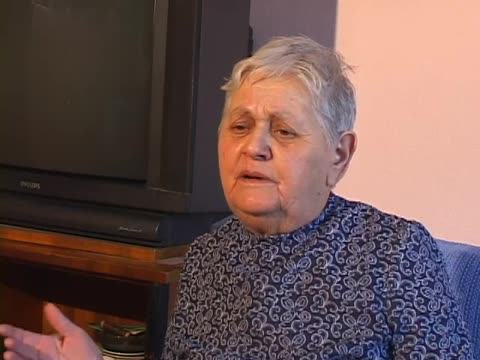
Finkel provides personal information.
From the machine transcript
Opening identification: Finkel gives her name and Kerler checks her Yiddish first name and her husband's name. They also check her birth year, apparently 1925 (?), and Kerler asks for her address.
Finkel provides personal information and talks about her evacuation during World War II. They went to Hlipiceni and then returned to Sulita, before moving to Botoșani.
From the machine transcript
Finkel recounts being evacuated several times during the war, first to Hlipiceni, where peasants gave them room, and then back to Sulita, where her parents' house stood. The family then moved on to Botoșani. The account is partly garbled. Kerler then turns to her childhood.
Kerler's turn to childhood questions at the end.
Finkel talks about her family. Her father was a kosher butcher. She grew up with a brother and a sister, who lives in Israel. Finkel raised a son.
From the machine transcript
Finkel gives her parents' names: her father Mordechai (Marcu) Grinberg and her mother née Meirovich. She says her grandfather Moshe was a short man and that her father came from a family of about twelve children. Her father was a kosher butcher, and her mother kept house.
Names her mother's maiden name, her grandfather and her father's trade as a butcher.
Finkel discusses her childhood memories and her family.
From the machine transcript
Finkel says that as the eldest child she was not allowed to play with others and had to work. She mentions a brother, Sala Grinberg, who studied with rabbis, was sent to Siberia in the war and drowned there, though the account is garbled and mixed with Romanian. She also mentions a younger sister, Miriam, who lives in Petah Tikva and whom she has visited. Of three children, two sisters remain.
Names her brother and sister, her brother's fate and her sister's home in Israel; no mention of a son here.
Finkel talks about her life before the war. She attended a Romanian-Jewish school in Suliţa. She also studied with a privately hired tutor, who taught religion and the Yiddish language. Finkel helped out her family after school.
From the machine transcript
Finkel answers questions about schooling in Sulita: there was one Jewish school and the rest were Romanian, and she did not say what was taught in the Jewish school. At home she had a private tutor who came to teach her, but she has forgotten it. She says she helped her parents in the household before the war. She mentions her husband's death and her aching legs, and cannot name a best friend.
Finkel speaks about prewar religious life in Suliţa. According to her, three hundred Jewish families lived there. She then addresses holiday celebration.
From the machine transcript
Finkel says there were three or four synagogues in Sulita and about three hundred Jewish families. She tells how her father led the Passover seder at home but remembers little of the customs. She did not go to weddings and says there was no Yiddish theatre in Sulita. Prewar Sabbath practice is touched on briefly.
Gives the number of families and synagogues and adds Passover seder customs.
Finkel explains how her mother koshered meat and talks holiday about food customs. She then shares a fish recipe.
From the machine transcript
Finkel explains how her mother koshered meat by soaking it for half an hour and then salting it for an hour. She remembers that her mother baked challah every Friday in the communal oven and mentions Sabbath soup and baked goods. She says she blesses the candles in Hebrew and has forgotten the Yiddish prayers. Lemster asks about gefilte fish and chopped fish, and she describes how fish were prepared with little salt, sugar and pepper.
Finkel discusses holiday celebration, including Purim. She also recalls concerts.
From the machine transcript
Finkel answers questions about Purim in Sulita. People prepared Purim treats and people came from Botoșani, and there were masks, music from Gypsies or fiddlers, and dancing all night. She cannot recall any songs. Kerler asks about Zionist songs sung on outings, and she mentions the Hatikvah; the interviewers steer back to Sulita.
Adds Purim food, masks, musicians and her recalling of songs.
Finkel talks about prewar Jewish life, including occupational structure. She also remembers traditional weddings. Finkel moved to Botoșani in 1951.
From the machine transcript
Finkel remembers Jewish occupations in Sulita such as tailors, shoemakers and others, and weddings held in a hall. She says Gypsy musicians played waltzes and tangos, and cannot say if there was Jewish dancing. Under questioning she says some Jews owned land and kept sheep and grew grain, potatoes and similar crops, as the non-Jews did. She says she remembers little of the town, which had a beth midrash and one Jewish school.
The move to Botoșani in 1951 is not visible in this stretch of transcript; it adds farming and a beth midrash.
Finkel talks about the local Jewish school, she attended. She then addresses holiday celebration, particularly Passover.
From the machine transcript
Finkel says Sulita had one Jewish school and she learned from the prayer book, and later from a tutor who came to her house. Lemster asks how Passover was kept. She says she did not know where matzo was baked in Botoșani and that the matzo was brought from there, and she does not recall the food. The passage ends with Kerler asking the name of her best friend.
Adds Kerler's question about her friend.
Finkel discusses her childhood memories and her childhood friends. She then shares the episode about how she met her husband.
From the machine transcript
Finkel says she cannot recall her childhood friends, who have gone to Israel, and that she had no close friend. She tells how she met her husband: he lived in Botoșani and she in Sulita, and friends who later left for Israel introduced them. The match was arranged and she had to consult her parents. She cannot recall the wedding meal.
Finkel's son shows his parent's wedding photograph. Finkel then talks about her wedding.
From the machine transcript
The interviewers look at the wedding photograph shown by her son, and Kerler comments on it. Lemster asks her about her wedding, the canopy, the parents, the matchmaker and the fiddler. She recalls little after so many years, though she says there was a matchmaker in Sulita.
Finkel speaks about prewar religious life. She recalls that her father went to see the Ştefăneşti rebbe.
From the machine transcript
Finkel says her father used to travel to the rebbe, whom the transcript renders unclearly, perhaps Ștefănești (?). She says her father was an honest man and she does not know why he went. She does not remember holiday practices such as the Tisha b'Av ones. Kerler urges her to tell what she remembers for the sake of the visitors.
Adds Tisha b'Av and the interviewers' appeal.
Finkel answers questions about cultural terminology. She then briefly speaks about her life in Botoșani, where she moved in 1951. She also touches upon folk customs.
From the machine transcript
Finkel answers questions about the meaning of terms such as dybbuk, which she explains as someone cursed, and goylem, which she explains as crazy. She says briefly that she lived in Botoșani after coming there in the 1950s and worked at home. She also describes a folk cure of dropping coals into water against the evil eye, but cannot recall the words said.
Finkel talks about Jewish life before the war.
From the machine transcript
Finkel says Sulita had a Jewish bath and perhaps a mikveh and was near a river or pond with fish. The interviewers ask for the Yiddish words for the water and the stream, and whether her father fished. They then ask where the Jews of Sulita went afterwards.
Finkel talks about contemporary life in Suliţa.
From the machine transcript
Finkel says the Jews of Sulita went to Israel and no one lives there now. She describes visiting the Jewish cemetery about two years earlier with the president of the community and her son. It is fenced with many stones and neglected. She asks who would work there. Lemster asks for the Yiddish word for the fence, and she says her father is in Israel.
Finkel discusses life in the 1930s. She addresses the great fire in 1935. She also talks about her family. Her father moved to Israel.
From the machine transcript
Kerler asks about the expulsion of Jews from Sulita to Botoșani in 1941 and about the fire. Finkel says about eighty houses burned, and Kerler corrects the date of the fire to 1935. Her father rebuilt the house and later sold it and left for Israel to join her sister after her mother died in Botoșani. Lemster asks what she says at the grave of her ancestors.
Adds the 1941 expulsion, the move to Israel and the question about prayers at graves.
Finkel addresses her son's bar mitzvah and theater performances in Botoșani.
From the machine transcript
Finkel says she held a bar mitzvah for her son, prepared by a rabbi who had come from Israel. She cannot recall Yiddish songs or stories. Asked about theatre in Botoșani, she says she went and that Christians came too, and that the audience came from Iași. The interviewers compare Iași and Botoșani and the livelihood there, and the interview ends with thanks.
Adds Iași as the origin of audiences and the comparison of towns.