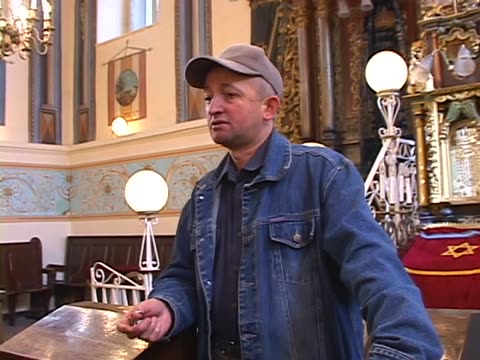
Brief's son provides historical background of the synagogue. It was built some time between 1835 and 1840. He also addresses prewar religious life and contemporary services during holidays.
From the machine transcript
The speaker gives the history of the Botoșani large synagogue. It was built in the 1830s or 1840s (the date is not entirely clear in the transcript) by Jewish families who had come from Ukraine and Russia, and it was the biggest synagogue in the town. He says there were many small synagogues in Botoșani before and after the war. He describes how services are now held on Friday evening, Sabbath and holidays, with about fifteen to twenty men at a minyan, and how the women's gallery was used earlier. He answers questions about the unknown architect and about the old and new cemetery fields, and speaks of Torah reading and Simchat Torah. He also mentions the few remaining Jewish families in nearby villages and the lack of a congregation there.
The transcript also shows the old and new cemetery fields, attendance at holidays, and the Jews left in nearby villages.