People › Rudolf Rozenblat › conversation

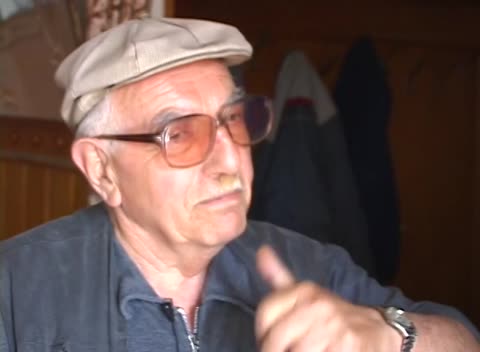
Rudolf Rozenblat

Iași 26 May 2006 Interviewed by Dov-Ber Kerler, Jeffrey Veidlinger 35 min · 1 part on 1 tape
Loading the player…
  1. MDV 273 0:00–35:00 · 35 min · archive.org
Passages

0:00

Rozenblat shows songtexts by Emil Sekulets, whom Rozenblat personally knew. Rozenblat then talks about his own work as musician. He played in the local philharmonic orchestra for twelve years.

From the machine transcript

Rozenblat shows a songbook with Hanukkah and other song texts, and says he copied the songs from a Yiddish composer, Emil Sekulets (spelling unsure), who died in Israel and whose family were musicians. He says he played violin in the philharmonic for twelve years and describes his large music library and old records. Kerler asks about the sources of the songs and the dates of the records.

Hanukkah song and the record collection, with Kerler's questions about sources.

3:24

Rozenblat sings a few popular Yiddish songs from his typed songbook.

From the machine transcript

Rozenblat sings several Yiddish songs from his songbook, including a Passover song, a 'Tumbalalaika' type song and a song about his hometown Iași. Kerler asks when he compiled the booklet and whether it has a table of contents, and Rozenblat sings more.

8:36

Rozenblat speaks about his Hebrew-language education, as well as his family.

From the machine transcript

Rozenblat speaks briefly about his family, saying his maternal grandfather was a rabbi, and about learning Hebrew. He recites or sings a text about a teacher in a cheder, and Kerler asks for songs he remembers from his mother, after which he sings a partisan song.

A maternal grandfather who was a rabbi, and a cheder scene.

10:57

Rozenblat sings more popular Yiddish songs.

From the machine transcript

Rozenblat sings more Yiddish songs, among them a lullaby-like song and a 'Lekhayim brüderlekh' song. Kerler asks for songs from his mother not in the book and asks why the texts are written in Latin letters rather than Yiddish ones. Rozenblat also mentions a Romanian-Hebrew item, and Kerler then proposes a short visit to the old synagogue.

The question about Latin transliteration of the Yiddish texts.

15:28

The team and Rozenblat chat with a Jewish soldier from Iraq outside the synagogue.

Informal MDV 273 · MCO
From the machine transcript

Outside the synagogue the team and Rozenblat meet an American Jewish soldier on leave from Iraq; much of the talk is in English. Rozenblat says the big synagogue is nearby, and a number of Jews (the figure is unclear) is mentioned. The soldier talks about his military career, Shabbat plans and his travel route. Rozenblat then talks of the community center and the synagogue.

19:38

Rozenblat provides background history on the Meransky Synagogue.

From the machine transcript

Kerler asks Rozenblat for background on the synagogue, and Rozenblat says it dates back more than a hundred years. The Veidlinger voice meanwhile talks of a friend who made a film about the Jews of Romania. Rozenblat explains that the guilds each had their own synagogue and that this one belonged to apple merchants, hence the name Meransky, from the Romanian word for apple.

The explanation of the synagogue's name from the apple merchants' guild.

21:12

The team and Rozenblat enter the building of the former Meransky Synagogue of Iaşi and Rozenblat gives a tour.

From the machine transcript

The team enters the former Meransky synagogue, and Rozenblat shows where the Torah scrolls stood and the women's section with its memorial name plaques. He says the synagogue closed some twenty years earlier. Rozenblat speaks of the cost of restoring it and of his wish for a Holocaust museum of Jewish life in Iași. In parallel, the team keeps talking in English with the American soldier about his service and about politics, and they exchange contact details before he leaves.