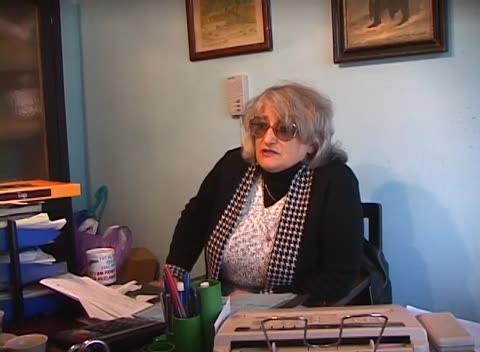
Grinberg speaks about her family life in prewar Fălticeni. She descends from a family of cantors and hasidim. She then addresses her childhood memories and work as synagogue caretaker.
From the machine transcript
Grinberg describes her family in Fălticeni as very pious, with hasidic (Chabad) roots and several cantors among her father's relatives. She recalls her maternal grandfather's piety, and her own childhood task of calling neighbors to the synagogue on Sabbath mornings. She says Yiddish was spoken with her grandmother, while at school she had to speak Romanian and had few people to speak Yiddish with.
Adds her grandmother's Yiddish and the Romanian-only school; the synagogue-caretaker work is not evident.
Grinberg speaks about contemporary Jewish life in Rădăuţi. She also speaks about her activities as the head of the community.
From the machine transcript
Grinberg talks about present Jewish life in Rădăuți: prayer at the synagogue, a communal seder, Purim and Hanukkah observances, and Jews coming from Bucharest and elsewhere. Before Passover a shochet comes and she arranges kosher meat for Jews in Rădăuți and nearby towns. She says the community is old, with few young people, and mentions a young couple expecting a baby. Lemster asks where she learned her Yiddish.
Adds the kosher meat arrangements and the young couple; interviewers' question about her Yiddish.
Grinberg speaks about Jewish life in Fălticeni during and after the war. She states that Fălticeni Jews were not deported to Transnistria. Grinberg then addresses Jewish life in Rădăuţi after the war.
From the machine transcript
Grinberg says many Jews remained in Fălticeni after the war, and that Fălticeni Jews were evacuated toward Suceava but, after a change in policy, were not deported to Transnistria. By contrast, she says nearly all of Rădăuți's Jews were deported and only a few professionals and a factory owner remained. The talk then turns to whether Rădăuți Jews spoke German or Yiddish, and her arrival there in 1971.
Adds Rădăuți deportations and the German versus Yiddish discussion.
Grinberg speaks about her life in Rădăuţi, where she moved to Rădăuţi in 1971 and received a work assignment for a nearby-village. She earned her doctorate in mathematics. Grinberg worked in the village from 1971 to 1992 and then took on work in the community.
From the machine transcript
Grinberg says she was sent to a village near Rădăuți after 1971 and worked there until 1992, going home to her parents on free days. Kerler establishes that she is a mathematician, not a medical doctor. From 1992 she worked in the community. She then speaks of the old Jews she met, who spoke only German, and of an elderly man of 97 who is deaf and blind but remembers the deportation.
Adds the old German-speaking community members and the 97-year-old man.
Grinberg plays a recording of her father praying and speaks about the local community.
From the machine transcript
Grinberg speaks about her mother's recovery after paralysis and the difficulty of finding a caregiver. The conversation covers local Jews who still speak Yiddish, a recently deceased community doctor, and her use of French. The group then discusses a gravestone made during a man's lifetime, other people of the community, and the many synagogues of prewar Rădăuți. The catalogue's recording of her father praying is not evident in the transcript.
Adds the gravestone, the community doctor and her languages; recording of her father not evident.
Grinberg gives a tour of the community center and speaks about the local community today. She also addresses mixed marriages in prewar Rădăuţi.
From the machine transcript
In the community center, Grinberg and the interviewers discuss a dialect word for Purim and where it is used. She says Rădăuți Jews were less pious than those of Fălticeni, and that many in Rădăuți married non-Jews even before the war, which surprised her. She discusses children of mixed families who come to her wanting to be recognized as Jews.
Adds a dialect-word discussion at the start.
Grinberg talks about prewar religious life in Fălticeni.
From the machine transcript
Grinberg talks about prewar religious life and charity in Fălticeni: collecting donations for the needy, and the two rabbinical families, including the Rozen family. She says a Rozen rabbi gave her father the name at her naming and names the role of the marriage helpers, with Kerler and Lemster asking about naming customs for girls and the term for the person who gives the name.
The camera then records footage of the Rădăuţi synagogue. Grinberg speaks about contemporary Jewish life and events. She also mentions her academic activities.
From the machine transcript
After footage of the synagogue, Grinberg speaks about her recent activities: the city days at Gura Humorului where minorities bring food, and her baking of sugar cookies, then the Jewish periodical and the Romanian readers who buy books from the community. She mentions conferences in Constanța and Suceava, and complains about visiting foreign groups who presented themselves as rabbis.
Adds the minority food event, the conferences and the visitors who came as rabbis.
Grinberg speaks about her hasidic family in Israel. She also mentions visitors from abroad.
From the machine transcript
Grinberg tells of her father's relatives in Israel, many of them rabbis and hasidim, including a cousin teaching at a yeshiva in Jerusalem. She describes unwelcome foreign visitors posing as rabbis and a visit to an aunt near Bnei Brak. Two visitors promised help to renovate the synagogue and left her pictures of a rebbe. The interviewers agree to meet again.
Adds her visit to Israel and the offer of help for the synagogue.
Grinberg speaks about her Yiddish education at a Romanian school Fălticeni in the 1950s. She explains how a female teacher taught at her school twice a week for two years. Grinberg then speaks about her family and childhood memories. Her father was a glazier.
From the machine transcript
Grinberg recalls Yiddish lessons at her Romanian school in Fălticeni in the 1950s, taught by a woman teacher for a year or two, using primers in Hebrew letters, which she found strange. She says her parents did not let her speak Yiddish so she would learn Romanian well, and spoke it mainly to keep things from others. The talk also covers Yiddish among non-Jewish neighbors in small towns.
Adds her parents' restriction on Yiddish at home; her father as a glazier appears in the next passage.
Grinberg addresses holiday celebration at home during the postwar Soviet period. She recalls how her father never worked on Sabbath and holidays. Grinberg then speaks about her family. She grew up as an only child.
From the machine transcript
Grinberg speaks about her father, a glazier, who prayed before the amud and never worked on Sabbath or holidays, with nobody objecting. She says she was an overprotected only child, whom her grandmother and mother fed and pampered, and her father took her to school by bicycle.
Adds her father's trade and the pampered childhood.
Grinberg speaks about her education. She attended a Romanian school in Fălticeni and then the mathematics institute in Iaşi. The camera then collects more footage of the Rădăuţi synagogue (outside and inside).
From the machine transcript
Grinberg briefly states her education: school and lyceum in Fălticeni, then the faculty in Iași, where she took her doctorate in mathematics. The interviewers then arrange to go to the club for lunch and afterwards to her mother.
Adds the plan to eat at the club and visit her mother; the synagogue footage is not evident.