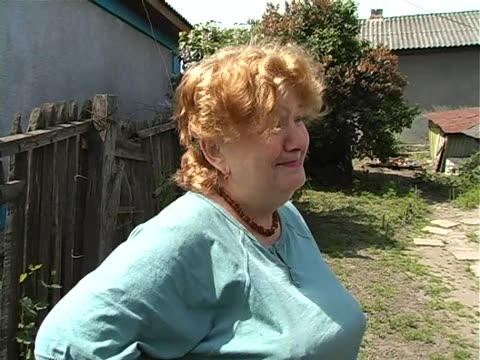
People › Klara (Khayke) Davidovna Lokteva › conversation

Klara (Khayke) Davidovna Lokteva

Balta 20 May 2008 Interviewed by Dov-Ber Kerler, Moisei Lemster 52 min · 1 part on 1 tape proposed
Loading the player…
  1. MDV 320 0:00–51:54 · 52 min · not online — MCO · a part of the tape
Passages

0:00

Lokteva talks about her family. Her father was drafted into the Red Army. She and her mother were imprisoned in the Balta ghetto. She raised two sons who live in America. Lokteva lives in Rostov since 1963. After the war, she lived with her aunt.

From the machine transcript

At the family house, Lokteva says Jewish people lived there and her mother's family stayed on. She says her mother died years earlier and she looks after her blind sister, while living alone in Rostov. She names her father's Mogilevskii family and her mother's Dorfman family, and says her father was taken to the war. She says she has two sons in America (Hartford, Connecticut). She also says she still speaks and can sing Yiddish, and answers questions from Kerler and Lemster.

The catalogue says she and her mother were imprisoned in the Balta ghetto and that she lived with an aunt after the war; the transcript here shows her father taken to the war, her mother's death, and her sister's blindness.

6:16

Lokteva discusses Yiddish songs and talks about postwar Jewish life in Balta. She then recalls a Yiddish song that her uncle taught her and talks about her family.

From the machine transcript

Lokteva is asked where she knows Yiddish songs from and says her mother passed some on. She recalls fragments of a song learned from an uncle and discusses Yiddish in Balta in the 1950s–60s, including Jewish weddings and the custom of giving a gift called makes (?). She names her uncle Gavriil and talks about her mother's nine siblings, seven of whom survived. She gives her own name as Khayke Klara, and discusses the age of the house.

The transcript also shows questions on wedding customs and on Yiddish speakers in Balta, and the names of her mother's siblings.

15:53

Lokteva and the team enter her childhood home, in which her sister Yulia Davidovna Mogilevskaia now lives. Lokteva provides a tour of the house and provides personal information about her sister. Mogilevskaia worked in the sewing factory after the war. Lokteva then discusses food customs.

From the machine transcript

The team enter the house and greet Lokteva's sister in Yiddish, and Lokteva shows them around, including the stove. She answers questions about Sabbath cholent and holiday cooking, and then about foods such as gefilte fish, chopped fish and potato pancakes, with some talk of how they were prepared. She says she learned cooking from her mother.

The catalogue says the sister worked in the sewing factory; the transcript shows mainly food terms and recipes, and the sister's workplace mention is unclear.

19:44

Lokteva talks about holiday celebrations and her family. Her mother cooked and sold borshtch. She then talks about Purim celebrations and remembers a Yiddish song about Purim. She also recalls her mother baking matzah in the oven at home. She then discusses postwar Jewish life, when people gathered in private homes for services. Lokteva remembers her own wedding and talks about their family, in particular their mother’s family. Their cousins live in America and Israel.

From the machine transcript

Lokteva says her father did not return from the war, and her mother cooked and sold borscht to support the family. She is asked about Purim and recalls a short Purim song only partly. She recalls her mother baking matzo at home and answers questions about a shoykhet, weddings and a Yiddish theater before the war. She tells how a visitor photographed the house, and names her mother's siblings and her relatives in America and Israel.

The transcript also shows a long exchange on the interviewers' travels and distance from America, and the names of her mother's siblings.

30:19

Lokteva shows a family photograph, taken in the family’s home. She then talks about their family, before briefly addressing holidays. Lokteva’s wedding took place at her aunt’s house nearby.

From the machine transcript

Lokteva and her sister show a family photograph from the house and name the people in it: grandfather Khayim and grandmother Leye (?) Dorfman and their children. She says her grandfather supported many children by his work. Kerler and Lemster explain the project and discuss a ceiling and other household words, and Dorfman relatives abroad. Asked where her wedding took place, she says at her aunt Etl's house two doors away. She says her grandfather died before the war and her grandmother in 1945.

The transcript also shows Kerler and Lemster explaining the project and discussing words for ceiling and boards.

39:13

Lokteva talks about her life during the war. Her family was imprisoned in the Balta ghetto and lived in their home during that period. She then remembers the best moments of her life and talks about her family. Lokteva married twice. After her first husband Kleynburt passed away, she married a non-Jewish man.

From the machine transcript

Lokteva answers questions about the ghetto period: the house was large, and only her mother and two sisters lived there with her. She says she was very young. Asked about the best time of her life, she says it was her childhood. She says she married at eighteen, married twice, and her first husband Kleynburt (?) died; she tells of her two Jewish sons' wives and of the money lent at interest for the wedding. She also talks about Jewish holidays and a Yiddish school.

The transcript also shows Nudelman relatives who left the ghetto, details of her wedding finance, and the interviewers' questions about Yiddish and Jewish life.