People › Marta Izrailovna Lerner › conversation

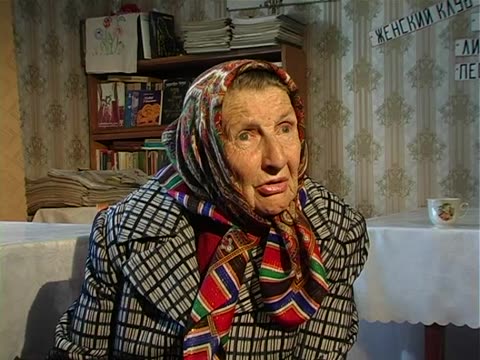
Marta Izrailovna Lerner

Balta 21 May 2008 Interviewed by Dov-Ber Kerler, Moisei Lemster 18 min · 1 part on 1 tape
Loading the player…
  1. MDV 327 0:00–18:09 · 18 min · not online — MCO
Passages

0:00

Lerner talks about her family, particularly her father. She was raised by a aunt. Lerner also addresses her education and work. Lerner explains that she studied mathematics at an institute in Odesa and worked as high school teacher.

From the machine transcript

Lerner says her father was arrested in 1936 under Stalin and died in a camp. She was raised by her mother's sister. She describes her good schooling and her studies in mathematics at a pedagogical institute in Odesa. After graduating with distinction she was assigned to teach in a village school for three years, in a district now part of Balta district. At the end an interviewer asks where and in what year she was born.

Her father's arrest and death in a camp, and her village teaching assignment, are in the transcript.

1:30

Lerner provides personal information and speaks about her family. Lerner mentions that she lives in the same house her grandfather bought. Lerner grew up with two cousins. She also has relatives in America.

From the machine transcript

Lerner gives personal data: she was born on 2 March 1934 in Balta. She names her parents (patronymic Izrailovna) and her surname Lerner. She lives in her grandfather's house, where she bought out her brothers' share (?). She grew up with two cousins who were her aunt's sons. One lives in America and sends her money, and another, Efim Khaim, lives in Chicago. She remembers a doctor, Genia Borisovna, from Berdychiv, who looked after the children and died in Kishinev.

Evacuation to Kokand is mentioned, as is a doctor, Genia Borisovna, from Berdychiv.

3:50

Lerner speaks about the history of her house and describes the rooms.

From the machine transcript

Lerner explains that her street was called Lesnaya before the revolution and was later renamed after Kirov. Her grandfather moved from Rybnytsia to Balta in 1930 and bought the house. She describes the house room by room, including a passage room, the stove, a south-facing room with a balcony and a bedroom. She says she once took in lodgers and painted the floors herself. She also recalls returning from evacuation in September 1944 and living in part of the house.

5:59

Lerner speaks about her work and colleagues after the war. She then speaks about her family and mentions her relatives, who made aliyah in 1928.

From the machine transcript

Lerner speaks of her studies, her professors and her three years of teaching at a village school. She then taught at an evening school in Balta. She mentions her uncle in Chernechi, a merchant, and a colleague whose husband returned from German captivity. She says the family spoke Russian at home, with Yiddish used by the aunt and uncle. She lists her mother's siblings: an aunt who went to Palestine in the 1920s, and a brother who lived in northern Russia. She recalls the aunt's visit from Israel in 1965 and the family reunion in Kishinev. She talks about her cousin in Kishinev, an engineer, and his daughter in Jerusalem.

Adds her colleagues, the language spoken at home, the aunt's 1965 visit from Israel, and her cousin's family in Kishinev and Jerusalem.

12:02

Lerner speaks about her life during World War II. Lerner's mother evacuated with her to Kokand, Uzbekistan and passed away there. She also mentions her family's fate during the war, before addressing her grandparents.

From the machine transcript

Lerner recalls the outbreak of war and the bombing of Balta in July 1941. Her aunt took her and her mother east in a cart, a journey that went as far as Rostov, and then to Kokand in Uzbekistan. Her grandfather Moyshe, a learned man, stayed behind and survived the Balta ghetto. Her grandmother was Sara (maiden name Gorina). She says he was hired to pray for others, kept bonds safe, and returned to his house after liberation. After the war she lived with him. She also recalls the synagogue that became a library, says she read Russian at an early age, and turns to Jewish weddings.

Adds her grandfather Moyshe and his survival in the ghetto, her grandmother's name, and the old synagogue that became a library.

16:10

Lerner talks about his cousin's wedding. She then speaks about playing chess.

From the machine transcript

Lerner talks about a cousin's wedding: the cousin Roza married Rudolf in Vitebsk and later moved to Beltsy. Lerner visited them as a student, and Roza later went to Israel. She says she remembers Jewish weddings in Balta, Beltsy and Kishinev only poorly. She also says she was a Komsomol member and an athlete. She describes playing chess for Balta at a first-class rank and taking fourth place in a regional competition in Kotovsk.

Adds the cousin's later move to Israel and Lerner's weak memory of Jewish weddings.