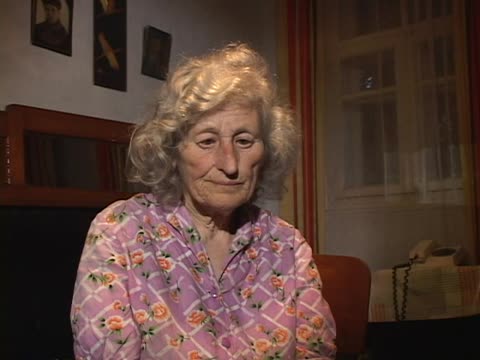
Guzman discusses the Tomashpil ghetto. It was established in 1941, and included her house where she lived throughout the war, from 1941-1945. A large number of the Tomashpil Jewish community was killed during the war, but many returned afterwards.
From the machine transcript
Guzman answers Katz's questions about the Tomashpil ghetto, where her family lived in its own house on a street that was fenced off from the rest of the town. She dates the ghetto to 1941 and its end to 1944 or 1945. She explains that the Ukrainian police, working with the Germans, killed many Jews, some of them thrown alive into a pit. Her father was beaten at the gendarmerie and left an invalid. She says that after the war some Jews who had been evacuated returned, but few remain now.
The catalogue sentence does not mention the Ukrainian police, her father's beating, or the evacuees who returned.
Guzman discusses life in Tomashpil today. She also briefly discusses family members she has in America and in Odessa.
From the machine transcript
Katz asks how Guzman lives today; she describes her pension and her modest circumstances. Asked what she would say to Jews in America, she mentions her father's relatives in America who wrote to the family regularly after the war and are no longer alive. She also mentions her mother's brothers in Odessa and a two-year stay in a place whose name is unclear in the transcript.
Life after the war. After the war, Guzman worked as an accountant. The Jews of Tomashpil were still practicing after the war, and the synagogue was rebuilt some time in the 1940s (?),
From the machine transcript
Answering Kerler, Guzman describes her working life after the war. She went to school, took bookkeeping courses and worked as an accountant in several places until the district office was closed and later reopened. She then answers questions about Jewish religious life after the war: Jews still prayed, a synagogue remained for a while and was closed in the later 1940s.
The catalogue sentence does not mention the closing of the district office or her later work places.
Guzman describes life in the ghetto. It was difficult to buy anything. She describes how she received food from Christians over the ghetto wall. Her parents were forced to work during the war as well as afterwards.
From the machine transcript
Guzman describes the ghetto, which was closed off so that no one could go out or buy anything. Some non-Jewish neighbours secretly brought milk and potatoes, while police stood watch in the street. In answer to Kerler she says the police fled when the Red Army returned, and that her father was beaten at the gendarmerie and became an invalid. Romanians are mentioned, but how the family survived is not clearly answered.
Adds the fleeing of the police after liberation and her father's beating at the gendarmerie.
Guzman speaks briefly about her family in America. One of her mother’s sisters, Rukhl, lived in the United States, and used to write to her in Yiddish in the years after the war.
From the machine transcript
Answering Kerler, Guzman says relatives in America wrote to her after the war, and that her mother's sister, whose name is heard as Rukhl, was among them. They corresponded in Yiddish. Kerler then turns to wrapping up the interview.
Conclusion of the interview. The camera then cuts to Guzman showing photographs of her family.
From the machine transcript
Katz asks Guzman what she would want to say to Jews in the world. She answers that there should be no more war. Kerler and Katz thank her, and talk then moves to photographs before the camera cuts.
The camera cuts to an old gazebo outside, and the team chatting in Russian with some representatives of the village. They discuss potential Yiddish-speakers in the region with a representative of the Jewish community. One of the representatives recommends that the team interview Raia (Rive) Leybovna Kazakevich.
From the machine transcript
Outdoors, the team talks in Russian with local representatives about possible Yiddish speakers in the area. They discuss an elderly woman who has memory problems but spoke well to earlier visitors and who has lived in Lityn all her life. Kerler asks her age and where she lives. The Yiddish lines are mostly unclear.
The catalogue names Kazakevich; the transcript does not make clear who recommends whom, nor her name.
Camera cuts to outside the house of Raia (Rive) Leybovna Kazakevich, in Sleyishtshe (Lityn).
From the machine transcript
The team arrives outside the house in Selishche, where Kerler and others remark on a new house and a cherry tree (?). Few words are heard.
Entering the house and setting up for the interview with Kazakevich.
From the machine transcript
Inside the house, Kerler asks the woman where she is from (Lityn) and explains that the team wants to record her Yiddish. A relative mentions in Ukrainian that an earlier video of her exists, and Kerler states the date and place for the camera.
The interview begins. Kazakevich was born in Lityn in 1925. Both of her parents were from Lityn. Her father was named was Leyb, and he was a tailor. Her mother name was Feyge, and was a housewife. Kazakevich has difficulty both with Yiddish, and with discussing her siblings and parents, none of whom are living.
From the machine transcript
Kazakevich gives personal details to Kerler: she was born in Lityn in 1925. Her father Leyb was a tailor from Lityn and her mother Feyge a housewife from Lityn. Her siblings and parents were killed by the Germans. Her Yiddish is halting.
Adds that she was killed-family statement: siblings killed by the Germans.
ife before the war. Kazakevich does not remember much of her life before the war. Her father used to attend the only synagogue in Lityn. There were a lot of Jews in Lityn, all of whom she says were killed. Kazakevich has only vague memories of Jewish practice, her father’s praying, and other accoutrement of Jewish religious life. There was a Rabbi in Lityn.
From the machine transcript
Kazakevich answers Kerler's questions about prewar Lityn but remembers little. Her father went to the one synagogue and she cannot recall whether he wore tefillin. She attended a Ukrainian school and was about fourteen when the Germans came. She recalls the Sabbath baking, played with Jewish children, and cannot recall the mother lighting Sabbath candles or the preparation of fish. Kerler's questions cover Sabbath customs, games and the home.
Adds Sabbath baking, games with Jewish children, and the home.
Childhood and friends before the war. Kazakevich attended Ukrainian school with a mix of Jewish and non-Jewish children. There were only a few children who attended Jewish schools, and they spoke Yiddish at home.
From the machine transcript
Kazakevich says she studied in a Ukrainian school with Jewish and non-Jewish children and was not taught Yiddish there. A Jewish school existed in Lityn but she did not attend it. In answer to Kerler she says her parents spoke Yiddish at home and kept Passover. Her father's death is asked about at the end.
Family. Her father died before the war, but her mother survived (?) together with Kazakevich herself. Her eldest brother was named Chaim, her older sister was named Bronye. Kazakevich slips often out of Yiddish, and her bibliographical details are supplied by a family member off-screen, in Russian.
From the machine transcript
Kerler asks about Kazakevich's family. Her father died before the war and her mother survived, hidden among Ukrainians who took in the mother and the children; the daughter passed as Ukrainian. She had five siblings, including the eldest, Chaim, and a sister Bronya. A brother who was a football player died at the front and a sister who was a nurse also died. An off-camera relative speaks Russian and supplies much of the family information, including half-siblings now in America and Israel.
Adds hiding among Ukrainians, the football-playing brother, and a relative's Russian supply of details.
Life after the war. Information continues to be supplemented by an off-screen family member. Life was difficult in Lityn after the war. Kazakevich continues to respond in Russian.
From the machine transcript
Kerler asks how life was after the war and Katz asks her to tell something in Yiddish, but Kazakevich answers mostly in Ukrainian and Russian, helped by relatives. She says the family spoke Yiddish at home, that her mother looked Ukrainian and passed as one, and she recalls the Germans rounding up Jews to be shot in prepared pits and her escape. Very little coherent Yiddish speech is heard.
Adds her escape from the pit and her mother passing as Ukrainian.
Concluding the interview with Kazakevich.
From the machine transcript
Kerler thanks Kazakevich and wishes good health to her, her daughter and grandchildren. She mentions the yortsayt of her father, killed by the Germans.
The camera cuts to the team outside another building, and the team chats with someone in Russian about a possible interview.
From the machine transcript
Outside another building, the team talks in Russian with two women about a possible interview. They understand Yiddish but no longer speak it. One gives her Russian name Zoya and her Yiddish name Zlote, and Kerler wishes her good health.
Russian chat with Klara Borisovna Vaynman
Formal interview begins and background information. Vaynman was born in 1939, in Vinnytsya.
From the machine transcript
Kerler states the date and that the team has arrived in Bar to speak with Klara Vaynman. She says she was born in Vinnytsya. The birth date is garbled.
Adds Bar as the place of the interview.
Family and life before the war. Before the war, Vaynman moved to Lvov. During the war she was evacuated to the Ural region. Her father, Boris (Borekh) was killed during the was. She was young when they moved to Lvov, and doesn’t remember anything of life there.
From the machine transcript
Vaynman says that her family lived in Lviv, that they moved there before the war, and that she was evacuated to the Urals. Her father Boris Aronovich (Borekh in Yiddish) was killed in the war. She is Khayke at home and Klara in Russian documents. She was only a few months old when they moved and remembers nothing of Lviv.
Life in the Ural region during the war very difficult. Her mother was a teacher at a Yiddish technical institute before the war, and taught both in Yiddish and Russian, so was able to speak with the other evacuees who came from Poland and Lvov. When they were sent to the Ural region they all lived in 1 room. Her father was a director of a factory.
From the machine transcript
Vaynman describes the hardships of evacuation to the Urals. Her mother, Rivke Abramovna, had taught at a Yiddish college or institute in Lviv, in Yiddish and Russian, and worked there with children from Poland. They lived in a dugout, and many Polish Jews died of hunger and cold. Her father was a director at a manufacturing base and was killed on the first day of the war. She also recounts the journey in cattle trucks via Kyiv to Kuibyshev, and says her mother was born in Liber (probably Lyubar).
Adds the journey via Kyiv and Kuibyshev.
Family. Her mother was born in Lubenets, and spoke with her in Yiddish. Many of the other people in the Ural region did not speak Yiddish. Her mother was very religious, and many Jewish women came to their home for the Jewish holidays. Vaynman’s mother would pray together with these people. Her mother wanted to teach her how to pray, but Vaynman did not want to learn.
From the machine transcript
Vaynman says her mother spoke Yiddish with her, in the dialect of her birthplace, and that nobody in Bar speaks it now. Her mother was learned and pious; on holidays, when there was no synagogue, Jewish women came to her home to pray with her. The mother wanted to teach her to pray but she refused. She is now alone, widowed and childless.