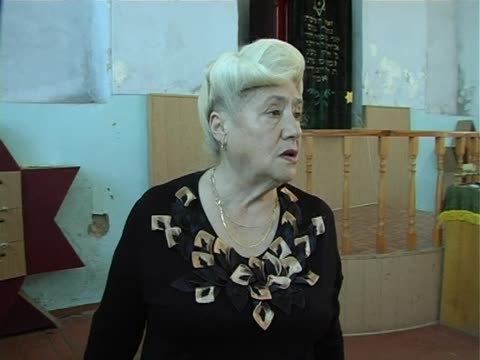
The team enters the Jewish community center and the camera collects footage of the center. The team chats in Russian with Markovich about former Jewish institutions.
From the machine transcript
At the Jewish community center, the team talks in Russian with people there about where to find the community head, whose name is heard as Vladimir Markovich (Krichevsky?), and about the building and its keys. Someone says the building was not a synagogue but a sports hall, and that matzo is stored there. The head of the community is said to live in Germany and visit periodically, and the community's charges have passed to Hesed.
Beyond the chat about former institutions, it covers who runs the community and the matzo stored in the building.
The team is headed to the synagogue. The camera then collects footage of the synagogue, while Marina Isaakovna Milevskaya gives a tour and talks about contemporary religious life. The community owned the building before the war. After the war, it was used as a sports hall until 1991. The community reopened the synagogue in the post-Soviet era.
From the machine transcript
The guide, speaking Russian and Yiddish, shows the former synagogue and women's section and says it was used as a sports hall in Soviet times. She describes the restoration by a benefactor named Fishl (?), the current neglect of the building, and the Hebrew classes upstairs. She recalls holidays filled with 140–160 people and says it was not comfortable to speak Yiddish in the street. Kerler asks about Moldovans, Bulgarians and Gagauz in town, and the meaning of the town's name is explained.
Besides the tour, includes the guide's remarks on speaking Yiddish in public and on the town's ethnic mix and name.
The second part of the tape is a formal interview with Dora Semyonovna Teitel, conducted in Russian. The team is headed with Milevskaya, born 1935 in Pervomays'k, to the next interview. Once the team arrives, they set up the formal interview with Dora Semyonovna Teitel.
From the machine transcript
The team drives with Milevskaya to the next interview and passes through the area; there is chat in Russian and Yiddish about the road, a phone and wine. At Teitel's place she talks about Yiddish: her family understood it but did not speak it in public for fear. Her parents, grandparents and mother-in-law spoke it among themselves.
Adds the drive and arrival chat, and Teitel's first remarks on Yiddish in the family.
Teitel talks about the non-existing opportunity to speak Yiddish in town after the war. She then talks about her family, in particular her children. She then discusses her work as an accountant and returns to talking about her family and their life during the war.
From the machine transcript
Teitel says there was no chance to speak Yiddish after the war, and that her children understand some words. She then talks in Russian about her daughters' professions (a doctor in St Petersburg and a psychiatrist), her husband's work as a factory director, and her own work as chief accountant of a printing house. She describes the family's five years in Turkmenistan for earnings. She recalls her father's service as a German-speaking intelligence translator, his severe wounds in a vehicle crash in Bulgaria, his return in March 1946, his decorations, and his burial. She begins to say where she was born.
Adds the father's wartime service and burial, and her husband's work.
Teitel provides personal information. She was born 1936 in Baremcha Saratskiy. She raised three daughters. She then discusses her life during the war in evacuation and her return. Teitel evacuated to Kazakhstan and finished two years of schooling there before her return. She moved to Bilhorod-Dnistrovs’kyy in 1960. She then talks about her family. Teitel grew up with a sister and a brother, who lives in America.
From the machine transcript
Teitel gives personal information: she was born in 1936 in the village of Baremcha in the Sarata district. Her grandfather ran a restaurant, and the family was evacuated to northern Kazakhstan, where she finished two grades before returning to Baremcha. She describes the destroyed synagogues there and the fate of the Jews killed under German occupation. She tells about her paternal family from Stanislav, her uncles, and the move to Bilhorod-Dnistrovs'kyy in 1962. She says her brother lives in America, and discusses her children and grandchildren and her husband's work in Sarata.
Adds the grandfather's restaurant, Baremcha's destroyed synagogues and Stanislav relatives, and the brother's visits from America.
Teitel talks about prewar life and her cousin’s family, who worked on a kolkhoz. She shares more about her family and her husband. She then talks about postwar Jewish life and holiday celebration. Teitel then discusses antisemitism during the Soviet period and life today. She recalls her grandmother talking about the founding of Israel. Teital then talks about her work life.
From the machine transcript
Teitel talks about a distant relative of her mother-in-law and about her own family, her husband's death and her grief, and holidays kept only while the older generation lived. She tells of antisemitism in Sarata and why the family did not speak Yiddish, and says her husband praised Soviet power and asked for a Russian burial. She talks about Israel and the Jewish wife's role, and about her own long work life. Near the end Kerler and Milevskaya discuss matzo, the unwillingness of older people to pass Yiddish on, and the postwar atmosphere.
Covers the husband's illness and death, the Soviet-era antisemitism anecdote, burial, matzo and the Yiddish question, beyond the catalogue's summary.