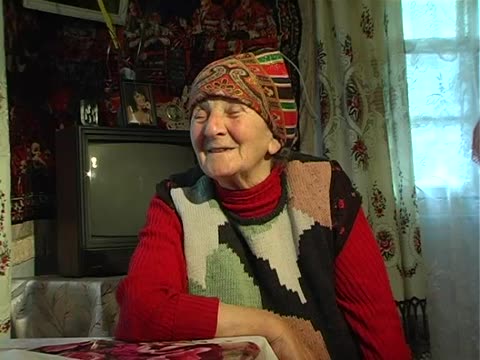
The team meets Koifman, who speaks about her life today and provides personal information. She moved to Bratslav from Vapnyarka thirteen years ago.
From the machine transcript
The team meets Koifman, who says she comes from Vapnyarka and moved to Bratslav thirteen years ago. She gives her age as eighty and notes that few Jews remain. Introductions follow, with Kerler asking about her name and where she was during the war.
adds the age she gives and the introductions
Koifman briefly talks about her life during World War II, which she spent in evacuation. Koifman then discusses her childhood memories of Jewish Vapnyarka. She attended a Ukrainian school. Koifman also shortly addresses prewar holiday celebration at home.
From the machine transcript
Koifman says she spent the war in evacuation. She recalls Jewish Vapnyarka, where there was once a Jewish school but not in her time, and says she attended a Ukrainian school. She was born in 1928. She mentions that there was a shoykhet and that her mother took poultry to him, and says that at Passover matzo was eaten and there were separate dishes. Kerler asks about the cemetery there.
Koifman speaks about locals, before she addresses her family.
From the machine transcript
Koifman says Yiddish was spoken at home and that her father was named Yosi. She notes that he prayed at home, where he had his books and a tallis. She has no children. The passage begins with little recorded speech.
adds her father's name, home prayer and her lack of children
Koifman speaks about the contemporary community, as well as life today. She also speaks about her family. Koifman has family in Israel.
From the machine transcript
Koifman talks about life today: the hardship of life now, pensions and radiation worries. She mentions Anya (Kelmenson), who is also about eighty and still works in a school, and says she will show the team where Anya lives. She says her parents died in the war and that she has a sister in Israel, and that few Jews now live in Bratslav.
adds her sister in Israel, her parents' deaths and the radiation concerns
Koifman speaks about her life during and after the war. She returned to Vapnyarka in 1946. Koifman then talks about her life today. The team walks with Koifman through Bratslav, headed to Kelmenson's house.
From the machine transcript
Koifman says she returned to Vapnyarka in 1946 after the evacuation. She had worked during the war, apparently in a mine. She talks about her pension, whether the Hesed helps her, heating with coal and wood, and the neighbours and sons of acquaintances nearby. Kerler asks about the number of Jews left. The team then walks through Bratslav with her toward Kelmenson's house.
Koifman talks about postwar Jewish life in Vapnyarka. Koifman lived in Bershad in 1972. She also addresses local geography.
From the machine transcript
Koifman recalls Jewish Vapnyarka after the war, with a number of Jewish families who later left for Israel or America. She says she lived in Bershad in 1972 and mentions its old synagogue. She also discusses the languages the teacher Anya speaks, Russian, Ukrainian and Yiddish, and gives local distances and directions.
The team arrives at Kelmenson's house and set up the interview with her.
From the machine transcript
The team arrives at Kelmenson's house and sets up the interview; she says she understands Yiddish.
Kelmenson talks about her life today. She works as Ukrainian and Russian language teacher. Kelmenson then provides personal information and speaks about her family. Her father was arrested in 1937 during the period of Stalin's persecution. Kelmenson raised two sons.
From the machine transcript
Kelmenson says she still works as a teacher of Ukrainian and Russian after her husband's death. She was born in Proskurov in Khmelnytskyi oblast. Her parents and grandparents spoke, read and wrote Yiddish. Her grandfather was dispossessed as a kulak, and her father Chaim was repressed in 1937. Her husband was a mining engineer who studied in Dnipropetrovsk, and her two sons are a doctor and a businessman who speak Russian but understand Yiddish. The interviewers introduce themselves and the project.
adds her father's repression in 1937, her husband and sons, and the grandfathers' names
Kelmenson speaks about her family's life during World War II. She evacuated and her grandfather survived the Pechera concentration camp.
From the machine transcript
Kelmenson says her family left in evacuation, but her grandfather was in a camp whose name resembles Pechora and survived. She does not remember one grandmother, who died young, and says her other grandfather was also named Abraham.
Kelmenson provides personal information. Kelmenson talks about her family.
From the machine transcript
Kelmenson confirms the surname Kelmenson and her maiden name Shtivelband, and talks about her family, including her father's family. Her grandfather had a tea plantation in Staraya Sinyava, was dispossessed, and went alone to Crimea in the 1930s, where he died. Her father was a Soviet employee. She says that during the war the family went to Tashkent, where her mother worked as an accountant.
Kelmenson speaks about her life during World War II and her family. Her mother was an accountant and her father worked for the the office for provision of livestock. She evacuated to Tashkent, Uzbekistan. Kelmenson explains that her father was imprisoned in the Vorkuta gulag for sixteen years. Kelmenson's family moved to Bratslav from Proskurovka in 1937. She grew up with a brother and her grandfather owned a tea plantation in Staroya Sinyava, Khmelnytskyy district.
From the machine transcript
Kelmenson says her mother Nekhama was an accountant, and her father, arrested in 1937, was away sixteen years in Vorkuta. The family moved to Bratslav in 1937 to her grandfather, with her mother left with two small children and her brother later dying. Her grandfather Abraham, who owned a tea plantation in Staraya Sinyava, was dispossessed as a kulak. She mentions that many Jews lived in the area then.
adds her brother, the date of the move to Bratslav and the grandfather's dispossession
Kelmenson speaks about prewar and postwar Jewish life in Bratslav She then turns to her life after the war. Kelmenson finished ten years of high school and then studied at the pedagogical institute in Vinnytsya. Kelmenson explains how she moved to Central Asia due to her husband's work assignment.
From the machine transcript
Kelmenson says Bratslav was a Jewish shtetl in 1937 but now has no one, and that Jews remained after the war until they left for Israel and America. Kerler says he has read about the town's pious Jews. She finished ten classes and went to Vinnytsia to study. Her later move away, with a mention of Kishinev, is garbled in the transcript.
adds the schooling in Vinnytsia