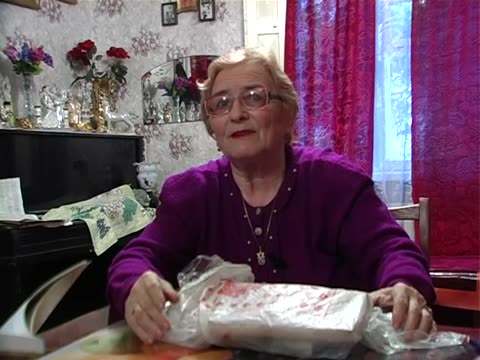
The team, together with Shekhter’s wife, greets Kopyt at her house and sets up the interview with her. She talks about life today and how she studied Yiddish with an older Polish woman during evacuation in Uzbekistan.
From the machine transcript
The team arrives at Kopyt's house; there is brief greeting talk, partly in Russian, about acquaintances, among them someone named Khandros, and about relatives in Israel (a place in Ukraine that is unclear). Kopyt says she once visited Israel. She says that a Polish old woman taught her Yiddish in Uzbekistan. She also mentions her son and language mixing. The camera is then set up.
Also covers acquaintances and relatives in Israel, and the camera set-up.
The formal part of the interview begins. She provides personal information and talks about her family, as well as the war hero Tchaikovsky.
From the machine transcript
The formal interview begins. Kopyt says she was born in Fastiv in 1935, and speaks about her mother, who lived to a great age, and about her father's Yiddish and Russian names. She describes the house she was born in and the Jewish street, formerly called Evreiskaia and later renamed Kyivska. She also talks about neighbours such as a watchmaker, and about a monument to a war hero named Chaikovsky (?), whom she wants moved to the town.
Also covers the house and Jewish street, and the Soviet-hero monument.
Kopyt talks about her life during the war. Her family walked to Kyiv. She then discusses her childhood memories and family. She grew up with one brother. Her grandmother was a baker and grandfather was a gabbai. Kopyt got married twice. Her first husband died in Chernobyl. She also addresses the Great Hunger in 1932 and her family’s hiding during World War II, as well as life after the war.
From the machine transcript
Kopyt recalls the outbreak of war and the family's flight on foot toward Kyiv, and says seventeen relatives were killed. She talks about her mother, who was a baker, and her grandfather, a synagogue gabbai, and speaks about neighbours and Babi Yar. She describes her first husband's death after Chernobyl and her second marriage, her grandparents' hiding in the civil-war pogroms, and a visit to the site where her grandfather was killed. She also tells of her own fall.
Also covers her marriages, her grandparents' hiding in the pogroms, and the pilgrimage to her grandfather's killing site.
Kopyt talks about Jewish life after the war. She recalls Sabbath celebration with her parents and service gatherings in private homes. Kopyt talks about life today and Israel.
From the machine transcript
Kopyt describes how, after the war, Jews gathered in private homes for Sabbath and prayer while the synagogue was taken over by the militia, and she names families who hosted a minyan. Kerler asks what language was spoken at home. She then complains about housing and heating repairs and officials. She explains that she cannot go to Israel because of the graves of her relatives in Fastiv, and begins to say what songs she knows.
Adds the language spoken at home, her housing complaints, and why she will not go to Israel.
Kopyt hums a melody of a Yiddish song, she remembers from her father. She then sings Yiddish songs about a tailor and a strict mother, before she recalls a Yiddish lullaby and Hava Nagila in Yiddish. Another song deals with losing the groom to military service.
From the machine transcript
Kopyt sings Yiddish songs she remembers from her father: a sick tailor, a strict mother (girl and Yankl the cherry-seller), a lullaby with words sent by a friend (a Yiddish text from a Korsun museum man), and Hava Nagila in Yiddish. Kerler remarks the tune is a Hasidic melody, and she says she formed a girls' choir. She also sings a tune of a bride whose groom is taken as a soldier. She recalls a tune from her aunt, who was a hairdresser, and her father's death and a minyan.
Also covers Hava Nagila in Yiddish, the choir, and the aunt who sang.
Kopyt talks about her prewar neighbors and their life during the war. She also addresses life today and contemporary newspapers.
From the machine transcript
Kopyt talks about her aunts, who sang, and about neighbours during the war: the Grossman family, whose children were hidden by Russians. She says that her grandmother's home housed many families. She tells of being pressed to testify that people were Jewish, and she talks about Jewish writers from Fastiv such as Khashevatskaia (?) and Khentin. She says she gets no Yiddish newspapers, only Sovetish Heymland, and that she has helped make a museum in Korsun with artifacts.
Adds Jewish writers from Fastiv and the museum that she helped set up.
Kopyt sings another Yiddish song about a poor tailor, she remembers from her neighbor, a tailor.
From the machine transcript
Answering Kerler's questions about songs, Kopyt sings fragments of Yiddish songs she recalls from a non-Jewish shoemaker neighbour who worked with Jews, and a toast at a wedding. She sings the tailor song again in full, adding one on Sholem Aleichem. Kerler notes how to pronounce Yiddish words in the Ashkenazic way. Lemster then asks about gravestones, and she says she has photographs showing the Babi Yar-type memorials (a mass grave of Jews and one for kolkhoz peasants).
Kopyt talks about her family and the camera records family photographs.
From the machine transcript
A fragment of family talk, probably Kopyt's, about a brother and a Russian wife; too short to be clear.