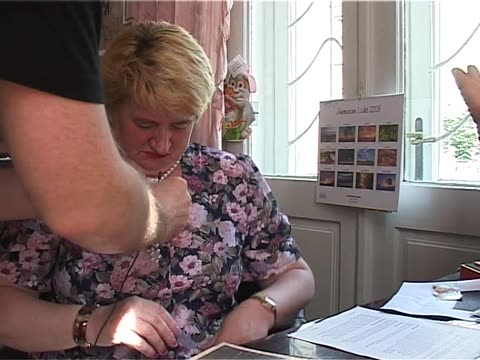
The first part of the tape is a formal interview with Polina (Pesel-Ester) Izrailovna Iuris, born 1949 in Chernivtsi. Iuris shows family photographs, before the team sets up the interview with her.
From the machine transcript
Before the formal interview, Iuris looks at family photographs with Kerler, and names a grandmother and relatives in the pictures. She says she has no one left to look for and wants to find relatives. Kerler explains that the recording is for students of Yiddish, not television, and the interview is set up. He asks for her Yiddish name.
Kerler explains the purpose of the recording and the recognition of the project.
The formal part of the interview begins. Iuris provides personal information and talks about her family. Iuris’ mother was born in Tatarbunary and her father, who worked at the main post office in Chernivtsi, was born in 5:41, 13:50, 14:00, 29:48 Moldova. Before the war, her parents owned a shop in Moldova. Iuris left Moldova and moved to Kolomyya in the immediate postwar period. Iuris grew up with a stepbrother.
From the machine transcript
Iuris gives her Yiddish name, Pesl Ester, and says she was named after her great-grandmother and her paternal grandmother. She names her parents and grandparents, and says her father worked in Chernivtsi's main post office writing addresses and her mother did not work. Before the war her parents had a shop or a small restaurant in Moldova. Kerler states the date and place of the interview, and she gives her address and telephone number. She mentions a stepbrother, Yasl.
Gives address and telephone, and names her great-grandmother's origin in Moldova.
Iuris discusses her childhood memories and talks about her parents. She explains that her grandmother told her to speak Yiddish at home and Russian with her Jewish and non-Jewish friends to avoid being made fun of. After the war, her parents moved from Moldova to Chernivtsi, into a house, formerly part of the Chernivtsi ghetto.
From the machine transcript
Iuris recalls that Yiddish was spoken at home but Russian outside, with both Jewish and non-Jewish children, so as not to be laughed at. She has friends in Israel who speak Yiddish. She tells of her mother and father after the war, the death of her father's first wife and his marriage to her mother, and the poverty after the war. The family was offered a house in Chernivtsi in the former ghetto.
Adds her friends in Israel and the house in the former ghetto.
Iuris talks about Sabbath celebrations at home and her family. She remembers that her parents frequently attended synagogue. She then talks about traditional weddings after the war. She put up a wedding canopy at her own wedding. Iuris raised two sons, one of whom lived in Israel for four years.
From the machine transcript
Iuris describes Friday preparations for the Sabbath and how an oven was kept warm, and says her parents attended synagogue. She mentions a grandmother or widow from a small synagogue. She recalls Jewish weddings, including her own with a chuppah, and that her husband's parents sang. Kerler remarks on her surname. She has two sons; the younger lived four years in Israel, partly on a kibbutz.
Adds the two synagogues in the town and Kerler's remark on her surname.
Iuris discusses postwar Yiddish culture in Chernivtsi, including newspapers and theater. She then talks about her relatives in America and shows letters written in Yiddish and describes a family photograph.
From the machine transcript
Iuris talks about postwar Yiddish culture in Chernivtsi, including visiting singers, a Yiddish newspaper and theater. She shows Yiddish letters from relatives in America, names the relatives in a photograph, and says her mother's sister lived in Romania. Kerler reads the address on a letter. She says she lost contact with her family and wants to trace them; she also gives the birth years of her parents.
Adds Yiddish letters from American relatives, the photograph and the search for relatives.
Iuris talks about holiday celebrations, including Passover. She then explains how to make gefilte fish.
From the machine transcript
Iuris describes Passover at home: baking matzo with her mother, cleaning the house, and the special dishes. She then explains how she makes gefilte fish, discussing onion, matzo meal, salt and pepper, and little sugar. Kerler compares it with the sweet Galician version.
Iuris briefly talks about her life in the immediate postwar period. She lived in Kolomyya, before moving to Ivano Frankivsk in 1970 as a result of her husband’s work assignment. Iuris then talks in Russian about her family.
From the machine transcript
Iuris says she moved to Kolomyya in the postwar period, where her husband came from, after her mother died and her father remarried. She describes Kolomyya's Jewish community then and now, and that her husband was transferred for work to Ivano-Frankivsk. Kerler thanks her, and she then speaks in Russian about her family's history, mentioning her grandmother's sister, relatives in Romania, food parcels, and the closing of the border.
Adds Russian talk on relatives in Romania and the lost contact.