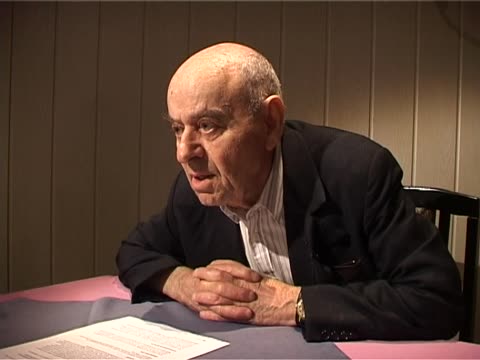
The camera collects town footage from the van while Dorfman points out the his former workplace. He was the chief engineer of a pharmarcy company.
From the machine transcript
From the van the camera records L'viv street scenes. S2 points out the pharmacy company building, where he says he worked for many years on an upper floor, and the opera theater. He then offers to take the group to a small hotel run by a Jewish owner, with prices. Some Russian remarks come from a driver or guide.
Also covers the hotel offer and arrival, and the opera theater, beyond the workplace remark.
The formal interview with Pensatii begins. He provides personal information.
From the machine transcript
The formal interview begins. Kerler asks Pensatii to speak Yiddish rather than Russian, records the date and place, and asks for his birthplace (Odesa) and his official Russian and Yiddish names (Abram Isaakovich, Avrom ben Yitskhok). They check the spelling of the surname and Kerler starts asking about his address in L'viv.
Pensatii provides personal information. He moved to Kyiv from Odesa in 1934, before moving to Lviv in 1939. He then speaks about his family. Pensatii became an orphan in 1919. His father, who passed away in 1919, worked at a printing plant. Pensatii grew up with one brother, who died in Odesa in 1941.
From the machine transcript
Pensatii gives his birth date (20 December 1914) and says he left Odesa for Kyiv in 1934 and came to L'viv in 1939. He names his father Itsik, who worked as a typesetter in a printing house and was killed in 1919, leaving him an orphan at five. He remembers his mother only by a name that is unclear. His one brother, David, died in Odesa in 1941.
Adds the birth date and the typesetter detail, and that the mother's name is unclear.
Pensatii discusses his life before the war in Odesa. He studied at a Jewish technicum, where the language of instruction was Yiddish. Pensatii explains that the students of the technicum were sent to learn a profession at a factory in 1928. Pensatii became a turner within six months.
From the machine transcript
Pensatii recalls his schooling in Odesa at a Yiddish-language technical school on Bazarna Street, with instruction in Yiddish. In 1928, at the start of industrialization, about three hundred young people were sent to a factory to learn a trade, and he trained as a turner in six months. He also mentions a labor exchange for youth on Politseiska Street. Kerler asks about Odesa Jewish life.
Adds the labor exchange for youth on Politseiska Street.
Pensatii talks about prewar Jewish life in Odesa. He mentions the positive relations between Jews and non-Jews and recalls non-Jews who spoke Yiddish.
From the machine transcript
Pensatii describes Odesa in the 1920s as a Jewish city where Jews and non-Jews lived together without distinction. Jews spoke Yiddish among themselves and Russian with non-Jews, and he knew non-Jews who spoke Yiddish. Kerler asks about the bendyuzhnik, a kind of horse-drawn carter, and Pensatii explains the word and mentions Jewish carters and a film made on a street in Odesa.
Adds the explanation of the term bendyuzhnik (carter) and Jewish carters.
Pensatii addresses his religious education, when he went to services at Odesa's Great Synagogue. Pensatii also mentions that he frequently visited the local opera house.
From the machine transcript
Asked where he learned Jewish things, Pensatii says he did not study formally but once knew how to pray, and mentions the Great Synagogue (Korshul) in Odesa. He says he often went to the opera, where Italian and local singers appeared, and he heard many arias. Kerler asks whether he can recall an aria.
Adds the Great Synagogue and the visiting singers at the opera.
Pensatii speaks about his life and also work as turner at a workshop before the war. He was drafted into the Red Army in 1934 and sent to Kyiv shortly thereafter. In Russian, Pensatii talks about military figures. After his military service, Pensatii worked at the main post office.
From the machine transcript
Pensatii explains that he worked in a factory shop with many turners in three shifts and got cheap tickets to the opera. He was called up in 1934 and sent to Kyiv, to the Ukrainian military district under Commander Yakir. A long stretch mostly in Russian recounts Yakir's arrest and the forged signatures in the Tukhachevsky affair, and Kerler steers him back to Yiddish. S2 briefly interrupts about arranging other interviews. Pensatii says he later worked at the main post office in Kyiv.
Adds the long story about Yakir and Tukhachevsky and S2's interruption about other interviews.
Pensatii speaks discusses his childhood memories and prewar religious life in Odesa. He recalls how members taught him several prayers and speaks about visiting cantors on holidays.
From the machine transcript
Kerler returns to Pensatii's childhood and religious education. He says he was taught to pray, to say kaddish, and to say the memorial prayer, by Jews at the Great Synagogue on Pushkin Street, and that he has forgotten much since. He describes the cantors brought in for the High Holidays and Passover, the large fees, and their concerts. Seating by the eastern wall is also discussed.
Adds the High Holiday cantors and their concerts and the eastern-wall seating.
Pensatii addresses his participation in prewar cultural life. He then speaks about holiday celebration, including Shabbat HaGadol (Sabbath immediately before Passover) and Passover at wealthy people's home.
From the machine transcript
Pensatii talks about attending the opera through his factory, with special seats in the boxes, as part of prewar cultural life. Kerler asks about Sabbath customs, and Pensatii explains Shabbes Hagadol, the last Sabbath before Passover, and that wealthy householders invited poor people to the seder. He says he was once able to recite the Four Questions. Kerler asks about the Sabbath songs.
Adds the Shabbes Hagadol explanation and the wealthy hosts at the seder.
Pensatii speaks about Sabbath food customs. He also talks about his visit to America. He then addresses Sukkot and Yom Kippur celebrations before the war. In particular, he recalls visiting a local bookbinder for the holiday.
From the machine transcript
Pensatii describes Sabbath dishes in Odesa, such as fried or chopped and filled fish and a sweet kugel, comparing them with a meal he had on one of three visits to New York. For Sukkot he recalls visiting a Jewish bookbinder who built a sukkah in his home. He speaks about fasting on Yom Kippur and the shofar blowing in the synagogue with an old rabbi, and people who came especially to hear it.
Adds the Yom Kippur fast and the shofar blowing.
Pensatii mentions Purim and Passover celebrations and food customs before the war. He remembers how he asked the Four Questions.
From the machine transcript
Pensatii answers questions about Purim, Hanukkah and Passover in Odesa. He says Purim was eaten with hamantashen and that he and his friends used a particular form of the holiday's name, and recalls Hanukkah. He explains the use of special Passover dishes and the removal of chametz. He says he cannot recall Passover songs but remembers asking the Four Questions at the family seder.
Pensatii speaks about his father who was shot in 1919 by French soldiers. His older brother took care of him at an orphanage. Pensatii then addresses Yiddish literature.
From the machine transcript
Pensatii says that both his parents died early. His father was shot in 1919 by French soldiers who were occupying Odesa, after which his older brother looked after him. Kerler then asks about Yiddish literature at the technical school named after Winchevsky, and about Mendele, Sholem Aleichem and a Mendele museum in Odesa.
Adds the Yiddish literature at the technical school and the Mendele museum.
Pensatii speaks about his life before the war. He worked at a factory and studied at the Workers' University (Rabfak) in the evenings. Pensatii also mentions Yiddish theater and music performances.
From the machine transcript
Pensatii explains that he worked shifts at the factory and studied in the evenings at the workers' faculty (rabfak) of the industrial institute. He says there was a Yiddish theater in Odesa and one in L'viv, but he does not remember what he saw. He recalls concerts by Yiddish singers, including a baritone and Clara Young (?), and the circus.
Pensatii addresses prewar Yiddish press. He also speaks about German language instruction before the war and then about catching Nazi criminals.
From the machine transcript
Asked about the Yiddish press in Odesa, Pensatii says he read a Yiddish newspaper published in Moscow, and a German-language paper. In Russian he describes using German as a Soviet officer in postwar Germany, where he hunted war criminals responsible for killing Jews and sat on a military tribunal. He retells an interrogation of a former Gestapo chief from Zaporizhzhia who explained Hitler's rise, and Kerler tries to bring him back to the interview questions.
The German-language talk concerns postwar service in Germany and the trial of a Gestapo chief rather than prewar German teaching.
Pensatii speaks about his life during World War II. In particular, he addresses changing his documents.
From the machine transcript
Pensatii speaks in Russian about two years working underground in occupied Kyiv under a false Muslim (Kumyk) identity. He tells how he was denounced and brought to the German commandant's office, where a German officer vouched in writing for his false papers and he was released. He also mentions Raisa Akipnaya of the Kyiv underground and says he saved many people. Kerler thanks him at the end.
Gives the story of the false papers and denunciation in the commandant's office, and Raisa Akipnaya of the Kyiv underground.