People › Ron Shoikhetman › conversation

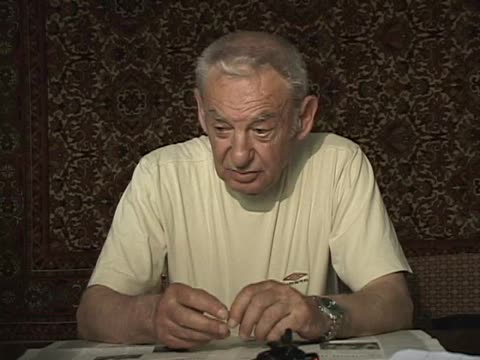
Ron Shoikhetman

Luts'k 9 June 2007 Interviewed by Dov-Ber Kerler, Moisei Lemster 58 min · 1 part on 1 tape
Loading the player…
  1. MDV 580 0:00–58:13 · 58 min · not online — MCO
Passages

0:00

Entering Shoikhetman’s apartment and setting up interview

Informal MDV 580 · MCO
From the machine transcript

Greetings and settling in at Shoikhetman's apartment. Kerler asks his name and where he was born, and he says Derazhnya. Lemster and Kerler arrange the recording, decline refreshments, and say they want to talk with him.

2:14

Jewish life after the war

after the war Daily life (general) MDV 580 · MCO
From the machine transcript

Shoikhetman tells of leading the morning prayer for a visiting group, at a service where a man said in English that he was from Derazhnya. The details of who the visitors were are unclear. Kerler then turns to the planned questions about his talk.

The transcript shows the prayer leading and a visitor speaking English, rather than a general account of postwar Jewish life.

3:32

Jewish life in Derazhnya

From the machine transcript

Shoikhetman says the story of Derazhnya would fill a whole scroll. Thousands of its Jews were shot, and it took years to get a monument with three graves from the Soviet authorities. Kerler asks his year of birth, which is given as 1935, and then what his father was called.

The transcript gives the monument with three graves and the long struggle to obtain it, and the interviewee's birth year.

5:19

Personal introduction and family

From the machine transcript

Shoikhetman gives personal details: his father's name (David, patronymic Davidovich), the family name Shoikhetman, and his birth in 1935 in Derazhnya. Kerler confirms the dates of his years there and Shoikhetman describes Derazhnya as a small district-centre town.

6:11

Early childhood memories and Jewish life

before the war Childhood MDV 580 · MCO
From the machine transcript

Shoikhetman recalls the outbreak of war: a railway running by the house and a plane dropping three bombs. He speaks of the Jews of Derazhnya, with one synagogue and several small prayer rooms before the war, and says there was a cheder but no yeshiva. Kerler and Lemster press him on a yeshiva and on a man from Proskurov who studied in Derazhnya. He also quotes census-type population figures for Ukrainians, Russians and Jews, and says almost no Jews survived the occupation.

The transcript adds the outbreak-of-war memory, the single synagogue, the yeshiva question and population figures.

12:50

Family and arrival of the Germans

From the machine transcript

Shoikhetman tells of a well-off local owner with a large building in the town centre and of a young person connected with him who hid gold, escaped to the forest and was later taken into the army. Who the person is and how he relates to the speaker is unclear in the transcript. Kerler asks what languages he spoke, and Shoikhetman then estimates how many Jews were in the town after the war, perhaps about a thousand.

The transcript shows an account of one survivor's escape and army service, and estimates of the postwar Jewish population.

16:40

Jewish life after the war

after the war Daily life (general) MDV 580 · MCO
From the machine transcript

Kerler and Lemster ask how many Jews live in Luts'k now compared with before the war. Of roughly sixteen to seventeen thousand prewar Jews, almost none native to Luts'k remain. Shoikhetman and the interviewers discuss survivors, a woman born near Luts'k, and a present Jewish population of perhaps two to three hundred, about half of them elderly.

The passage covers the numbers of Jews in Luts'k before the war and today.

20:33

Yiddish-speakers from the region

From the machine transcript

Shoikhetman talks about a young man of mixed Jewish and non-Jewish parentage who works with Yiddish and is described as a good fellow. Which parent was Jewish is unclear in the transcript. Kerler then asks about his own Yiddish from Derazhnya, and he begins to speak of his father's poor family.

21:28

Family and speaking Yiddish

From the machine transcript

Shoikhetman speaks about his family. Many of his father's relatives were killed in the war, and some had gone earlier to Palestine. An aunt read Sholem Aleichem to him in Yiddish. At home they spoke Yiddish, Ukrainian and Russian, he attended a Ukrainian school, and he knows some Yiddish and English. He says he came to Luts'k around Passover in 1959, and then begins to speak of his grandparents.

The transcript adds the relatives in Palestine, the aunt reading Sholem Aleichem, the Ukrainian school and the languages he knows.

24:19

Family and Jewish holidays

From the machine transcript

Shoikhetman remembers his grandmother's kosher household, with separate Passover dishes kept in the attic and glasses marked for Passover. Kerler asks about the dishes. Near the end he starts on something connected with his brother, which is unclear in the transcript.

26:42

Jewish customs

From the machine transcript

Asked about customs in Derazhnya, Shoikhetman speaks of circumcision and of laying tefillin at thirteen. The tefillin and a tallis came as a parcel from his father's brothers in Palestine. He recalls his family burying belongings in a tin from American canned food to hide them. He then shows an old prayer book with Hebrew and Russian text, with a date in the 1870s mentioned, and Kerler discusses who translated it.

The transcript adds the tefillin sent from Palestine, the buried belongings and the old prayer book shown to the camera.

30:41

Introducing AHEYM project and Yiddish literature

From the machine transcript

Lemster and Kerler explain the project to Shoikhetman: Indiana University has been documenting Yiddish speakers for five years, and they leave him a Russian-language program sheet. The talk turns to a Yiddish book in Russian translation, probably Sholem Aleichem, and to postwar Soviet editions, including the 1947–1948 closures after the Jewish Antifascist Committee.

The transcript adds the explanation of the project and the discussion of Soviet editions of Yiddish books.

33:19

Town footage of Lutsk

Footage MDV 580 · MCO
From the machine transcript

The team drives through Luts'k with Shoikhetman, with much Russian talk among those in the van. He and the others point out sights such as a theatre and the former wooden synagogue, now a police building, then the castle-area synagogue and a building now used as a Dynamo sports hall. Passing talk about local figures (Rabinovich, Dolinsky) and a book on Jewish history is hard to follow, and there is a recogniser loop.

46:39

Entering a former synagogue building

From the machine transcript

The team walks into the former synagogue now used as a sports hall. Shoikhetman and others point out the prayer hall, the women's section and the galleries, and the columns and vaults that survive. They compare it with another synagogue near Lviv and note the nearby former Jewish hospital and an orphanage.

48:47

Outside the former synagogue

From the machine transcript

Outside the building, Shoikhetman and the others talk about the surrounding structures, once Jewish, now a repair workshop and car showroom. They also mention the charity administration (UEV) and the writer Dina Rubina. He says he worked in archives drawing plans of these buildings, and he speaks of mass graves, one without a marker and another with one, and of a possible visit to the cemetery area.

The transcript adds the mention of mass graves and memorial signs, and that he did archival and drawing work on the buildings.

51:27

Town footage of Lutsk

Footage MDV 580 · MCO
From the machine transcript

The drive continues past street names, former Jewish buildings and the castle synagogue, now apparently a dental clinic, of which nothing remains. Shoikhetman talks about Jewish schools in the town, some teaching in Yiddish and others in Polish. He also tells of a woman survivor who was denied compensation because her village had no ghetto, and mentions the Spielberg interviews and a woman who had been in the ghetto.