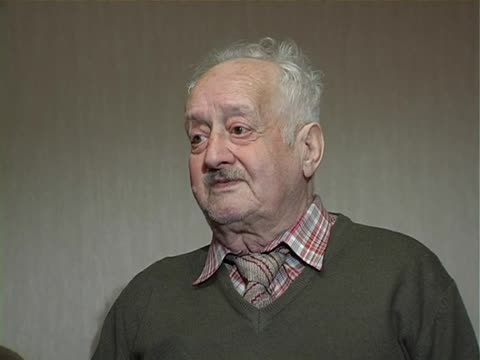
The team sets up the interview with Tzentziper.
From the machine transcript
Opening exchange before the interview starts. Kerler and Lemster explain that they do not speak Russian and want Yiddish, the people present settle on seats, and Kerler introduces the interview in Mykolayiv and asks whether Tzentziper is his family name.
The formal part of the interview begins. Tzentziper provides personal information and talks about the Jewish agricultural colony in Dobroye, where he was born. Jews worked together with a minority of Germans and Russians. He distinguishes the colony as the place to live and the kolkhoz as the place to work. His family lived in Dobroye until 1940, when his father received a work assignment in Mykolayiv. He grew up with one brother.
From the machine transcript
Tzentziper gives his names: Berl, with patronymic Hershevitch, and surname Tzentziper. He was born in 1923 in Dobroye, Bashtanka raion (spelled as Mashtansky in the transcript). Kerler asks the difference between a colony and a kolkhoz: a kolkhoz is where one worked and a colony where one lived. Dobroye had two Jewish kolkhozes, with some Germans and Russians living on either side, and the Germans left when the war came. The family lived there until 1940, when his father was transferred to Mykolayiv work. The father was then drafted into the army, and then Tzentziper himself.
adds the Germans and Russians living beside the colony and their fate in the war
Tzentziper talks about his life during the war. He evacuated and his father was drafted into the Red Army at the beginning of the war. While Tzentziper was also drafted soon after his father, his mother and brother evacuated to Kazakhstan. He then talks about his family. His father worked as ware loader and was born in Dobroye. His mother was born in Dobroye as well.
From the machine transcript
Tzentziper says his mother and brother ended up in Kazakhstan. Lemster asks about his father, named Hersh, who worked at a grain elevator receiving grain. S2 helps with the Russian and Yiddish terms and gives the father's birth year as 1898 (given in Russian). His mother's name is given as Khasya, and she was also from Dobroye. Kerler explains that they record such details for history, and Tzentziper says everyone at home spoke and sang in Yiddish.
adds the mother's name and the father's birth year, and that Yiddish was spoken and sung at home
Tzentziper sings two well-known Yiddish wedding songs, before he sings a song about the Jewish fate, he wrote himself.
From the machine transcript
Asked what was sung in the family, Tzentziper sings a mekhutonim wedding song, in which the bride's mother addresses her new in-laws, and then a variant of a wedding song about Itsik who has already married. Lemster and Kerler discuss variants with him. He then sings a song of his own composition about the Jewish fate, in which he climbs a ladder to ask God why Jews have no place. Kerler asks him to repeat it later.
Tzentziper talks about life today, before he discusses his family.
From the machine transcript
Tzentziper mentions a man who came from America (?) and a stay in a sanatorium in Lithuania, and says he sang and talked with Dovid Katz. Lemster asks about his grandparents. He says he does not know where they came from, perhaps from Lithuania in Catherine's time (?), and S2 translates. Kerler and Lemster then ask when he came to Mykolayiv, and he answers 1940, adding that he was at the war.
adds the sanatorium in Lithuania and the meeting with Dovid Katz (?), and the grandparents' origin
Tzentziper talks about his military awards, he received from Israel. He then discusses his childhood memories growing up in the Jewish colony.
From the machine transcript
Tzentziper says he has a medal from Israel, sent as a letter or certificate in his name, which he cannot read. He then tells of his childhood in the colony. There were many children, only one or two of them still alive, and the colony lived reasonably well, everyone working.
adds the Israeli medal
Tzentziper talks about his life during the war when he served in the Red Army. He fought in the 2nd and 3rd Ukrainian front, before his division was sent to China in 1946 to fight the Japanese army. He recalls good relations among the soldiers and no antisemitism in the army.
From the machine transcript
Tzentziper says he served on the Third (?) and a second Ukrainian front and in 1946 was sent to fight Japan in China. He says the mixed unit had good relations and that he felt no antisemitism in the army or at work. He mentions the medals he received, saying they equalled those of others.
adds his statement that no antisemitism occurred at work or in the army
Tzentziper talks about his life after his army service. He explains how he had to return home to help his severely injured father, despite the offer of prolonging his service. In recognition of his service, he was able to choose his work and before retirement he worked in the 21:45 factory. There he was the chief administrator of a department.
From the machine transcript
After demobilization Tzentziper was offered the chance to stay in the army, but he returned home because his father had come back from the front without a leg. He worked at several places and finally in a tobacco factory (?). There he was a senior foreman in the metal-stamping shop, sometimes standing in for the chief, with S2 helping with Russian terms. He learned the work on his own.
adds that he was largely self-taught and that the Kharkiv (?) factory is mentioned
Tzentziper talks about his education at the Yiddish school, which was part of the colony. In primary school, he skipped one grade. He then talks about his life in the Jewish agricultural colony, which included two kolkhozy, one of which was called “Forward.” Tzentziper attended a Yiddish school for nine years and recalls how Russian and German students studied in the surrounding villages.
From the machine transcript
Tzentziper says he skipped a grade at school. Lemster stresses that he should tell this for future generations. Kerler asks about the colony and its two Jewish kolkhozes, one called Periad (?), meaning Forward in Yiddish, while he forgot the other's name. He worked in the kolkhoz and attended the Yiddish school in the 1930s. There was a single Yiddish school, while Russians in villages ten kilometres away had their own schools, and he does not know about the Germans.
adds the name of one kolkhoz, apparently meaning Forward, and the neighbouring Russian and German schools
Tzentziper talks about his education at a Yiddish school and discusses Yiddish literature.
From the machine transcript
Tzentziper recalls Yiddish school: everything was taught in Yiddish, with songs and dances and exams in every class. Kerler and Lemster ask which Yiddish writers he read, and he does not remember, though he recalls Sholem Aleichem and mentions Itsik Fefer. Kerler asks about Gorky, and says he read that in Russian. His teachers, a woman and a director, are mentioned only vaguely, and he does not remember much. Lemster asks whether a Yiddish theater visited the village.
adds the discussion of Yiddish writers read at school and the teachers
Tzentziper talks about prewar Yiddish culture, including a theater. The theater building was turned into a Yiddish club in the 1930s. He then discusses holiday celebrations and Jewish life in the colony. Tzentziper remembers how his school made excursion to the bigger Jewish settlement in the Kherson region.
From the machine transcript
Tzentziper says a Yiddish theater existed in Dobroye, later closed and turned into a Yiddish club, where people sang and danced and traveled to other colonies. He says holidays were observed by his family, who baked matzo themselves, and recalls a synagogue and a rabbi who lived several kilometres away. Kerler asks which Jewish colonies he remembers, and Tzentziper names Poltavka (?). He also recalls the school trip to the new Jewish district in Kherson region. He then begins to sing "Lomir zikh iberbetn".
adds the rabbi living several kilometres away and the start of a song at the end
Tzentziper sings the well-known Yiddish song “Lomir zikh iberbetn” (Let’s make up). He then talks about Jewish life in the colony, in particular a kosher butcher. Tzentziper then discusses holiday celebration, which became more difficult in the late 1930s according to him.
From the machine transcript
Tzentziper sings "Lomir zikh iberbetn". Lemster and Kerler then ask about the kolkhoz chairman, who was a Jew, and about other Jewish colonies, including Romanovka (?) and Berezhnovata (?), and Lemster asks the meaning of a colony name. Tzentziper says a shoykhet lived in Dobroye. He also discusses women working at home, making sukkot until the late 1930s, sabbath work in the kolkhoz, and that people left after the war.
adds the discussion of colony names, the shoykhet, sukkot and sabbath work
Tzentziper talks about Jewish life in Mykolayiv in 1940. He then discusses Jewish life in Mykolayiv after the war, including Yiddish cultural life and the visit of an Israeli politician in 1949. Tzentziper mentions the kosher butcher and synagogue closures.
From the machine transcript
Kerler asks about Jewish life in Mykolayiv in 1940, and Tzentziper says many Jews lived there, some well off with houses and animals. There were Hasidim and three synagogues, some of which were closed after the war while others remained, and the modern synagogue with its mikveh is discussed. A shoykhet also continued after the war, and S2 gives Russian comments on the date of the slaughterer. Lemster asks about writers and Kerler about a singer. Tzentziper then tells of Golda Meir's visit in 1948–49 (?), when people gathered to be sent to Israel, and she rather urged them to go to Birobidzhan (?).
adds the synagogues and mikveh, the shoykhet and the visit by an Israeli politician (?)
Tzentziper sings a Yiddish song about longing for the years of youth. He then talks about his family and religious tradition, before he sings the song again. He then sings another song from his childhood about a rebbe meeting a girl.
From the machine transcript
Tzentziper sings a song about the lost years of youth. Kerler asks whether he was taught to pray, whether he had a bar mitzvah or wore tefillin, and what his father did; Tzentziper says he did not pray in synagogue and that his father wore tefillin. Kerler asks him to sing the song again for Lemster, who missed it. Asked who wrote the song, Tzentziper credits a woman teacher (a schoolteacher in Mykolayiv, origin unclear) and then sings a humorous song about a rebbe who chases a girl and is sent home by his wife. He says he learned it in Mykolayiv, around 1938 (?).
Beyond the songs, the passage includes questions about his father's tefillin, bar mitzvah and prayer, and the teacher who sang the song.
Tzentziper talks about his life in Mykolayiv after the war. He states that the Jewish school in town closed down in the 1950s. He then sings his own song about Jewish fate, which he wrote a couple of years ago.
From the machine transcript
Tzentziper talks about his friends and leisure in Mykolayiv before and after the war. He says the Jewish school in town taught in Yiddish and Russian and closed around 1950 (the year is uncertain). He is evasive about whether Communists attended synagogue. He then sings his own recent song about the Jewish fate: he will set a ladder to heaven and ask God why the Jews have no place, and he asks Him to let them live well and to cast their haters into a pit. Kerler and Lemster discuss its folk models.
The passage also covers the language of the Jewish school and the question of Communists attending synagogue, and Kerler and Lemster discuss the song's folk models.
Tzentziper talks about life today. He then addresses his life during the war, in particular his wedding in Kazakhstan in 1942. He evacuated with his wife, before drafted into the Red Army. Tzentziper then discusses his family. He grew up with two brothers, one of whom immigrated to America.
From the machine transcript
After brief talk about modern prices and medicine, Tzentziper tells Lemster he married in 1942 in Kazakhstan, where he travelled with his wife after Jews were evacuated and from where he was drafted into the army. His wife came from Markuleşti in Bessarabia (Moldova) and her name is discussed; S2 and Lemster talk about Kishinev. Asked about siblings, he says one brother lives in America (named Simon, in Chicago (?)) and another, Itsik, has died.
Beyond the wartime marriage, the passage covers his wife's Bessarabian origin from Markuleşti and a talk about the Kishinev operation.
Tzentziper talks about his life after the war and his family. He raised a daughter and a son. His grandchildren live in Israel.
From the machine transcript
Tzentziper says his best years were after the war, when he and his wife both worked and lived well though not richly. He had two children, a daughter and a son. The grandchildren live in Israel, and a photograph is looked at. Kerler then asks about Purim customs and songs, to which Tzentziper has little to say.
Tzentziper sings the well-known Yiddish song “Varnitchkes.” He then discusses food customs.
From the machine transcript
Tzentziper sings the humorous Yiddish song "Varnitchkes", in which each verse asks where to get flour, a board, a pot, and a bachelor to eat the dumplings. Lemster asks about other Jewish dishes; Tzentziper names varenikes and mentions fillings. Kerler comments in Russian that a woman present may not have understood the song, and Tzentziper ends with a few words in Russian and the start of a Russian wartime song.
The passage also contains a brief exchange about other Jewish dishes (varenikes) and the closing words of the interview.