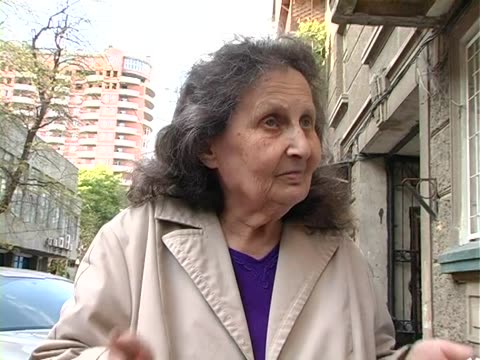
The team meets on the street and drives with him to the town center. The first brief part of the recording includes an informal chat with an unidentified man, recorded in Bershad. The team meets on the street and drives with him to the town center.
From the machine transcript
Street scene in Bershad' with two or three local people, mostly in Russian. They sort out where to meet, mention someone's closed-up house and a phone call that did not get through, and head off by car. Kerler asks in Russian whether Jews lived here before the war, and the answer is that many did. The speech is largely garbled.
The transcript is mostly arrangements and who lived where, with Kerler's question about prewar Jews.
The second part of the tape is a formal interview with Sima (Sima Ilinichna) Moiseyevna Listengurt in the town center of Odesa. She was born 1932 in Odesa. The team meets Listengurt on the street and sets up an interview with her. She talks about her life during the war. She evacuated to 01:58 Siberia. She then talks about her family. She then gives a tour of homes of well-known Jewish figures, including Hayim Nahman Bialik. She also talks about prewar Jewish life and continues showing buildings of the former Jewish neighborhood.
From the machine transcript
Listengurt is introduced and objects to being photographed. She says that during evacuation, Bessarabian Jews were with them in the Kustanay region. She points out the courtyard of her childhood, where Jews lived in prerevolutionary times. She mentions a shoemaker's family and a visiting relative, the Kaganovich family (?), and her family's fear of speaking freely. Lemster is introduced as a history professor. She then shows where Hayim Nahman Bialik is said to have lived and the former homes of the Kataev brothers. She talks about Jewish life before the war, with Jews making up most of the district. The discussion also covers a sister's acquaintance who emigrated to Palestine, with Kerler working out the name of an Israeli leader (Shkolnik?). She ends on the Stalin-era buildings, high ceilings and good housing.
The transcript adds the Kustanay evacuation, the Kataev brothers and a sister's acquaintance who emigrated to Palestine.
Listengurt talks about her childhood memories, living with other nationalities in one building. She then addresses her family. Her father was born in Voznesensk and her mother in Lyakhova. Her parents were both orphans and moved to Odesa in 1921. She grew up with an older sister who was a nurse at the front. Listengurt evacuated to Tashkent during the war. Listengurt continues the tour of the former Jewish neighborhood, explaining former buildings, including a tuberculosis treatment center and a Yiddish school. Listengurt also addresses her uncles’ encounter with Felix Dzerzhinsky in 1920.
From the machine transcript
Lemster asks about her parents and about her Yiddish. She says they spoke it, and describes the courtyard as full of Jews with a few Christian neighbours. Her father came from Voznesensk and her mother from Lyakhova (?). They were orphans who married in the early 1920s and settled in the city, and an older sister served in the war. She was born in 1932 and says she was in evacuation. She says few people still speak Yiddish and offers to introduce two or three Jewish acquaintances. Walking through the quarter, she shows a tuberculosis institute and children's sanatorium, streets and an artists' building. She describes a school with mostly Jewish teachers, where her sister studied, and a Yiddish school that existed until the 1930s. She also tells how a sister called her a Zionist. Her uncles Misha and Rafe, tailors, met Dzerzhinsky in 1920 and were later arrested; she mentions Yezhov and Beria in this connection.
Adds her remarks on who still speaks Yiddish, the Yiddish school, her sister's naming her a Zionist, and the uncles' arrests.
Listengurt continues the tour of the former Jewish neighborhood. She also discusses prewar religious life.
From the machine transcript
The tour continues. Listengurt names the streets in the former Jewish quarter and mentions a park and a poet, speaking about language and the shift of the word 'Jew' (zhid, Hebrew). She points to a former prerevolutionary building and the rabbi's flat (the rabbi had five or six children). She remembers going to the synagogue at Yom Tov and Yom Kippur, with two synagogues and many orphans there, taught trades. She also talks about the first rabbi who came to Odesa and who blamed the Jews themselves. The recording is interrupted by suggestions to sit somewhere quieter. A remark about the Jewish tree (?) and a request addressed to Lemster in Russian are also heard.
The transcript adds the rabbi's family and the first rabbi in Odesa.
The formal part of the interview begins. Listengurt talks about different periods of Jewish history in Odesa and party politics. She then talks about her family, in particular her sister.
From the machine transcript
Kerler explains the interview, and Listengurt settles in to speak. She speaks about the early Jewish settlement of Odesa and its large prewar Jewish population (a majority). She tells how the Germans and Romanians took the city in 1941 and how long Odesa held out, and she recalls a Jewish history teacher and her own challenge to antisemites. She says Stalin was good to the Jews and names local figures such as the party secretary Naum Gurevich and General Petrov. She also tells of her father, who worked in the port and was a Communist, and of the early days of the war. Her father was nearly blind and ended up in Tashkent. Her older sister served at the front for the whole war, was a medical-institute student and afterwards a nurse (?). She also discusses catacombs and local building stone.
The transcript adds Odesa's early Jewish history, the defence of Odesa, her father's war role and her sister's army service.
Listengurt talks about Jewish scientists and contemporary Jewish life.
From the machine transcript
Listengurt talks about the microbiologist Vladimir Khavkin, who studied in Odesa and fought plague and cholera. She mentions his work in India (?) and the Volga cholera epidemic, and that he was refused entry to Russia because he was a Jew and a social democrat. She then mentions Mechnikov, whose mother was Jewish, and says she cannot speak of contemporary Jews. Kerler then steers her back to his question about neighbors in her courtyard.
Focuses on Khavkin and Mechnikov; the catalogue's 'contemporary Jewish life' is only a brief complaint about present-day Jews.
Listengurt talks about prewar Jewish life in Odesa and initial expectations of Hitler’s occupation. She then talks about Jewish life at the beginning of World War II.
From the machine transcript
Answering Kerler about Jews who awaited Hitler, Listengurt recalls her mother's account of educated Germans who visited their home. She discusses German science, Niels Bohr and Jewish physicists in the atomic bomb effort. She then describes Hitler's expulsion of Jews, the poor remaining while the rich fled and were stripped at the border, and Stalin's role in letting Jews in. She also mentions deportation to Siberia.
The passage is largely a political digression on Germans, the atomic bomb and Jewish refugees, more than Jewish life in Odesa.
Listengurt discusses her life in evacuation, in comparison to the wealthier families.
From the machine transcript
Listengurt compares conditions for the rich Jewish refugees with those of ordinary Jews in evacuation. A second speaker asks about the postwar period. She talks about a man named Aleksandrovich (?) who came from Romania, and about Gromyko as Stalin's foreign minister, whose wife was Jewish.
Listengurt talks about post-World War II politics, including the founding of Israel.
From the machine transcript
Listengurt talks about the founding of the United Nations and the vote on Israel, arguing that America, Britain and France stayed silent while Stalin's Soviet Union and satellite states voted in favor. She describes the Jews' suffering and the statehood declaration of Ben-Gurion, criticizes the refusal of countries to admit Jewish refugees, and mentions a film (Kerler names its Hebrew title). Kerler then asks about the time of the doctors' plot.
Gives her view of the UN vote and Israeli statehood, not just the founding of Israel.
Listengurt talks about Lazar Kaganovich. She then talks about prewar Jewish life on Crimea.
From the machine transcript
Prompted by a question about Kaganovich, Listengurt describes him as a transport minister without formal education and mentions his Jewish daughter. She speaks of her mother as a Trotskyist and her father as a Stalinist. She then recalls the 1923(?) Crimea plan for a Jewish republic, a three-day pogrom, and Stalin's postwar deportations, and mentions the Karaites. She also touches on the Jewish Anti-Fascist Committee.
Includes her parents' political divide (Trotskyist mother, Stalinist father) and the Karaites.
Listengurt talks about postwar Jewish politics regarding Crimea. She also addresses postwar Soviet politics.
From the machine transcript
Listengurt continues on the Jewish plan for a republic in Crimea and the 1923 pogrom. She then explains Stalin's deportation of Germans and Tatars, Khrushchev's role, and the later Jewish settlement in the Birobidzhan region between two rivers. She describes a bare area and what an acquaintance said of the Crimea's beauty, then moves to the doctors' plot at Lemster's prompt.
Includes Birobidzhan and the deportation of Germans and Tatars; Khrushchev is also mentioned.
Listengurt talks about Stalin’s politics and the doctor’s plot of 1952/53. She recalls that period during her studies at an institute and the subsequent public antisemitism.
From the machine transcript
Listengurt recounts the doctors' plot of 1952–53 and Stalin's last years, with Lemster correcting the years. She tells of Khrushchev, an anecdote involving Kaganovich and a newspaper, and of the threat of pogroms in the city. She recalls that as a girl of seventeen she was afraid to walk the streets, and of food shortages and hunger afterwards. She describes attending evening courses and the antisemitism in town, and Kerler asks what she worked as.
Adds Khrushchev, the Kaganovich newspaper anecdote and hunger afterward; the details of her studies are vague.
Listengurt talks about her education, her family, and Yiddish literature.
From the machine transcript
Answering Kerler and Lemster, Listengurt says she studied at an evening school in Odesa, reading biology and chemistry. She talks about her mother, whose Trotskyist views she did not want to hear about as a girl, and of the family killed by Hitler. She mentions having one daughter. Lemster then asks which Yiddish writers she knows, and she recites a Russian children's poem.
Adds her mother's Trotskyism and the recitation of a Russian poem.
Listengurt discusses and recites parts of Jewish literature, in particular by Itzhak Katzenelson.
From the machine transcript
Lemster and Kerler ask Listengurt about Yiddish writers; she recalls Leib Kvitko and Itzik Katzenelson (Kerler says she means a Ukrainian-language poem) and recites lines in Ukrainian, which Kerler questions. She says she knows no Yiddish poems. She mentions Beyderman and Note Lurye, the latter known to her mother during his arrest, and her mother's limited schooling.
Adds Beyderman, Note Lurye and her mother's connection to Lurye.
Listengurt talks about her family and Jewish writers. She then talks about contemporary Jewish life and music.
From the machine transcript
Listengurt tells Kerler about Odesa Yiddish writers and about contemporary Jewish life: she attends a synagogue on Pushkin Street and compares crowded high holidays then with now, when many non-Jews come. She says that at the Hesed a woman named Anna Lvovna (?) can tell about the music competition and violinists. She names Wieniawski, David Oistrakh, Buzya Goldstein, and Leybele Weisbein.
Adds the Hesed, the Wieniawski competition and Jewish musicians.
Listengurt talks about her sister, who studied at the Odesa Medical Institute. She served as a nurse during the war returned home from Romania. She then talks about her life after evacuation in the Caucasus. Listengurt’s sister finished her medical studies after the war and worked as a doctor.
From the machine transcript
Listengurt talks about her sister, who entered the Odesa medical institute and studied there after the war; she resisted party pressure to become chief physician. She recalls evacuation to the North Caucasus, where the family used false non-Jewish names. Kerler asks about the sister's wartime service as a medical assistant, which reached Romania; the sister is no longer alive.
Adds the Caucasus evacuation, false names and Kerler's questions on her wartime service.