0:15
The camera collects town footage of Fastiv. Then the camera cuts to the team entering Shvartsburg's apartment to set up the interview with him.
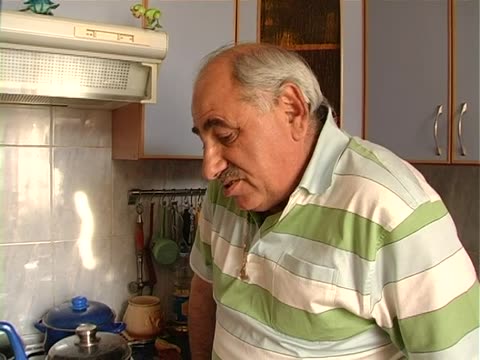
The camera collects town footage of Fastiv. Then the camera cuts to the team entering Shvartsburg's apartment to set up the interview with him.
Shvartsburg talks about the contemporary Jewish community.
Shvartsburg talks about the remaining Jews of Skvyra who still speak Yiddish: a few very old people, among them a woman of eighty-eight who barely leaves her house. He also mentions a woman who survived the war with a non-Jewish family and no longer speaks Yiddish. Kerler and he discuss who the best Yiddish speaker in town would be.
adds the discussion of who still speaks Yiddish.
Shvartsburg talks about his family and explains that he learned to speak Yiddish from his family. He has been the chairman of the Jewish community for the past fourteen years.
Shvartsburg says that his grandparents and parents spoke Yiddish at home and that he understood it but spoke little himself. He has been the head of the Jewish community in Skvyra for fourteen years and has no one to speak Yiddish with. Kerler remarks that he remembers the language well.
Shvartsburg talks about prewar Jewish life in Skvyra, how he remembers it from his family's stories. He then discusses postwar Jewish life in Skvyra.
Shvartsburg tells what he knows of Jewish Skvyra before the war from his grandmother's and parents' stories and from a book. The town had a large Jewish population, a dozen or so prayer houses, and a Jewish center. The Jews who lived there, about a thousand, were shot by the Germans, and Jews have since left for Israel, America and Australia.
adds the figures on the prewar population, the shooting of Jews, and later emigration.
Shvartsburg talks about the Jewish cemetery. In particular, he mentions the grave of Itsik Twersky, who was the father of the Tzadik David Twersky. Shvartsburg is an architectural engineer. He mentions how he built pilgrim sanctuaries for Hasidic pilgrims, as well as built religious sites in surrounding locations. He also built a new synagogue in Skvyra in 1999. It took four years to finish the constructions works. He then addresses the contemporary Jewish community.
Shvartsburg describes the grave of Itsik Twersky, the father of Rebbe Dudl Twersky, who lies there with two children, and how Hasidim found the neglected site. He is an engineer by training and built the site for the Hasidim. He also built a large synagogue in Skvyra with a hotel for 120 people and two mikvehs. A few Jews remain in the surrounding villages, among them three who were hidden as children and have forgotten Yiddish.
adds the Twersky family and the three villagers who lost their Yiddish.
Shvartsburg and the team are headed to the Skvyra synagogue.
Shvartsburg and the team arrive at the synagogue and the camera collects synagogue footage, while Shvartsburg gives a tour. He then talks about synagogue activities and the its architecture, as well as contemporary Jewish life. The building of the current synagogue is based on photographs of a 19th century synagogue building, which was destroyed in the 1930s.
During the tour of the synagogue complex, Shvartsburg explains that he designed it from pictures brought by Americans of the old synagogue, and that building it took four years because money was short. He describes the hotel, the mikvehs, the large prayer hall and the size of the building. He also mentions pilgrims, the Twersky Rebbe's visits, and an American claim to the property that was settled for money. Kerler asks about visitors, the Berdychiv rebbe and the minyan on Sabbath.
adds the American pictures and money claim, pilgrims, and Sabbath minyan.
Shvartsburg and the team continue the synagogue tour.
The tour continues with talk about fundraising, including a portrait and the Chabad rabbi's contribution, and about the burial place of Itsik Twersky. Shvartsburg recalls that a synagogue was built in 1860s (?) and that the Soviets later closed it. Kerler asks about the postwar period and who still prayed there.
Shvartsburg talks about religious life after the war during the Soviet period. He also addresses contemporary Jewish life.
Shvartsburg speaks about religious life in Skvyra under the Soviets, when circumcisions and weddings were held quietly. He says most Jews do not speak Yiddish today, and that his own children and wife do not. Asked by a member of the team, he also discusses the town's shoykhet before the war.
adds the shoykhet and Yiddish among his children.
Shvartsburg and the team get back into the van and drive to the Rebbe Itsik Twersky's grave.
On the drive to the grave of Rebbe Itsik Twersky, Kerler and Shvartsburg talk about the large hotel built for the Hasidic pilgrims, who come in large numbers on Yom Kippur, and about the town's river, which Kerler asks whether it is a river or a lake. Russian directions are given to the driver.
Shvartsburg and the team arrive at the grave of Rebbe Itsik Twersky. Shvartsburg explains how he built the site. Itsik along with two of his children were buried there.
At the grave, Shvartsburg explains how he secured the site with a gate and how it was remembered by non-Jews. The old Jewish cemetery was destroyed during the war and its gravestones used by non-Jews. A brickworks now stands on the land. Kerler asks what is on the site of the old cemetery.
adds the destroyed cemetery and brickworks.
The camera collects footage of the site. According to Shvartsburg, the site was built based on the memory of Rebbe Itsik Twersky by non-Jews before the war.
At the site, Shvartsburg and others talk about the memory that elderly non-Jews kept of Rebbe Itsik Twersky and his two children, a boy and a girl, who are buried there. Water and the buried children are mentioned. Kerler asks whether his grandparents told him anything about this.
adds the non-Jewish memory of the rebbe.
Shvartsburg talks about his family, in particular his grandparents. He also addresses Hasidic life until 1917. Shvartsburg has two sons.
Shvartsburg talks about his grandparents. One grandmother came from Pavoloch and the other from Kyiv. His grandfather Yokhanan Kogan was killed by the Germans, and the other grandfather's family was large. The family went to the rebbe before the Soviets, and the grandmother told him of Jewish life in Skvyra. He has two sons and talks about the war years when Jews were killed.
adds his grandparents' origins and his two sons.
Shvartsburg discusses memorialization after the war. He mentions how the community buried Jews in 1947 from three massacres under German occupation. Approximately 1,200 Jews were killed within six days, according to Shvartsburg. He then talks about contemporary Jewish life.
Shvartsburg explains that about 1,200 Jews were shot in Skvyra in three massacres within six days in September 1941. In 1947 their bones were gathered and buried in the new cemetery under three stones, and he says no marker stands at the killing sites. He also says that few Jews were left, many having been evacuated. Then he talks about Jews and their children today, including intermarried families and two grandchildren studying in Zhytomyr.
adds the numbers and the 1947 reburial.
Shvartsburg and the team return to the van and the camera collects town footage.
Shvartsburg and the team return to the van and drive through town, with directions in Russian, while a plan or memorial is mentioned. Much of the Yiddish is garbled.