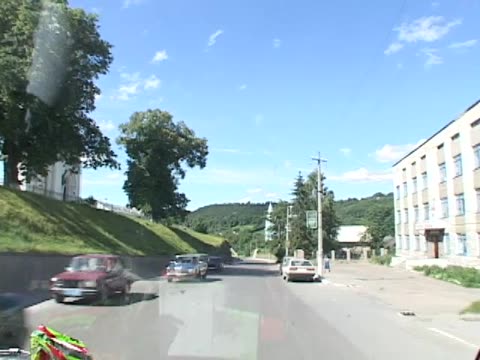
Shots of the town of Kremenets’.
From the machine transcript
Opening shots of Kremenets' with a few fragmentary remarks among the party, partly Russian and partly Yiddish. The content is thin and unclear.
Little speech in focus; the transcript shows only fragmentary remarks among the party.
Speaking in Russian, Larisa Kliuch leads the team on a tour of Krements’, pointing out the place of former synagogues, old Jewish homes, the location of the wartime ghetto, and other sites of interest as they drive around the town.
From the machine transcript
In Russian, the guide gives figures for the Jews of Kremenets' killed in the war, including immigrants from Łódź who arrived in 1939, and says the intelligentsia were killed early in the war and buried on Cross Mountain. She points out the site of the old central synagogue and old Jewish houses, and says something was burned in September 1942. As they approach the slope with the old Jewish cemetery, Kerler adds that expeditions dated gravestones to the 16th century.
Gives death tolls and the date of a burning, and the old synagogue site, as well as the cemetery's age.
The team drives to the town’s Jewish cemetery, where Professor Kerler reports his great-grandfather is buried. Kliuch mentions that financial assistance from an American “landsmanshaft” (former residents of the town) organization is used to keep the cemetery in good condition.
From the machine transcript
The party arrives at the old Jewish cemetery. The guide says an American foundation may give a grant for its restoration, and that an American association of former Kremenets' residents, with Ronald Doctor as co-founder, is raising funds. Arrangements for the group's arrival are discussed, partly in Ukrainian, and Kerler speaks of finding his forebears' graves.
Names the American association and its co-founder; the great-grandfather is not clearly confirmed in the transcript.
Kliuch leads the team through the cemetery, indicating its oldest sections and other distinguishing features. She notes that many gravestones were taken by Nazis to build roads in the town and that other local non-Jews used the stones to build their houses. She also reports that local photographer Valerii Rozenblit has taken a photograph of every gravestone in the cemetery for proper documentation. The research team also says “kadish” (a memorial prayer) at an unidentified grave.
From the machine transcript
The guide leads the party up through the cemetery, describing its older sections and the many surviving gravestones. She says the Germans made ghetto Jews carry stones to pave roads and that locals took others for outbuildings. She compares the amphitheatre-like slope with a cemetery in Israel and with Mohyliv-Podil's'kyi, and says a local photographer, Valerii, photographed every stone for registration in America. The group looks at stone carving and dates, and discusses a site on the hill with 8 or 9 mass graves near a ski jump, as well as a stone with a Hebrew inscription and Ronald Doctor's reading of it. Kaddish is not clearly audible here.
Adds the mass graves near the ski jump, the carving and dating of stones, and the Hebrew-inscribed stone; the kaddish is not audible in the transcript.
Back in the car, Kliuch talks about the history of the local Jewish community and the difficulties of publishing research on Jewish topics, all the while pointing out different sites of interest along the way.
From the machine transcript
In the car, the guide talks about local Jews who spoke Yiddish at home and about a woman who wrote a short history of the Jews of Kremenets' in Ukrainian, and a manuscript the group gave to a Ternopil community figure (Feinstein). She describes the difficulty of finding sponsors for publication, and the hope of obtaining copies of old books from Tel Aviv and a book from Buenos Aires. She also discusses searching for a family (Tut) through the diaspora. The party passes a gate on the Dubno road, and she points out a synagogue building by the bus station.
Adds the Ukrainian-language history, the sponsor problem, and the search for the Tut family.
Kliuch leads the team to an old synagogue that is now part of the bus station. There are also scenes of the town and a closer look at an older building.
From the machine transcript
The team goes to an old synagogue now incorporated into the bus station and looks at a reconstructed older building. The Yiddish remarks among the party about the building and its history are largely garbled. A Russian remark refers to a ditch with bodies of victims, according to someone named Reizman (?).
The team returns to the car as Kliuch continues discussing the history of the town and indicating various landmarks.
From the machine transcript
Driving on, the guide says that nothing is visible at a supposed site and discusses where a trench with bodies lay. Approaching the main killing site, she says the road was used by trucks carrying victims and that Jews were piled in layers on the trucks. The site was chosen because trenches left from a regiment's firing range already existed. She says about 7,000 were killed in the field and points out a new Israeli-funded memorial before a Soviet-era one.
Includes the trucks, the chosen site and the number killed.
The team stops at a memorial plaque in Ukrainian and Hebrew in honor of local victims of the Holocaust put up, according to Kliuch, by a group of Israelis.
From the machine transcript
The group stops at a memorial at the killing site, and the guide mentions a yearly gathering there in September for young people from the town. Kerler and a second visitor speak about relatives' bones and family connections, and Katz asks about the Soviet monument.
Adds the yearly September gathering of young people and the visitors' mention of their families.
The team briefly visits a memorial to victims of the war put up by the Soviet government. The team again recites the kadish prayer. Kliuch and Professor Kerler discuss the history of the Kremenets’ ghetto uprising.
From the machine transcript
Kaddish is recited at the memorial. Afterwards the guide and Kerler discuss a planned uprising in the Kremenets' ghetto, drawing on Samuel Schutzman's writing, and the manuscript held in Ternopil. She mentions eyewitnesses, and that Germans carried out the shootings openly, so local boys watched from trees. She recommends Stanisław Szeybel's (?) memoir in Polish held in the museum, and mentions a list with over 30 relatives of a named person (Paivol?). Katz asks about a rabbi and a shoykhet, and the area of the former ghetto is pointed out.
Adds the ghetto-uprising discussion, the literature recommended and the eyewitnesses; the kaddish is explicit.
Another brief drive, during which Kliuch touches upon various historical topics.
From the machine transcript
A short drive through the town centre, with the guide pointing out the market square and old houses. She says a building was used by the Gestapo, and that Ronald Doctor hopes to move gravestones to the cemetery. Kerler and the guide exchange remarks in Yiddish and Russian.
The team is taken to a site where Jewish gravestones have visibly been used in the construction of other things in the town. Kliuch brings the team to a memorial dedicated to the memory of the town’s murdered intelligentsia, which was ethnically diverse (Ukrainians, Poles, Jews, Russians). She also briefly talks about recent Hasidic and Israeli visitors to the town.
From the machine transcript
At Cross Mountain, the guide explains that several mass graves of victims of one shooting action lie there, and that the dead included Ukrainians, Poles, Jews and Russians from the intelligentsia. She speaks of a museum house, and of Hasidic and Israeli visitors who find the climate cold, even in summer, and cannot manage the slope in winter.
Adds the ethnic mix of the dead and the description of Hasidic and Israeli visitors.
Back in the car, Kliuch relates further anecdotes about the town’s history as well as the stories of some of its families. Cities and towns mentioned on this tape: Kremenets’, Mohyliv-Podil’s’kyy
From the machine transcript
In the car, the guide mentions a thematic collection on the Jewish ghetto and photographs of the Battler-Kanner family. She describes the Lyceum and the museum, and says a diary kept as a boy by Roman Kravchenko-Berezhnoi (?) about Nazi crimes against Jews, now living in Murmansk oblast, is to be published in English. She also tells how the family hid in an attic, how a baby's crying during a roundup caused the mother to poison the child, and how she then hanged herself with her father's help. The planned visit of kobzars and the museum's opening hours are also mentioned.
Adds the wartime diary and the attic story of the Kanner family, including the child's poisoning and the mother's suicide.