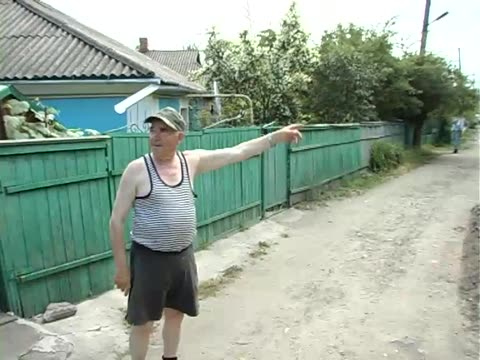
Nisen Kiselman, born 1927 in Tomashpil, joins the conversation and provides personal information, as well as talks about his family. Pesia also speaks about community life today. Nisen grew up with five brothers. They discuss Nisen's imprisonment in the Tomashpil ghetto in 1941.
From the machine transcript
Kerler asks the man's name and birthplace; the answer is Tomashpil, with the Russian name Mikhail (Misha). His birth year is established as 1927. The women tell of the Tomashpil ghetto, where about two hundred people were killed, and of the family left orphaned. Kerler asks about a Jewish kolkhoz near Tomashpil.
Shows the name check, the question of surnames and a 1941 date asked by Kerler, and the kolkhoz question.
Kiselman speaks about his life and family before the war. He grew up near the "Gigant" kolkhoz in Tomashpil. His parents worked on the kolkhoz. Kiselman's father was also born in Tomashpil and was a coachman. He passed away during the Great Hunger, 1932/33. Kiselman attended a Yiddish school.
From the machine transcript
Kiselman speaks about the Jewish kolkhoz called Gigant near Tomashpil. His mother worked there and his father died young, leaving six children. He attended a Yiddish school for some years. His father died around 1933, in the famine; his mother was named Rachel. He stayed in Tomashpil until 1944. His father's name is unclear.
Gives the mother's name (Rachel) and her kolkhoz work.
Kiselman talks about his life during the war. Alexandr and Tolkovitz explain how Kiselman's family was imprisoned in the ghetto. He describes the beginning of the war, when the Germans entered in 1941 and set up the ghetto. Kiselman states that he escaped from a massacre in 1941, where his mother and sister were murdered. He was believed to be a non-Jewish boy and left with a relative.
From the machine transcript
Kiselman and others recount how, after the Germans arrived in the early 1940s, Jews were driven from their homes into the ghetto. His mother and sister Leike were killed in a massacre. He escaped because a Ukrainian man took him for a non-Jewish boy. His sister lies in a mass grave.
Names the sister (Leike) and the man's belief that the boy was non-Jewish.
Kiselman talks about his life during World War II, particularly how the Tomashpil ghetto was set up. He also mentioned how non-Jews threw food into the ghetto. Pesia describes the conditions Kiselman lived in, before he joined the army in 1944. He served for seven years; five of which he spent in Germany. Yenta shares an episode from Kiselman's army service in Germany.
From the machine transcript
Kiselman describes the Tomashpil ghetto: all Jews were driven into a single street, and non-Jews threw potatoes and bread over the fence. The women describe the hardship, including clothes sewn from sacks and coal. He was called up in 1944 and spent five years in Germany, where he spoke Yiddish with Germans and acted as an interpreter.
Shows the army service as interpreter in Germany.
Kiselman discusses his army service on an island in the Baltic Sea, where he worked as translator.
From the machine transcript
Kiselman talks about his army service in the Baltic area, on an island not far from Kaliningrad (Königsberg). He served as an interpreter in a military commandant's office, and his Yiddish helped him learn German. The women add that the army treated him well. He then returned with nowhere to go and met an aunt from the camp.
Yenta addresses Kiselman's return to Tulchyn after the war. In particular, she addresses how he joined his aunt's family (Pesia's mother). Kiselman was married to Pesia. Pesia then talks about her family.
From the machine transcript
The women tell how Kiselman, back from the army, was taken in by his mother's sister's family, living crowded in a small room and cooking in tin cans. They discuss the Jewish custom of cousins marrying, and Kerler asks his mother's name. A relative who makes hats is mentioned, and Kerler talks about where he lives.
Shows the cousin-marriage custom and the mother's name and surname questions.
Yenta talks about her time in Israel and why she returned to Tulchyn, upon her husband's request. She also speaks about her family, as well as life today.
From the machine transcript
A woman speaks about her time in Israel: she liked living among Jews and hearing Yiddish, and had three rooms, television and a washing machine, but found it too hot. She returned to Tul'chyn because her husband wanted to be buried beside his mother, and he died at 85. Her son and grandson visit, and Kerler asks about other places.
Gives details of her life in Israel and the husband's age.
Yenta and Pesia speak about prewar Jewish life in Tulchyn, particularly anecdotes about the local wealthy Jew "Roytshulem" (Sholem Royt). Tolkovitz and Alexandr then addresses Jewish life in the ghetto, shortly before liberation.
From the machine transcript
Kerler asks about the wealthy man 'Roytshulem' (Royt Shulem). The women tell the story of a rich man who died of hunger locked in with chests of gold, as heard from their parents, and mention large houses of wealthy people in the town. They then turn to the camp, where thousands were driven and few survived.
The wartime talk at the end moves from the rich-man story to the camp rather than the ghetto before liberation.
Alexandr provides personal information, before he speaks about his life in the Pechera concentration camp. He shares an episode of cannibalism, as well as describes the occupiers' violence. Pesia then recalls inmates' deportations for forced labor and Yenta addresses starvation of her relatives. Pesia also shares episodes of daily violence.
From the machine transcript
A man who says he was born in 1929 tells of the Pechera camp, including a woman who ate a dead person and the Romanian gendarmes and Germans. The women describe prisoners worked to death or killed, and a sixteen-year-old sister of a relative who was killed. They also tell of Jews forced to dig their own graves, and a gendarme overturning the soup.
The cannibalism episode and the shootings by the river are heard.
Pesia speaks about her life in the Pechera concentration camp, specifically witnessing the transport of corpses out of the camp into mass graves. She also speaks about commemoration. Yenta and Alexandr then recall daily deaths and speak about commemoration.
From the machine transcript
A woman describes corpses carried out of the camp by ox cart toward graves and hundreds dying in a day; flowers are mentioned, possibly in connection with commemoration. The man says a few survived from the camp, and that Vinnytsia's Jews were all killed. He describes a monument in the centre of Vinnytsia near a school, on the site of the Jewish quarter.
Yenta speaks about her life in the Pechera concentration camp. She recalls when the Germans came into the camp to collect inmates, including her mother, for forced labor. Her mother escaped the collection, according to her.
From the machine transcript
A woman recalls the Germans coming to the camp to take people for work. Her young mother had a baby sister and was urged to run away. The mother escaped and survived, living to old age. The daughter held the child and the details of who was taken are hard to follow. A woman named Sarah is mentioned.
Yenta speaks about her family's fate during World War II. She then provides personal information and speaks about her family. Yenta's mother was born in Tomashpil and her father was born in Tulchyn. Yenta then shares episodes about daily life and food acquisition, as well as sharing, in the Pechera camp. Yenta explains how her father, a designated grave digger, received food from non-Jews, which he brought back to the camp. Yenta also describes her mother's survival mechnisms.
From the machine transcript
The woman gives her maiden name, Tolkovitz, and says her parents were from Tul'chyn and Tomashpil. She recalls her father being assigned to bury the dead in the camp, and non-Jews bringing him food that he brought back. Her mother sold clothes and shared potatoes. A sister, Hela, lives in Israel.
Gives the maiden name and the mother's trading for food.
Alexandr and Yenta speak about their life in the Tulchyn ghetto, undergoing disinfection at the local Yiddish school, before headed to Pechera.
From the machine transcript
The man and women describe how Tulchyn Jews were driven from their homes and held in the Ukrainian school, where they were disinfected naked in front of Romanian police before being sent to the camp. Kerler asks about the distance to Pechera, about 25 km. He proposes driving there, and the talk turns to a prewar sanatorium.
Includes Kerler's offer to drive to Pechera and the sanatorium question.
Yenta addresses life in the Pechera concentration camp and refers to a mass grave.
From the machine transcript
The women speak of the Pechera camp, where prepared pits were covered with the dead and another was kept for the rest. Kerler asks which month the Soviet troops came, with the war lasting to 1945. At the end he changes subject and begins asking about the Tulchyn Yiddish school.
Yenta speaks about her life before the war. She attended a Yiddish school. Pesia also speaks about her Yiddish school education for four years and recalls charity. They then discusss the school building.
From the machine transcript
Pesia talks about her four years in the Tulchyn Yiddish school before the war, remembering the school director giving clothes and books to poor children. Kerler works out the years and asks whether it was Yiddish teaching until the war. The women say it later became a Ukrainian school, with the building enlarged. They then recall the same building being used to hold people.
Yenta speaks about her life during the war, specifically addressing the disinfection at the Tulchyn Yiddish school. Alexandr adds more information on the experience and describes the condition people were kept in. Yenta then recalls cruelties of a Ukrainian doctor and remembers starvation.
From the machine transcript
The women describe being held crammed in the school building, without food, water or room to lie down, while Romanians shot at crying children. A Ukrainian doctor beat out the windows in the freezing cold. People died daily and survivors recall starvation. Kerler asks whether the doctor was German.
Shows the cruelty of the doctor, who is said to be a Russian/Ukrainian non-Jew.
Pesia talks about the fate of regional Jews during the war and mentions a massacre. She also addresses commemoration, organized by the Tulchyn community.
From the machine transcript
A woman tells of a mass grave in the Kreshchenits area (name uncertain), where Germans brought many people to work in gardens. She tells of a child, Rita, who was buried alive and died after a long time. The group collected money to build a monument, and Kerler asks how many died. Commemoration is organised by the Tulchyn community.