0:00
Town footage of Uman
From the machine transcript
Town footage of Uman'; the speech picked up is unintelligible and nothing can be made out.
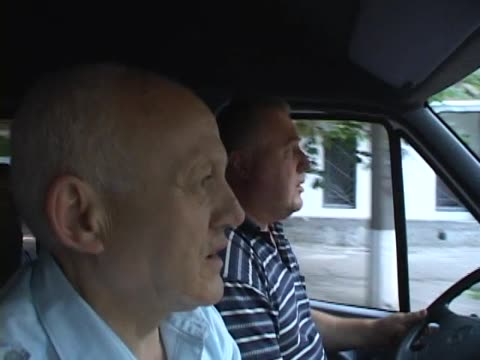
Town footage of Uman
Town footage of Uman'; the speech picked up is unintelligible and nothing can be made out.
Brief chat with Alex about potential interviewees
Brief talk with the local guide and others about potential interviewees. They mention people born in Uman' and others who were in the ghetto there. Kerler says an interview takes one to two hours, and they discuss whether to walk or drive a couple of minutes.
Kerler explains how long an interview takes, and people who were in the Uman' ghetto are mentioned.
Town footage of Uman
Driving through Uman' toward the Jewish community center, with Russian talk about how to get into the courtyard. At the end a speaker tells of a visit by the German ambassador and his wife, who met former prisoners and went to the place where 25,000 Jews were shot.
Includes a story of the German ambassador's visit to the killing site.
Inside the Jewish community center
Inside the community center, the guide and Kerler discuss who still speaks good old-style Yiddish in Uman'. The best speakers have left or died, including a man of about eighty-five and another near a hundred who died half a year ago. The remaining Yiddish-speaking Jews are mostly Romanian Jews, and Kerler asks whether people came from elsewhere.
Shows that the remaining Yiddish speakers are said to be Romanian Jews, and that the best speakers have died.
Alex inside the office
Conversation in the community office about Teplitskaia and other possible interviewees. A woman called Manya Faynkold (?) is described in Russian as the one person in town who still speaks Yiddish perfectly; she went through the ghetto. They also discuss pilgrims coming to Rebbe Nachman's grave, the lack of a year-round rabbi, and Uman' before the war, when about 32,000 Jews lived there and about 25,000 were killed by the Germans.
Covers Manya Faynkold, Bratslav pilgrims and the prewar and wartime Jewish population of Uman'.
Walking to the next interview with Raisa
The team and guide set out on foot toward Teplitskaia, who is already waiting for them. On the way they talk about a woman said to be the last good Yiddish speaker in the city, about Bratslav pilgrims and the lack of a resident rabbi. In Russian they speak of the old Jewish places, and a speaker gives the prewar Jewish population of Uman' as about 32,000, of whom 25,000 were killed.
The catalogue's walk is accompanied by talk about Yiddish speakers, pilgrims and the prewar and wartime Jewish population.