People › Yuri Rafulovich Krasheny › conversation

Yuri Rafulovich Krasheny

Uman' 27 June 2005 Interviewed by Dov-Ber Kerler, Jeffrey Veidlinger, Dovid Katz 62 min · 1 part on 1 tape
Loading the player…
  1. MDV 740 0:00–1:01:50 · 62 min · archive.org
Passages

0:00

Life today and family

From the machine transcript

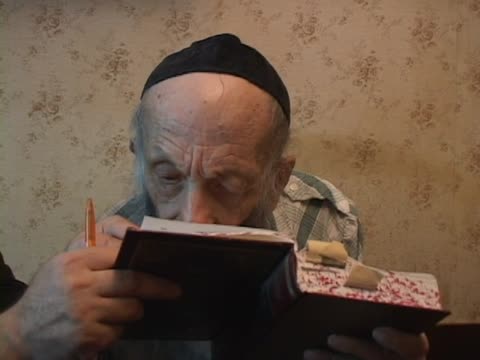
Krasheny talks about going to the synagogue and praying, saying he prayed there for three years and at the minyan. He mentions when the synagogue was being built and that he can say Kaddish by heart, and Kerler and Katz ask him to say it. He also talks about an American visitor, Rosh Hashanah, a dream of visitors coming, and his older daughter's move to Germany with her family. He says he wanted to travel to Israel.

Also covers an American visitor, a dream about visitors, and a daughter in Germany.

8:24

About emigration

From the machine transcript

Krasheny speaks about his wish to travel to Israel and why he did not go. He says he was still active in his eighties (the exact age is unclear), and remembers a doctor's visit. He talks about health being the first thing and about how he used to go out each day.

10:37

Religious life today and family visits

From the machine transcript

Krasheny talks about visitors to the rebbe and about relatives visiting from America. His older daughter and her family went to Germany, where they received housing and a pension, while he chose to stay. He describes his poor health, with few teeth and sight in one eye only, and his dreams. Kerler thanks him, and Katz then tries to ask about his earlier life in Uman'.

Includes his daughter's emigration to Germany and his own health.

15:29

Zoye tells about his life

From the machine transcript

Katz and Kerler try to draw Krasheny out about his childhood before the war, and Zoya answers for him. She says his father was killed (apparently shot in the Petliura period), that his mother raised many children, and that he was born in 1912 (apparently). She says his mother and sisters were shot and that he was at Babi Yar and got out of it, and that he served in the army and was taken prisoner. She also gives his name and surname, a telephone number, and says she is named after his mother Zisel.

Zoya, not Krasheny, supplies the biography, including Babi Yar and his mother Zisel.

23:20

Life today and family

From the machine transcript

Krasheny talks about his mother Zisl, his younger brother, and how the whole family was murdered, leaving only him. He describes being old and hard of hearing, and says visitors from America and Israel come to see him. He then reflects on few Jews being left in Ukraine, young people emigrating to Israel and America, and intermarriage. Using the example of his own grandchildren and their children, he speaks of Jewish identity being lost through marriage to non-Jews. Kerler thanks him and wishes him health as the team leaves.

Covers intermarriage and the loss of Jewish identity, and the murder of his family.

39:18

Meeting Waldman on the street

Informal MDV 740 · MCO
From the machine transcript

Waldman, whom the team meets on the street, says Jews lived in her Rakovka district. She invites Kerler to talk with her in her home rather than in the synagogue and mentions another woman who writes and reads in Yiddish. Kerler then states the date and that they will speak with Maria Abramovna Waldman, born in Uman'.

40:28

Life in Uman before the war and family

From the machine transcript

Waldman says she loves her town, which before the war had about fifty thousand people and was divided into three districts. She describes the largest, Rakovka, where many Jewish families with many children lived, among them the writer Polyanker (the spelling is not clear in the transcript). She says many people, including her grandmother's children, died of the Spanish flu, and mentions factories and craftsmen.

Adds the three districts and the death of her grandmother's children from influenza.

46:12

Evacuation and life after the war

during the warafter the war EvacuationDaily life (general) MDV 740 · MCO
From the machine transcript

Waldman talks about the hard years of wartime evacuation, when many died of hunger and her mother worked hard for little. After the war she studied, finishing school, a pedagogical college and universities in Kyiv and Cherkasy. She also mentions a brother living in Germany.

Adds her studies in Kyiv and Cherkasy and a brother in Germany.

47:12

Family and life today

From the machine transcript

Waldman talks about her brother in Germany and his son, who opened a school there. She also mentions her husband, who worked at the post office, and says she has no children of her own and helped raise his children. She is now a pensioner who works with the Soviet veterans' organisation and helps people, and she has ties with Israel and America.

48:57

Reb Nahman and religious life today

From the machine transcript

Answering Kerler, Waldman describes Reb Nahman's grave in Soviet times and today. After the war there was a small building at the site, and she recalls tombstones and a wall. She describes the pilgrimage of Hasidim, with thousands coming each Rosh Hashanah and a new multi-storey kloyz being built. Before perestroika people came quietly, because religion was controlled. She also mentions the director of a tourist organization for Hasidim and her trips abroad.

Contrasts Soviet-era secrecy with today's mass Rosh Hashanah pilgrimage, and a visitor organization.

54:18

Family

From the machine transcript

Waldman names her mother Khayke and her mother's siblings, including Yankl, her mother's youngest brother, who studied at a Yiddish university in Odessa. She recalls Yiddish songs, freylekhs dancing, and readings and theater of Sholem Aleichem. She talks about the writer Polyanker, who has a street named after him in Uman', and says she wants a museum in his house in Rakovka. She also mentions a museum in the city.

Adds her mother's siblings and her wish to open a Polyanker museum.

58:21

Jewish cultural life before and after the war

before the warafter the war Cultural life (general) MDV 740 · MCO
From the machine transcript

Waldman recalls that before the war Uman' had three Yiddish schools, and her mother's youngest brother was a school director. After the war Jews gathered in private homes because there was no synagogue, and Yiddish theater and drama circles existed. She tells of a woman who recalled a Yiddish play, apparently Goldfaden's Kolduniye, and of Sabbath eve as it was in her own home. She also mentions a Jewish cultural center that brought together Yiddish and Hebrew literature.

Includes private prayer gatherings after the war and a Sabbath-eve family scene recalled from a play.