People › Nesya Shulimovna Katz › conversation

Nesya Shulimovna Katz

Vinnytsya 22 May 2008 Interviewed by Dov-Ber Kerler, Moisei Lemster 61 min · 1 part on 1 tape
Loading the player…
  1. MDV 765 0:00–1:00:54 · 61 min · not online — MCO
Passages

0:00

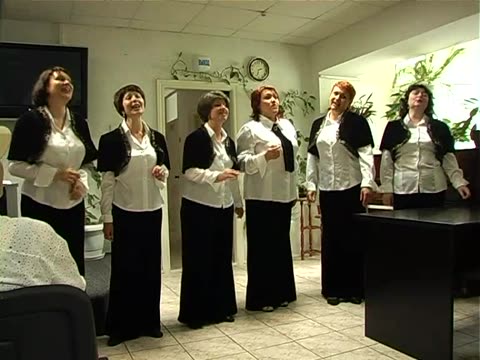
Vinnytsya Women’s Choir performance

From the machine transcript

The end of the Vinnytsya women's choir performance: songs about Vinnytsya sung in Yiddish and Russian. Then a Russian-speaking man compliments the choir on its alto and tenor parts and its conductor.

A listener's Russian compliments to the choir.

15:40

setting up interview with Katz

Informal MDV 765 · MCO
From the machine transcript

Setting up the interview: Katz says she lived through the war and gives her birthplace Vinnytsya, her street, her name and patronymic. Kerler states the date and place of the recording and asks her to tell her story; she gives her birth date.

17:31

early childhood memory and school years

before the war ChildhoodSchooling MDV 765 · MCO
From the machine transcript

Katz recalls her childhood. At three she lost both parents to typhus; she describes in detail her mother's last days and the neighbors finding her dead. A relative of her mother's, apparently an uncle, took her in, and she describes her chores in his household and his work as a tinsmith. She goes on to her few years of schooling, starting work as a child, and finishing school in 1939.

Details of the uncle's household and her early work.

28:01

working years between 1939-41

before the warduring the war Work and trades MDV 765 · MCO
From the machine transcript

Katz describes her nursing training and being taken into the army. She recites the Soviet military oath, in Russian, and describes her training. She was sent to Poland, and after the Polish campaign she brought wounded back to the hospital in Vinnytsya. She also tells of working in a factory and singing in a choir, and of the outbreak of war on 22 June 1941, the call-up and soldiers coming to her window.

Her army training, the oath, and the call-up on the first day of the war.

39:49

life during war

during the war World War II (general) MDV 765 · MCO
From the machine transcript

Katz recalls the first night of the war in Vinnytsya: a plane overhead, the first bomb falling on the old town, and paratroopers. She describes her work in the sanitary service with the wounded, and tells of the Banderites and her marriage while her husband was at the front.

42:30

family

From the machine transcript

Katz says she has a son and a daughter, who has two children. Her son is a doctor. She was herself wounded near Stalingrad, next to a factory.

43:10

life today

life today Life today MDV 765 · MCO
From the machine transcript

Katz says she was told by an official that no Jew was at the front, and she answers that many Jews fought. She lists the many killed, wounded and commanders, in poorly transcribed speech.

43:42

Jewish soldiers

during the war Army service MDV 765 · MCO
From the machine transcript

Answering Kerler, Katz says many Jews were among the soldiers, especially doctors, and names several Jewish doctors and colleagues. She then mentions her husband's death.

The names of Jewish doctors she knew.

44:49

life today and family

From the machine transcript

Katz gives details of her family, answering Kerler's questions. Her husband's surname is heard as Gersman (?) and his father's name as Gersh Leybovitsh (?). Her daughter Raya works in a factory and is a widow with two children. Her son, born in 1948, is a hypnotherapist in Yugoslavia who visits every two years. Her father Shalom worked at a mill, her mother Rachel was a housewife, and she lives on Komunistychna street. Her husband died in 1985, on Victory Day. At the end Kerler mentions her service during the war, and she says she is disabled.

Her parents' occupations, her children, and her husband's death.

50:52

medals

From the machine transcript

Katz says she appeared on television and received many medals. When Kerler remarks that she earned them honestly, she explains what that means to her as an orphan, recalling her uncle's advice before she went to the war. Kerler then asks where the uncle came from; he was a tinsmith and a native of Vinnytsya.

52:45

family and happiest times

From the machine transcript

Katz says she never knew her grandparents. Asked about the happiest time of her life, she names her wedding after the war, and tells how she met her husband, a film mechanic, through his first wife, who was killed in the ghetto with their children. She also recalls meeting him in Kyiv, and tending the wounded General Vatutin, who died there.

How she met her husband and her care for General Vatutin.

57:33

speaking Yiddish and family

From the machine transcript

Asked how she kept her Yiddish so well, Katz says she spoke it with her uncle and aunt and had few chances afterwards. She recalls hardly speaking it in postwar years, since a Yiddish word could cause trouble. She then returns to her husband's death, her two children and her grandchildren, and Kerler wishes her good health.