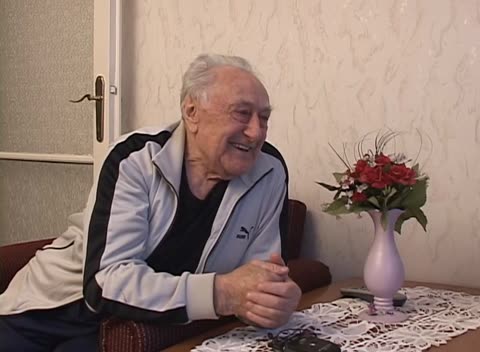
Smajovics speaks about his life and work after the war. He also worked as chauffeur. He then speaks about daily life in in the 1960s and mentions opportunities to make extra money. Smajovics moved to Budapest in 1978.
Smajovics recounts his postwar working life as a driver. He worked on a Moskvich car for a director and for a regional consumer union, and moved between jobs and workplaces. He describes earning extra money on the side by writing up meat deliveries and by dealing with a restaurant and a warehouse. He is then asked when he came to Budapest, and the answer is cut off.
Details the meat-trade side income and the Moskvich cars, not only Budapest.
Smajovics talks about contemporary life in Velyka Kopanya, as well as contemporary Jewish life in Vynohradiv. He then answers questions about cultural terminology.
Smajovics talks about visits to his home area after the war and about the Jewish cemeteries in Sevlush, one in the town and another outside it. A few Jews remain there. Kerler then asks him for Yiddish words for a Jewish cemetery, a church, a synagogue, a golem, a dybbuk and a good Jew, and Smajovics gives the terms and explanations. Kerler also asks about pouring a glass of water.
The cultural terminology part is a series of questions on terms such as golem and dybbuk.
Smajovics talks about the small yeshiva, or cheder, he attended before the war. He recalls studying Gemara, Mishnah and the Targum with a bochur teacher, learning prayers and blessings by heart, and the blessing over the new moon. Kerler asks whether the prayers were explained to them, and what tractates they studied.
Names the Gemara and Mishnah texts studied and the blessing customs.
Smajovics answers questions about Hanukkah and Purim food. He says fried doughnuts were not a Hanukkah custom at home, though his mother baked at home, and he first met them on arrival in Israel in the 1980s. He talks about latkes and Passover foods. For Purim he describes baked shalakhmones sent to the poor and acquaintances, and children's pastries. He mentions a man named Leizerovich, born in Erdőd (?) in Transylvania, who still lives in Budapest.
Also covers latkes, pancake terms and a man named Leizerovich in Budapest.
Smajovics remembers Purim shpiels and explains how older girls dressed up as gypsies and performed Purim shpiels. He then speaks about Jewish life after the war.
Smajovics recalls how a Purim shpil was said when shalakhmones were delivered, performed at homes by children. Older girls dressed up as gypsies and went from house to house collecting money. He then speaks about the Jewish old people's home in Budapest where he sometimes sings Yiddish songs. Kerler asks where he learned his songs, and he says before the war.
Adds the old people's home in Budapest and the question of where he learned his songs.
Smajovics sings a couple of Yiddish love songs. The first one deals with a young man leaving his home to be with his girlfriend and the second song tells a conversation of a young couple that go on a walk together.
Smajovics sings two Yiddish love songs. In the first a young man leaves home for his girlfriend; the second is about a couple walking and quarrelling. Kerler asks him to sing slowly and then asks about the meanings of words such as 'sakurn' and 'freiles'. He asks for further songs, about the Messiah and Passover, which Smajovics does not know.
Smajovics sings an ironic Yiddish song about being a good Hasidic follower, once sung by older boys before the war, when Hashomer Hatzair pioneers were already active in Transcarpathia. He also sings a song about where a girl slept and what she covered herself with. Kerler asks about the Hungarian words used, such as 'paplan' and 'abrik', and they discuss featherbed and hayloft terms.
Includes discussion of the Hungarian-derived words for bedding and hay.
Smajovics recites and half-sings a song of the kind a wedding jester (marshalik/gramer) would perform, a rhymed address to the guests. He remembers only parts of it. Kerler asks about the terms for the jester, and Smajovics says the word used in Sevlush.
Smajovics addresses his best moments in life and work during the Soviet period. He also speaks about his family. Smajovics continued to work for six and a half years after his retirement.
Asked about the best time of his life, Smajovics says he became a driver after returning from prison (his own word), then a locksmith and truck driver. After moving to Budapest, he continued working as a pipe fitter with a master after retirement for six and a half years. He speaks about his two daughters, one in Budapest and one in America, and about his son-in-law, a businessman in the U.S. with homes in Queens and Miami.
Gives his daughters, his son-in-law in America and the work after retirement.
Smajovics speaks about postwar Jewish life and religious customs in Vynohradiv. According to him, three kosher butchers worked there after the war. Smajovics then speaks about his life today and mentions Yiddish gatherings.
Smajovics speaks about postwar Jewish life in Sevlush, saying three shochets served the area and some people kept kosher at home, until the shochets left. He then talks about his life today, praying daily with tefillin and attending a club in Budapest where Yiddish speakers gather about once a month. He names other attendees, including Reizmovich and Tamás Milov (?). He tells an anecdote about a man who is kosher but does not pray, and about reading and writing Yiddish and Hebrew.
Adds the Budapest club, named Yiddish speakers and his Yiddish and Hebrew literacy.
Smajovics addresses Yiddish literature and Soviet Yiddish press. He then briefly touches upon postwar Yiddish culture. Smajovics also speaks about his trip to Israel and mentions Russian literary works.
Smajovics speaks about Yiddish reading, including Sholem Aleichem, and Soviet Yiddish press and journals, and mentions Birobidzhan newspapers. He tells of a Yiddish concert by American Jews that he attended in Beregszász (?) or a nearby town in the 1960s (?). He describes a trip to Israel and a taxi ride there. Kerler asks about Sovetish Heymland and Yiddish authors. Smajovics then talks about Russian war books on marshals Vasilevsky, Zhukov and Rokossovsky and the Stalingrad front, before Kerler thanks him.
The passage also covers Russian war memoirs and the story of Zhukov and Stalin at Stalingrad.