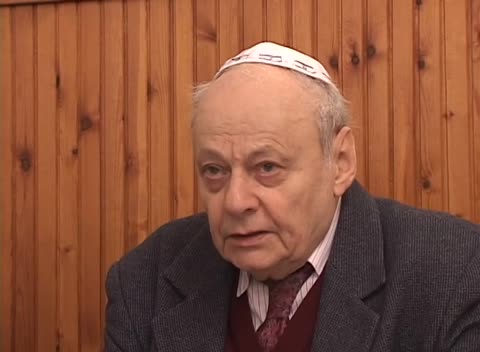
Kerler and Doman briefly discuss the state of Yiddish and Jewish life in Russia, including a rise in antisemitism there, in eastern Europe and in western Europe. Kerler then outlines the interview plan, asking about the difference between Yiddish and the German used in the yeshiva and about Yiddish in Budapest. Doman says he studied in four yeshivas, naming Verpelét, Dorog (?) and Galánta, the last now in Slovakia.
The passage opens with a discussion of antisemitism and Yiddish in Russia and western Europe.
Doman talks about his yeshiva education, including spoken languages, in Verpelét, 2:00 Szabolcs-Szatmar-Bereg county, Dorog and Galánta (today in Slovakia) in the late 1930 and early 1940s.
Doman describes the languages used in the yeshivas he attended. In Verpelét and the other yeshivas of the western region the students spoke Yiddish and Hungarian was forbidden; in Galánta and other yeshivas the students, mostly from Budapest, spoke Hungarian. He calls the Yiddish he learned poor and mixed with Hebrew; the sermons were learned pilpul, and the Talmud was translated into Yiddish. Kerler fixes the period as the late 1930s and early 1940s.
Doman briefly speaks about his life during the war; after he finished his yeshiva education he returned home to Budapest. Doman was a forced laborer in the Hungarian army. He then addresses his life after the war. Doman began to study at the university and Jewish Theological Seminary of Budapest in 1944.
Doman recalls that after the yeshivas he returned to Budapest, where he was drafted into forced labor when the Holocaust began, and survived. In 1944 (?) he began university studies and, in parallel, the rabbinical seminary, which he explains was Conservative. In answer to Kerler's questions he distinguishes the Hungarian Neolog communities from the Orthodox; his parents were Orthodox.
Includes his explanation of the Neolog and Orthodox communities and the seminary.
Doman speaks about his family, specifically his father, and prewar religious life. Doman addresses the differences between the orthodox and reform communities.
Doman says that Orthodox and Neolog Jews observed the commandments alike and differed mainly in dress, the Orthodox wearing black beaver hats and white stockings. He talks about his father, Ernst Doman, who was a rabbi for some fifty years and Orthodox, and gives his own Jewish name. He says Hungarian Orthodox Jews spoke Yiddish-German rather than true Yiddish, and he mixes some of it with English.
Includes his father's name and rabbinate, and the Yiddish-German spoken by Hungarian Orthodox Jews.
Doman and Kerler discuss differences between Yiddish and Hungarian Yiddish-German, including some words (Sukkot, travel to Vienna), and Doman's learning of German in school. He says his mother and grandmothers were strictly Orthodox and spoke Hungarian. He explains that Hungarian Jews' language shifted after emancipation in 1867, with women first. They also discuss Polish and Galician Jews in Hungary, such as those from Munkács and Ungvár, who spoke Yiddish and quickly learned Hungarian.
Doman speaks about his research and publications about jokes, Hungarian yeshivot, a Hungarian community, his father, his life as forced laborer and a translation study of the Talmud.
Doman tells Kerler about his seven books, the first on a Hungarian Jewish community between Vienna and Budapest, and others on Jewish jokes and on the history of the Hungarian yeshivas where he studied, whose rabbis died as martyrs in 1944 (?). He names four of them: Pollák, Grünberger, Frankfurter and Buxbaum of Galánta. One book concerns his father, who wrote his impressions of forced labor and Buchenwald in Hebrew; further works are a translation of the Talmud and a dissertation on the Talmud and Christianity.
Footage of the synagogue and a prayer service. The transcript records only a few lines of leave-taking and chat at the start, with Kerler speaking English, and almost nothing else for the rest of the passage.