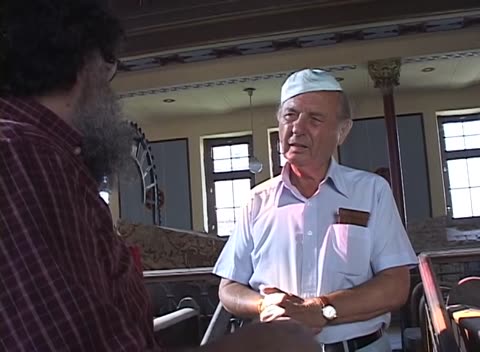
The team walks with Samadi to the synagogue to give a tour. He provides historical background about the synagogue, as well as about prewar and postwar religious life in Debrecen. According to Samadi, services in the Great Synagogue stopped in 1984. Other members, including Goronvalgy and Reti, join the conversation and inform about contemporary Jewish life in Hungarian and Yiddish.
Walking to and around the synagogue, the group talks with Kerler about the Jewish community of Debrecen. They discuss how many Jews returned after the war, how many later emigrated, and when services in the synagogue stopped. They also touch on the building's history, prewar prayer rooms, a donor from America, and the arrival of Russian soldiers after the war. Much of the talk is in Hungarian, and the details are unclear.
The transcript shows talk about emigration, a donor from America, and Russian soldiers, which the catalogue does not mention.
Synagogue footage with talk among the group about the cost of the restoration, in sums of money. They compare the beauty of this synagogue with another one, and discuss a former synagogue building and fittings. Kerler also asks about what the old building was used for. The speech is partly garbled.
The group talks about prewar visits to Debrecen to pray, about the mikveh and other synagogues in the town, and about Torah scrolls taken away and later returned. They discuss a fire at one synagogue after the war and a local history book on the Jews of Debrecen, whose author the transcript does not make clear. They also discuss a rabbi, a memorial and a grave in a cemetery. A good deal is in Hungarian, and the speakers are hard to separate.
The transcript shows talk about a local history book, a cemetery grave and a memorial, and the identity of Reti is not clear.
The team sets up for the interview. They look for a place to sit down, and one speaker describes the layout of the building, including stairs and a mikveh.
The formal interview begins with Kerler giving the date and place and Samadi giving his name, that he was born Shifman, and his Jewish name. He gives the year of his birth and says he was born in Bököny. He then recalls prewar Jewish life there, naming the rabbi, shoykhet and shames and the rabbi's four sons, who sang with Samadi in the choir. Kerler asks him to sing.
Samadi speaks about his education at a religious school (cheder) until he was eleven years old and then Talmud Torah school for two years, which was located in Újfehértó (Yiddish: Ratsfelt). Samadi then talks about prewar religious life in Újfehértó. He recalls how his mother instructed him to learn Yiddish, so he can communicate with Jews anywhere.
Samadi recalls attending cheder from the age of three until eleven and then a talmud torah in Újfehértó (Yiddish Ratsfelt), which he places a short distance from Debrecen. He names the rebbe there and his gabbai. He says his mother wanted him to learn Yiddish well so he could talk to Jews everywhere, and a later visit to Florida shows this.
The transcript shows a later visit to Florida where he spoke Yiddish with elderly Jews.
Samadi speaks about his life today. He then continues to talk about his education and life before the war. After Samadi attended a Talmud Torah school, he studied at a yeshiva in Tiszaeszlár 47:19 for five semesters. After his yeshiva education, Samadi became a baker and locksmith. After the war, he was a merchant and then worked at a sanatorium.
Samadi talks about meeting elderly Yiddish speakers in Florida and how they spoke Yiddish while their children spoke English. He continues with his education, studying in a yeshiva in Tiszaeszlár for four or five terms after the talmud torah. He then trained as a baker and as a locksmith, and later worked as a merchant and in a sanatorium (?).
Samadi speaks about his family. His father was a shopowner. He grew up with one brother and one sister. Samadi states that his sister was the only one from his immediate family who returned from Auschwitz.
Samadi speaks about his family. His father kept a shop and traded in all kinds of goods. He had one brother and one sister, and only his sister came back from Auschwitz. He gives the names of his siblings and his mother's maiden name, though some of these are unclear.
Samadi speaks about his and his sister's life in the immediate postwar period. He then talks about his family and language education, before addressing his cheder education.
Samadi describes the postwar years, when he came home half a year before his sister, who later married and had two sons, and both she and her husband have since died. He recalls a year of labor service. Kerler asks about his grandparents, whom he mostly never knew. They also discuss his home language, which was Hungarian, and how his cheder lessons were conducted. He learned German from a teacher whose name is unclear.
Samadi speaks about the war years, when he worked for German soldiers and they did not know he was a Jew. He acted as interpreter for a woman with two children and describes being asked to bake, and how he used his German and avoided showing he did not understand. He did not wear a star, and says he looked non-Jewish. He calls it a hard time.
The transcript shows that he acted as an interpreter for a woman with two children.
Samadi talks about working as a baker in Nyírkáta (Gobe) before the war, and about his call-up to labor service. He says the village notary could have exempted him but did not. Much of the passage is in Hungarian and garbled.