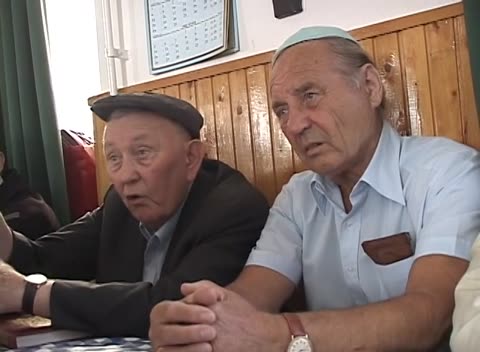
After a brief Hungarian aside about a film and talk of a nearby trip, Kerler asks what a 'khazer bokher' was in the yeshiva. Samadi recalls leaving the cheder and studying in a yeshiva in a village whose name is unclear (Tisa Bertsl?) with about twenty-eight boys, alongside a relative. Kerler explains the stages: khazer bokher, shiur geyer, khaver bokher, and what a boy could become afterwards.
Kerler explains the khazer bokher/shiur geyer/khaver bokher terms, and the passage opens with a Hungarian aside and a talk about a trip.
Samadi recalls a Jewish wedding at which he sang and sings a wedding song. Kerler asks whether there was a badkhn or rhymer at weddings; the answer is partly in Hungarian, and Samadi remembers a wedding at a rabbi's house with dancing. Kerler asks about the local rabbi, apparently Yehuda Fridlender (?), and then about Shavuot food.
Kerler's questions about a badkhn/rhymer and a rabbi's identity, and the lead-in to Shavuot food.
The speakers describe Shavuot food, namely cheese kreplach, and mention Purim food. Kerler asks about Purim plays, and a woman sings a Purim 'gutn purim' greeting that others take up. A play about a chimney sweep is recalled, along with who prepared the wedding meal, since there was no Jewish restaurant. The passage ends as Samadi begins a Hungarian remark about his father and grandmother, leading into the potato song.
Purim greeting song, discussion of a chimney-sweep play, and wedding catering.
Samadi sings a Yiddish potato song he knows from his father, with Sunday-to-Friday potatoes and a potato kugel for Sabbath. Kerler asks him to repeat it slowly to learn the words, and they discuss the Yiddish word for potatoes and a word in the song that Kerler explains. Samadi then tells and sings the song of two brothers, one rich and one poor, and the angel who comes for each of them. Kerler finally asks about a song on the Messiah, and Samadi says he sang that one in Hungarian.
Discussion of the Yiddish word for potatoes and other terms, and the question about a Messiah song sung in Hungarian.
Samedi sings the beginnings of a Hungarian song and then Reti and Goronvalgy sing a Yiddish song about a yeshiva student. Goronvalgy then sings Shoshanat Yaacov, before Samedi sings a Yiddish song about love.
Samadi starts a Hungarian song, and then several people sing a Yiddish song about not wanting to be a yeshiva student any more. Gurshteyn chants Shoshanat Yaakov at length. Samadi then sings a humorous Yiddish song about a woman out with a veil in a Budapest newspaper story, which he learned from his father. Kerler asks whether it was a theater song and whether his mother sang too.
Gurshteyn's chanting of Shoshanat Yaakov and the question about Samadi's mother's singing.
Samedi speaks about his family, in particular his mother's observance. He recalls how his mother read tsene rene on Sabbath. They then chant Shir haMa'alot.
Samadi speaks of his mother, who read the Tsene-rene on Sabbath. A second speaker recalls in Hungarian Friday-evening customs at home, including the father singing at the table before the family could leave. The group then chants Shir haMa'alot with the singing around the table. The recording is badly garbled here.
Recollections of Friday-evening table customs, partly in Hungarian, and the Tsene-rene detail.
Gurshteyn chants a second version of Shir haMa'alot, which he learned in cheder from a rabbi in a place whose name is unclear (Hoydl?). Samadi recalls his mother's uncle, who sang on Purim and loved singing a nigun. Kerler then asks about Kaliver Hasidic songs.
Samadi's mother's uncle and Kerler's question about Kaliver songs.
Samadi recalls visiting Kaliv in 1944, shortly before the Jews were taken away. The head gendarme there was friendly to Jews and helped a young Hasidic man; Samadi also names a Sholem Leyzer. They discuss the Kaliver rebbe's grave and the new ohel built over it. Kerler closes by asking about a song.
A friendly gendarme, the Kaliver rebbe's grave with its new ohel, and Sholem Leyzer.
Samadi and Gurshteyn sing a Hungarian folk song about a bird, in Hungarian with a Jewish text about when the Temple will be rebuilt. Gurshteyn explains the Jewish text in Hungarian. Kerler remarks on the similarity to other songs.
Gurshteyn's Hungarian explanation of the Jewish text about rebuilding the Temple.
Goronvalgy provides personal information. He then talks about life before the war. Goronvalgy lived in Budapest and Hajdúbagos 41:29, where he started working as tailor apprentice at fourteen. Goronvalgy left for Budapest at 18, where he was drafted for his military service. He explains that after two years of service, he returned home and continued his work as tailor. Goronvalgy lived in Israel for one year in 1948 and built roads.
Gurshteyn, now the interviewee, gives personal information: born in 1921, now in Debrecen, and in Budapest he spoke mostly Hungarian. He grew up in Shamshon, near Debrecen, and his first name is Simkhe. His father's name is given as Zalmen (?). Until fourteen he lived in Shamshon, then learned tailoring in Hajdúbagos. In Budapest he was drafted into the army for about two years, and he returned to Shamshon and worked. In 1948 he was in Israel as a soldier building roads for about a year. He also says he knows a little Hebrew.
Kerler's questions about name, birth year and languages; the army service and the Israel period.
Goronvalgy speaks about his family. He grew up with one brother and two sisters. Goronvalgy states that he is the only from his immediate family who survived the war. He then talks about his life after the war. He got married in 1940.
Gurshteyn says there were six Jews in his family home, and that he alone returned after the war. He then worked in Shamshon. Asked when he married, he gives the forties (1940?). Kerler asks about a Purim play, and Gurshteyn says he knows one in Hungarian.
Marriage date and the lead-in to the Hungarian Purim play.
Gurshteyn recites a Hungarian Purim play from memory, a comic monologue about an assimilated Jew who is not a good Jew, and then a scene with a cholent pot and friends. He says it was performed in his shtetl, the Hajdúbagos area (?), by three players including himself at twelve. Kerler asks about the date and about his Hungarian name and its Yiddish equivalent. Kerler ends by asking for a short Yiddish song and arranges to continue.
The play's content, his role at twelve, and Kerler's questions about his Hungarian name and about the date.