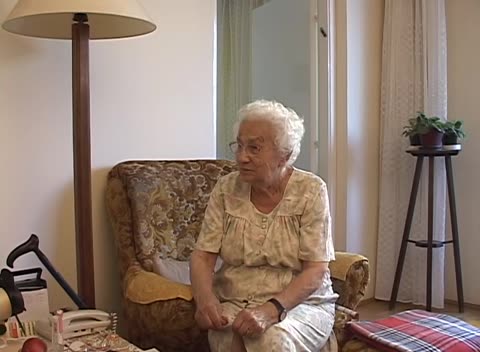
Stern provides personal information and speaks about prewar Jewish life in her hometown, as well as her family. Her mother was also born in Sonkad. Her father worked in agriculture. She grew up as an only child.
Kerler and the others first settle which language to use. Stern then gives her Yiddish name, her married name Stern, her maiden name Tsigler and her Hungarian name. She was born in the village of Sonkad, near the Satu Mare area and the old border. Her maternal grandfather and her parents are named, and her father worked in agriculture. She was an only child, and a few other Jewish families lived in the village. Kerler asks about her family, and she says that at home they spoke Yiddish and Hungarian. She says she is ashamed of her Yiddish. A relative who married into a rabbinic family is also mentioned.
Also covers the choice of language, her names, the village's location near the border and her only-child status.
Stern speaks about her life today. Her children live in Israel. Stern visited Israel three years ago. She then speaks about her and her family's life during World War II. She was deported to Auschwitz.
Stern talks about her life today, mentioning her children and a visit to Israel about three years ago. The conversation then turns to the war. She was in a camp, where she picked up some German. Her parents were taken away in 1944 (the transcript says 1949 (?)). She reads a Jewish newspaper and passes it on to her daughter. Much of the passage is garbled or in Hungarian.
Also mentions the Jewish newspaper she reads and the parents' fate, which the catalogue does not mention.
Stern talks in Hungarian, with some Yiddish interpreting, about Jewish life today. She keeps kosher with the help of a woman who shops with her, and the meat comes from Budapest. One of her sons lives in Israel, where the household is kosher, and her daughter lives in Debrecen, where it is not. The other speaker asks questions about her children and where they live.
The passage centres on kosher practice and where her children live.
The interview ends. Kerler thanks Stern and says he will try to learn Hungarian. Stern says in Hungarian that she has not spoken Yiddish for fifty years. In Debrecen she was once taken for someone from Transcarpathia because of her Yiddish.
Stern's remarks about how little she now speaks Yiddish in Debrecen.
Kerler asks what her parents called her in Yiddish and who her grandfather was. Stern says in Hungarian that she had no trade and, after moving to Debrecen, worked in a cooperative making plastic children's toys. The conversation also covers the words for city and village, an American Yiddish speaker, and her husband's job as chief bookkeeper on a state farm. She says they wanted to emigrate but were refused. The tape ends with some talk about travelling on to Oradea and about a woman from Mukachevo who lives in the building.
Also covers the Yiddish words for city and village, the refused emigration and the 1956 revolution.