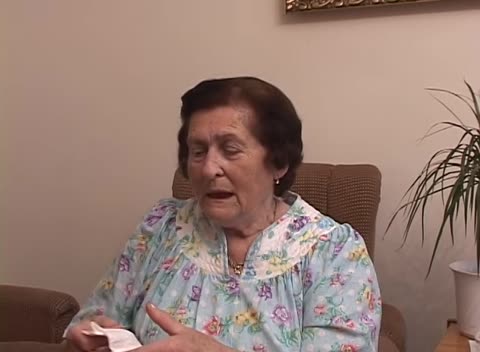
David discusses her childhood memories, in particular the visit of a rebbe. She also talks about her family and provides personal information. David's father was born in 6:25. Her family moved to Mukacheve when David was two years old. She explains that she learned Yiddish from a scribe and attended a Hebrew primary school.
After an opening in which David mentions her age and diabetes, Kerler asks for her personal information. She gives her Yiddish name Shayndl, her Hungarian name Lilly and her husband's surname David. Kerler asks about the surname Schön and its Yiddish spelling, and they discuss Yiddish names for Munkács and other towns. She was born in Kiralyhelmec (Slovakia) and taken to Munkács at two. Her father was from Sárospatak (?). She came to Hungary in 1965 after the war. She learned Yiddish from a scribe while learning sewing, since Hungarian was spoken at home and in the streets. She attended a Hebrew school for two years, and she and S2 discuss which Jews in Munkács were religious.
The transcript adds the Hebrew school, her naming (Shayndl/Lilly, Schön, David) and the question of Hungarian versus Yiddish speakers in Munkács.
David talks about her family. Her father was a cobbler. She grew up with a brother, who died in Birkenau. She then talks about contemporary Jewish life.
David says her father was a shoemaker and her mother Sara a housewife, and that there were two children. Her brother was killed in Birkenau, apparently of illness and burned. They discuss the names in the family, Jewish versus Hungarian. Talk then turns to a rabbi from Israel who speaks Yiddish and to rabbis in Hungary and elsewhere who do not, and she mentions acquaintances in Vienna.
Adds her mother's name and occupation, the naming discussion, and the talk of Yiddish-speaking rabbis and acquaintances in Vienna.
David talks about her life in Mukacheve before the war and addresses languages. She then talks about her visits to America and Israel, including her relatives.
Kerler asks about life in Munkács before the war; David says it was good, and S2 notes that things changed after the camp. She recalls her mother forbidding the children to go to the Latorca river, with talk of whirlpools and swimming. They discuss the languages she knows: Hungarian above all, a little Russian and Czech, with Munkács a multilingual town. She speaks of trips to America (twice), Israel (four times) and Canada, and of relatives there, including cousins' children and twins, a young man who spent months on a kibbutz, and a woman named Elke (?). The last part is a Hungarian exchange about offering food.
Adds the Latorca river, the languages she speaks, and the American, Israeli and Canadian relatives.
Mostly informal conversation, much of it in Hungarian, about food and drink offered to the guests, fruit, her diet and illness, and her flat. Kerler and David touch on a Purim greeting and on which towns it is known from, and S2 remarks that men rather than women used to speak Yiddish. David talks of her health, an operation, her age, and a move to the present flat from the Kossuth street flat (?). Kerler says he recently came from America and describes his travels and his parents' ages at death. The passage ends with thanks and goodbyes to David.
The transcript shows a long informal stretch on food, health and the flat, not just a brief Purim mention.
Kerler and David close the formal part with farewells in Yiddish and Hungarian. They exchange Munkács greeting phrases and remarks on how people spoke in Munkács, and Kerler says he hopes to come again. There are scattered remarks about dollars and about Yiddish in Romania, but the transcript is largely garbled.