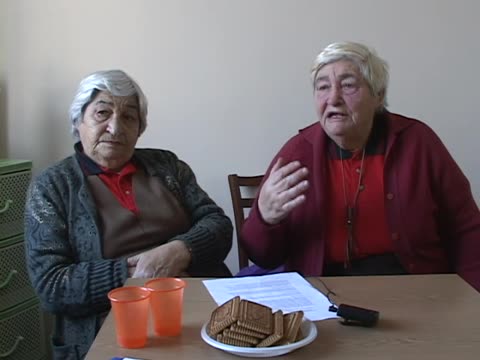
Dzigifker and Mundrian provide personal information and talk about their family. Their father was born in Kodema and their mother was born in Vadul-Rascov. They grew up with four siblings. They have relatives in America.
The sisters greet the interviewers, praise the warm welcome at the Hesed centre, and give their names and their father's. Mundrian and Dzigifker say their father was born in Kodema (Ukraine) and their mother in Vadul-Rascov. They recount that there were six children and two survive, and that a brother disappeared during the war after working in Uman. They mention relatives in America (Philadelphia, Brooklyn, Chicago). They then identify their home village Gertop/Vertuzhany in the Florești district, about eight kilometres from Florești, with Kerler looking for it on a map.
Also covers the brother lost in the war, relatives in America, and locating the village on a map.
Dzigifker talks about prewar Jewish life in Gertop and her family. Her father was a merchant of 13:15. She explains why her family moved to Marculesti, because her father was warned of being robbed. They moved in 1927/28 and lived there for six years. In 1936, they lived in Capresti for four years.
Dzigifker describes her father's wealthy Goldenfeld-related family, with a distillery, mill and estate, and her father's trading business. She says robbers' gangs threatened Jews in the district, and her father was warned that his name was on a list, so the family left for Mărculești. She tells of the father's illness, a treatment in Czernowitz, and his contribution to the first kibbutz in Israel, which put him in the Golden Book. Mundrian adds memories of a 1930s antisemitic scare and of the family later living in Căprești.
Also gives the Goldenfeld family background, the robber gangs, the father's donation to Israel and the Golden Book.
Mundrian recalls an antisemitic agitation in form of posters in churches in 1939. The community, however, was not harmed and they celebrated a happy Purim. Dzigifker worked in a factory as a service desk employee before the war.
Mundrian recalls an antisemitic agitation before Purim in Căprești, when notices were placed in churches. Nothing happened to the Jews, and the Purim that followed was a happy one. Dzigifker then tells how, after four years, a factory taken over by the Russians gave her mother a job, and how she worked there herself until the war in 1941, receiving grain for the factory. Kerler turns the talk back to Gertop.
Also covers the mother's job and Dzigifker's factory work receiving grain.
Dzigifker discusses her childhood memories and Jewish life in Gertop. Dzigifker recalls how she fasted on Yom Kippur. She then describes how to kosher meat and discusses food customs, in particular challah. They remember how their mother kept kosher after the war.
Asked about childhood in Gertop, Dzigifker says there was a synagogue and Jewish life. As a child of about ten she fasted on Yom Kippur until two o'clock, and the children then asked for pretzels. Both sisters say they still fast. They describe their mother's kosher practice: soaking and salting meat, the names Rachel, Rebecca and Leah said at salting, separate dishes for milk and meat, and Sabbath candles and challah.
Also covers the mother's kosher practice after the war and the Sabbath candles.
They discuss Sabbath celebrations and prayers. Dzigifker talks about her education at a religious school (cheder) in Marculesti. She explains that her father took her out of the cheder, because the boys would not allow her to study. He hired a private tutor to continue her religious education. The private tutor taught Dzigifker how to read and write in Yiddish.
The sisters describe the end of Sabbath, when the mother said a blessing for a good week, a prayer on rising, and the custom of putting a piece of bread in the water pail. Kerler asks who taught Dzigifker to read and write Yiddish. She says she was sent to cheder in Mărculești but the boys would not let a girl study, so her father took her out and hired a private tutor. The sisters offer songs and stories, and Katz greets them and joins in.
Also covers the bread-in-the-pail custom and the sisters' offer of songs.
Dzigifker talks about Jewish life today. They talk about food customs, in particular to kosher meat, at home before the war. Dzigifker and Mundrian then describe the custom at the conclusion of Sabbath at nightfall: throwing a piece of bread into water. On Sunday morning, they would throw out the dry pieces of bread from the tablecloth.
At the Hesed centre the sisters describe the warm welcome of the staff (Roza Yakovlevna is named), and the interviewers chat about being from America. The sisters then explain kosher practice at home: soaking and salting meat and the names Rachel, Rebecca and Leah (not Sarah). They describe the bread custom at the end of Sabbath, when a piece of bread was thrown into the water pail, and the crumbs on the tablecloth were shaken out only on Sunday morning, when the Jewish week begins. Dzigifker describes her prayer for a good week, and they discuss the morning Modeh ani prayer and Hebrew teaching.
Also covers the Hesed welcome, the interviewers' American origins, the Modeh ani prayer and Hebrew teaching.
Dzigifker discusses holiday celebrations in prewar Marculesti. She describes Purim celebrations in particular. Dzigifker remembers how people asked the rebbe Shmil Sandl for help, who visited their home town from Rascov. The rebbe stayed in their home for six weeks.
Dzigifker recalls Purim in prewar Mărculești, with a festively decorated turkey for a party buffet and children dancing. She tells how the rebbe Shmuel Zandl, from Rashkov(?), stayed in their home for six weeks with two attendants. People came to him for help, her mother's limp was healed by his blessing, and the mother refused payment. The father died after the family went back to the village, leaving three orphans. Practical talk about the recording and a Russian conversation about a scarf and photographs interrupt the passage.
Also covers the rebbe's visit and the father's later death.
Dzigifker and Mundrian sing a Yiddish song about life and growing old. Dzigifker then talks about Jewish culture life in prewar Capresti and recalls an artistic group with Sara Leybovich from Romania. They then sing a Yiddish song about farewell they remember from that group.
The sisters sing a Yiddish song about growing old, a failed match and the passing years. They describe a Yiddish ensemble in prewar Căprești, with Sara Leybovich(?) coming from Bucharest for evening gatherings of about eight days. They end with the lines of a song about times that will not return.
Also covers the Yiddish ensemble in Căprești and the Bucharest visitor.