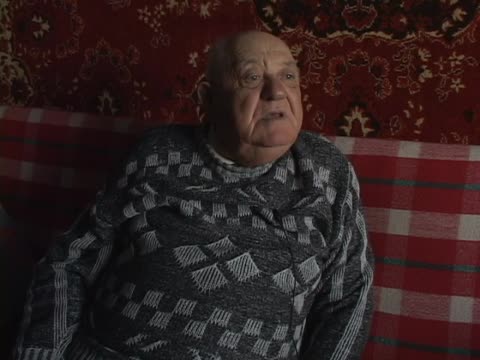
Kalussky talks about Yiddish literature. He then speaks about prewar Jewish life and tells an anecdote about a tailor's family that wanted to celebrate Passover.
Kalussky discusses Yiddish books and learning, and mentions a clever man called Tuvye (?). He then speaks about Jews in his town after the civil-war period of the 1920s–30s. He tells an anecdote about a poor tailor who writes a letter to God asking for money for Passover. The letter is opened by the police and the postal clerks, and the tailor is beaten in the end.
Also mentions books and libraries and the civil-war period.
Answers questions from Kerler and Lemster about the meaning of terms: a 'good Jew' (a rabbi who judged disputes and gave blessings), hasidim, a holy Jew, giving a pidyon, a dibbuk, a Litvak and a golem. He mentions the yeshiva in Chișinău and the shoykhet who slaughtered only chickens. He also describes how a rabbi ruled on questions about doubtful chickens, depending on whether the asker was poor or rich.
Also yeshiva and rabbinic rulings on kosher questions.
Kalussky talks about his life during the war. He was imprisoned in the Vinnytsya ghetto. He then sings a Yiddish song, he remembers from the ghetto. Kalussky then describes how he went into the villages to beg for food.
Kalussky is asked about the war years and the ghetto. He says he was in a ghetto near a place called Vinets (?). He sings a sad war song and recites a ghetto lament. He then recalls being left with two small brothers and going out to beg bread from Christians, and says Ukrainians helped. Interviewers ask for his phone number and he says he may recall more later.
Gives a second song and says non-Jews helped him; a phone number is also asked for.
Lemster asks Kalussky for curses and sayings and he gives a few. He then talks about a poor Jewish street in the town, near the tanneries, and the rough and merry behavior of the poor Jews there. He talks about folk remedies against the evil eye, such as a red ribbon and cut potatoes.
Gives the curses and sayings and the evil-eye remedies.
Kalussky says he had a traditional wedding with a chuppah, and that the marriage was registered with the state only a year later. Kerler asks about the Yiddish word for the register entry.
Mostly travel and chat in a car; the team drives to the cemetery, with Russian remarks and talk about the way. They walk among gravestones and talk about names and families on them. They mention Jews of Edineț (Yedenitser), a woman from Ariv, and that they travel from Kyiv to Chișinău. Much of the Yiddish is garbled.
Adds the walk through the cemetery and talk of Jews from Edineț and Ariv.
Informal talk with Faiershtein about a phone number, partly in Russian. She then says that some people claim there was no Holocaust in Moldova and wants to read them her poem; Katz asks who says it.
Faiershtein looks for and reads her poem in Russian, which she describes as an answer to those who say there was no Holocaust in Moldova. The poem names Vertiujeni, Cosăuți and Obodovka (?), and speaks of the camps. Kerler and Lemster comment briefly in Yiddish. At the end she says she herself was a camp prisoner.
The formal part of the interview begins. Faiershtein provides personal information and discusses her childhood memories. She attended a Romanian and Russian school before the war. After the war, she continued from fourth grade.
The formal interview with Faiershtein begins. She says she was nine when the war began and was born in Soroca, and says poems she wrote in 1932 (?) are in a book. She went to a Romanian school for one class and then a Russian one. After the war she went into fourth grade.
Faiershtein speaks about her parents and grandfathers. A grandfather had a field. Her father, the son of Israel, worked in the forest marking trees for felling before the war, and in a store after the war. Her mother, called Tuvele, did not work. Both parents died in 1986 (?), and she says they were with her in the camp.
Faiershtein talks about her childhood in Soroca. She recalls her non-Jewish neighbors. She also talks about her family. She raised two sons. Her grandparents in Racovăţ owned a mill.
Asked about childhood in Soroca, Faiershtein says she remembers little because of the camp. Non-Jewish neighbors did not steal from them. She mentions her two sons, one a musician, and says she suffered beatings in the war. Her family lived in rented rooms, and her grandparents in Rakovets, in the Soroca district, had a large house and a mill. She says she speaks only Yiddish when she meets Yiddish speakers.
Faiershtein says she has written 1,017 poems, mostly in Russian, with her own music. Kerler asks about the earlier interview for the Americans, which was in Russian. She says it is hard for her to tell war episodes in Yiddish, and begins a story about a nine-year-old child and a coat.
Faiershtein speaks about her life during the war. She was imprisoned in the Nova Obodivka ghetto. In particular, she recalls beatings by a Romanian soldier and hiding in a pit. She then talks about her poem about this period and how she recited it in Bricani two years ago. Faiershtein remembers how she met her helpers at the concert. She then shares another episode from her family's life and support from non-Jews during the war. Faiershtein maintains that her family consisted of thirteen members upon departure from Moldova and only three returned after the war.
Faiershtein tells how as a nine-year-old child in the camp she was given a dead woman's coat and beaten by a Romanian guard; she hid in a pit in the sandy ground. She recited the poem about this in Briceni two years ago and met people who had carried her. Her mother got a pot with brown sugar from a Ukrainian woman. Her family of thirteen left Moldova and only three returned. Lemster asks about songs from Soroca; she says she sings Russian songs.
Faiershtein sings a little of a Yiddish love song, then says she knows only Russian songs. She says she was in Obodovka (?) with Abramovich and describes the crowded room, about forty people, and the sister's child's frozen feet. She says she has poems in Russian and one in Moldovan about veterans, printed by Shmuel Kishinevsky, and starts to read.
Faiershtein translates one of her poem in Yiddish about life during the war. She then translates another poem about her ghetto experience and starvation.
Faiershtein renders in Yiddish some of her poems about the war: the first calls for remembering the dead and the survivors, and the second concerns hunger in the camp and the taste of brown sugar in a small pot. She reads parts in Russian, saying Yiddish is hard for her. Lemster says it is a pity.