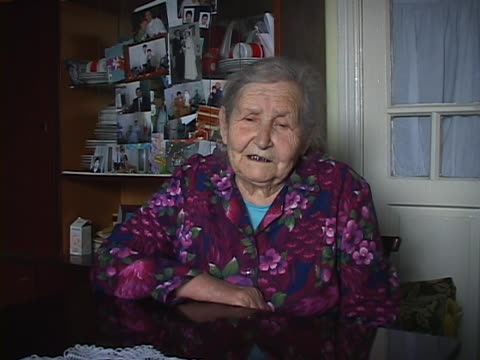
Goldberg talks about her family briefly and then the formal interview begins. She provides personal information and talks about her family. Her father was a kosher butcher, born in Oniţcani, and passed away in 1931. Her mother was born in Vorniceni. Goldberg grew up with two sisters and one brother. Goldberg's family moved to Călărași during her early childhood.
From the machine transcript
After introductions and the date of the visit, Goldberg gives her maiden name and her Yiddish name and the names her parents were called. Her father was a shoykhet who died young, in 1931 at age thirty-seven. His birthplace (a village near Rezina or Onitskany) and her mother's village are given only uncertainly. Her mother was a housewife with four children: Goldberg (born 1926), an older sister Esther, Rikl and a brother Itsik. She grew up in Călărași and remembers her grandparents only slightly.
gives the names of her siblings and grandparents and the uncertain village origins of both parents
Goldberg discusses her childhood and education. She attended a religious school (cheder) at the age of six. According to her, girls and boys learned separately.
From the machine transcript
Goldberg talks about her childhood in Călărași. She attended cheder from about age six and was taught by a male melamed. She says she learned the Yiddish letters and some Humash, and recalls a little of the morning prayer Modeh Ani. She says the war then interrupted her schooling.
adds the morning prayer Modeh Ani and her limited memory of the lessons
Goldberg talks about her family and prewar Jewish life in Călărași. Her mother worked odd jobs to support the family after her father died. Golderg states that she began working at the age of eleven.
From the machine transcript
Goldberg describes her family as religious and honest and says her father was very honest. She says there was one synagogue in Călărași, which stands today but is closed for repair and has no minyan. After her father died when she was about five, her mother, widowed at thirty with four children, worked in the hospital, and Goldberg herself began working at about eleven. She mentions the arrival of Soviet rule in 1940, after Romanian rule.
adds the single synagogue, now closed, and the mother's widowhood
Goldberg speaks about her brother's bar mitzvah. She then talks about her education. She attended cheder from six through ten and then studied at a Romanian school. Her school was transformed into a Russian school in 1940. Goldberg also mentions a Yiddish library.
From the machine transcript
Goldberg briefly recalls her brother's bar mitzvah, with tefillin in the synagogue and guests at home. She attended cheder from six to ten and then a Romanian school, which became a Russian school under the Soviets in 1940. She says she read Yiddish books from a Yiddish library on the lower street and tries to recall writers such as Sholem Aleichem, Mendele and Peretz.
names the Yiddish authors the interviewers ask about
Goldberg speaks about her family, in particular her brother. She then addresses prewar cultural life.
From the machine transcript
Goldberg says her brother was younger than she. During the war the family was in Stalingrad and then in the Urals, where he worked at a mine. She says Yiddish actors visited Călărași before the war, but she does not remember details. Lemster then turns to the Jewish holidays.
adds the brother's evacuation to the Urals and his work at a mine
Goldberg discusses holiday celebration, in particular Sabbath and Passover. She also turns to food customs. After her father died, she explains, her family celebrated Passover at her grandfather's. Her grandfather lived in the same building. Goldberg then speaks about Purim and Sukkoth.
From the machine transcript
Goldberg describes Sabbath preparations and Passover customs: strictly kosher matzah, separate dishes, and foods her mother prepared. After her father's death the seder was held at her grandfather's, who lived downstairs in the same building. Her brother asked the four questions. She says she recalls little of Purim customs, such as masks, and describes building a sukkah.
adds the Sabbath candle-lighting preparations and the matzah and Passover dishes
Goldberg speaks about religious life before the war. She recalls that the community hired a cantor to come to Călărași. She then remembers Simkhat Torah and Hanukkah celebrations, as well as addresses other holidays.
From the machine transcript
Goldberg describes prewar High Holiday observance, when a cantor was brought from Chişinău. For Simchat Torah she recalls processions with the Torah scrolls and a children's rhyme, and the interviewers press her to sing, but she declines. Questions on Hanukkah lights, Hoshana Rabba, Shavuot dairy food and the river for tashlikh follow. Near the end the interviewers discuss with her why remembering matters for historians.
adds Simchat Torah rhymes, Hanukkah, Shavuot and tashlikh, and the discussion of why remembering matters
Goldberg speaks about prewar life and violence in Călărași. She also recalls non-Jews who spoke Yiddish.
From the machine transcript
Goldberg talks about prewar life in Călărași: left-wing and Zionist movements, the police, and a communist who was not jailed. She says Romanians smashed windows and property when they left. She confirms that non-Jews who lived with the Jews spoke Yiddish.
adds the Zionist and communist activity and the damage done by the departing Romanians
Golderg speaks about her life after the war and return home. Her family lived with her uncle for two years, she explains, and then moved to Bravicea, before living in Călărași. She then speaks about her family's fate during World War II. Goldberg mentions that her family transferred her grandparents' remains to Călărași for burial.
From the machine transcript
Goldberg describes the return after evacuation: the house was destroyed, and the family lived with an uncle for two years, then in Bravicea, then Călărași, where they bought a house. One grandfather was killed by Romanians and Germans, and the other died in 1939. A grandmother died on the road and the other was shot with her husband. The remains were exhumed and reburied in Călărași, where a memorial now stands.
adds how her grandparents were killed and the reburial of their remains
Goldberg speaks about prewar Jewish life and her childhood memories. She then talks about her life after the war. She got married in 1949. She explains how she met her husband. During the war, Goldberg had medical trainding with the Red Cross and then worked in a hospital during and after the war.
From the machine transcript
Goldberg says life was hard before the war. She married in 1949 in Bravicea; her husband died twelve years ago. She says she met him while working in the hospital, after taking a Red Cross course during the war, and that no matchmaker was involved.
adds that her husband was a patient she met in the hospital, not through a matchmaker
Goldberg addresses her traditional wedding.
From the machine transcript
Goldberg says her wedding was traditional, with a chuppah and klezmer musicians playing Yiddish and other songs, although the family had very little after the war. Kerler then asks about a family of comb or kimel makers, and Lemster mentions someone named Kilimann (?) from Israel.
Goldberg speaks about her life during the war. Her family evacuated on foot from her hometown to Orhiv. Goldberg continues that they crossed the Dniester river and worked on a state farm (sovkhoz) in Ukraine. According to Goldberg, as soon as the Germans drew closer, they evacuated further to the Stalingrad region, where they stayed for ten months. In Stalingrad, her family worked at a military factory. She continues that as soon as Stalingrad was bombed, her family evacuated further to the east 41:49. Goldberg and her mother worked in a hospital. Her sister died in evacuation.
From the machine transcript
Goldberg tells how the family left Călărași on foot in 1941, crossed the Dniester and worked on a state farm in Ukraine while the Germans pursued them. They reached Stalingrad and worked in a factory. When the bombing began they left on the last ship and were sent east, where she and her mother worked in a hospital. Her sister fell ill and died there.
adds that her brother died young at forty-eight (?) after the war
Goldberg speaks about her family. Her son and daughter were born in Bravicea. She lived there until 1957. She then answers questions about cultural terminology.
From the machine transcript
Goldberg says her son and daughter were born in Bravicea, where the family lived until 1957, when the district was abolished and the Jews left. Questions follow on the Jewish cemetery, terms for it, and whether there was a grave of a righteous man or a prewar rabbi.
adds the questions on the cemetery and terms for it
Goldberg talks about postwar religious life during Soviet times. She recalls religious persecution and secret services. Goldberg maintains that people would meet in Chişinău on holidays. She then speaks about her family and then recalls someone who converted to Christianity.
From the machine transcript
Goldberg says that after the war Soviet authorities did not permit prayer, so people prayed secretly in private houses and travelled to Chişinău for the holidays. At home they spoke Yiddish, though her children only understand it. She describes a grandfather who refused to leave her husband's home village and mentions one Jew who converted.
adds the language spoken at home, the grandfather who stayed behind, and the Jewish convert
Goldberg discusses her family's observance and prewar occupational structure. She then speaks about life today.
From the machine transcript
Goldberg describes Sabbath table customs with kiddush and zemirot, and says prewar Jewish trades were mainly tailors and shoemakers. She says that now many people want to be Jews in order to emigrate to Israel or Germany. Questions follow on a tale of Hershele Ostropolier, the phrase "over there crazy" about a nearby town, and annual cemetery visits.
adds the Sabbath songs and the question about stories
Goldberg talks about food customs, in particular gefilte fish and sweet dishes.
From the machine transcript
Goldberg answers questions on how her mother prepared gefilte fish, which was salted rather than sweet, and on how she makes it herself, with pepper. They then discuss baked goods, such as Purim shalakhmones sent as gifts and what was put in the pastries.
Goldberg addresses folk and healing customs. She then answers questions about cultural terminology.
From the machine transcript
Goldberg answers questions on folk beliefs: the evil eye and non-Jewish women who charmed it away, whom she did not consult. They ask about pouring wax, and about a dybbuk and a golem. Kerler then turns to her work as a nurse.
adds the dybbuk and golem questions
Goldberg speaks about her work after the war. After the war, she took classes in Bălți for four years to become a medical assistant. In this profession, she worked for forty-five years in a hospital. Goldberg then speaks about her family.
From the machine transcript
Goldberg says that after the war she studied for four years in Bălți to become a medical assistant and worked as a nurse for forty-five years in a hospital. She talks about her pension and what she wants her grandchildren to know. Kerler and Lemster talk about her grandson's knowledge of Jewish history, the Rojtman family and Purim plays.
adds the pension, the grandchildren and the family's Rojtman name
Goldberg talks about prewar Jewish life and recalls the custom "shlugn kapores" on Yom Kippur. She then discusses her childhood and religious life after the war.
From the machine transcript
Goldberg describes the Călărași market and recalls the custom of kapores before Yom Kippur. She says her childhood and prewar and postwar life were hard, and that her best time was after her marriage when her children were born. The synagogue was closed by the Soviets, and people travelled to Chişinău to pray. At the end she says that people at first miss a place they have left, and that she has lived in Călărași all her life.
adds the closing of the synagogue and her reflections on her best times and on staying in Călărași