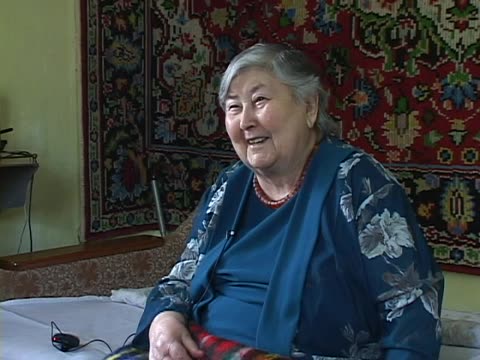
Leibelman, nee Shteynberg, talks about a book Moldavian ghettos, she was interviewed for. She then provides personal information and talks about her family. Her grandfather worked in a quarry. Her mother was born in 3:25, Yampol region, Ukraine. Her mother married her father, who already a son and a daughter. Her father worked as 6:00.
Leibelman talks about a book on ghettos by an author from America who interviewed her in Russian, and Kerler records the date. She gives her official name, patronymic, married and maiden names, and says she is from Libshen in the Rezina district, where her grandfather Hershl held the quarries. Her mother Rachel came from the Yampol region in Ukraine and fled to Bessarabia in the revolution, marrying her father, a widower with two children. Her father was killed by the Germans in 1942 and had leased land; she remembers great poverty.
Adds her half-brother in Lodz (?), half-sister Sanya, and her father's land leasing.
Leibelman talks about her life during the war. According to her, The Soviets liberated Bessarabia in 1940. When World War II broke in the region in 1941, her family fled. In 1942, Leibelman explains, the Germans caught up with them and imprisoned her, together with her sister and parents, in the Obodovka ghetto, undergoing selection for work. She explains how the selection took place at a horse stable. Leibelman was taken to forced labor twelve kilometers away from the camp. Every day, she brought back food for her family in the Bershad ghetto. Leibelman maintains that she was fortunate to receive sewing working assignments, whereas other prisoners worked in the quarry.
Leibelman tells how Bessarabia was taken by the Soviets in June 1940 and how the family fled on foot when the war began in 1941. The Germans caught up with them and her father was shot in 1942, leaving her with her mother and sister. She was taken daily to work, sewing, and brought food home, while others worked at stonework in Bershad. She describes arrival in Obodovka, where they were held in a horse stable full of Jewish people, and a terrible scene she witnessed there.
Adds the shooting of her father and a scene of a dead woman and a living child in the stable.
Leibelman talks about Jewish life in her hometown Libshen, Rezina district, where three Jewish families lived. She then discusses her education. Leibelman attended a Romanian school and then moved to Rezina in 1932, continuing her studies at another Romanian school and lived with her aunt. She remembers the local religious teacher (melamed). Leibelman talks about prewar Jewish life in Rezina, in particular recalls great poverty. She then discusses her aunt’s traditional wedding. Her aunt’s daughter lives in America. She then remembers parts of a wedding song. Leibelman returns to talking about her hometown and antisemitism in the 1930s during Easter.
Leibelman describes her native village, where three Jewish families lived, and her schooling in a Romanian school there, then in Rezina from 1932, where she lived with her mother's sister Manya. She recalls the melamed's teaching, poverty and beggars in Rezina, and an aunt's daughter now in Los Angeles. She recalls a wedding with gefilte fish, the chuppah, klezmer musicians and a bridegroom's jester. She ends with an Easter-time antisemitic threat and hiding in the cellar, and says Yiddish was spoken at home.
Adds the wedding customs, klezmer musicians, and the Easter-time fear of attacks.
Leibelman discusses holiday celebrations at home, in particular Passover. She remembers that her family parodied the Four Questions. Leibelman then describes her house, before she continues discussing holiday celebrations. Her family went to the neighboring village Glinjeni, with a bigger Jewish population, and celebrated in private homes. Every Sabbath, Leibelman walked to Libshen from Rezina.
Leibelman describes the family Passover seder at home: her father reading the Haggadah, the cup of wine, the opening of the door, and burning the chometz. She gives a comic parody of the Four Questions asked by her brother. She describes their one-room thatched house, her father's daily prayer, and going to the neighboring village of Glinjeni for the holidays. She also recalls walking home from Rezina every Sabbath.
Adds the details of the seder, the parody of the Four Questions, and the weekly walk of eighteen kilometers.
Leibelman talks about her family and life after the war. She had to take care of her mother after the war for twenty-three years. Leibelman worked as an assistant to the director at a draft office in Dubăsari. Leibelman and her husband moved to Dubăsari in 1956. She explains how her husband could not continue working at a school in Rezina due to flooding.
Leibelman says she could not have children because her mother lay paralyzed for twenty-three years. After the war she worked as an assistant to the head of a department at a draft office, a good job because she was allowed to go to her mother. She and her husband moved to Dubăsari in 1956 from Rezina after the school where he worked was flooded.
Adds the husband's work in a mechanization school and the flooding that led to the move.
Leibelman discusses her childhood memories. She played with Jewish and non-Jewish friends. Leibelman recalls how her family would not allow her to play with non-Jewish children in the neighboring village. She then talks about food customs for holiday celebrations, before she addresses her mother’s observance and story-telling from the Tkhine (Yiddish-language prayer book) on Sabbath. Her family bought the kosher meat in Rezina. Her mother was a seamstress.
Leibelman recalls childhood play with non-Jewish village children, speaking Moldavian with them and Yiddish at home. She was not allowed to play with the children in the other village, and mostly played with her sister. She describes her mother's Sabbath bean and other dishes and the lack of a shoykhet, so meat came from Rezina. She also describes the Purim noisemaker custom and her mother reading the tkhine with its fables on Sabbath, while sewing during the week.
Leibelman talks about prewar political and cultural life in Rezina. She borrowed Yiddish books from a library in Rezina. She then recites a Romanian and a Yiddish/Russian song (koyft zhe papirosn), she recalls from the ghetto.
Leibelman answers questions about youth organizations in Rezina, such as Zionists and Communists who were arrested, and about the Yiddish library there, where she borrowed books. She recalls reading Romanian books and Turgenev. She recites the words of a Romanian soldiers' song and a Russian ghetto song about buying cigarettes, saying she remembers no Yiddish songs.
Adds the Zionist and Communist groups and her reading in Romanian.
Leibelman recalls Yiddish theater visiting Rezina, including a touring actress and a cantor-singer. She describes Rezina as a small town with many Jews but no gymnasium, and says Christians spoke Yiddish. She tells of a Russian acquaintance who had grown up among Jewish children and married a Jewish woman. She ends with a remark about same-sex marriage seen on television from Moscow.
Adds the Russian friend and the closing aside about television.
Leibelman talks about holiday celebration and her husband Yurkl (Yankl, Yasha), born 1920 in Rezina, who worked as a mechanic. She also recalls stories about Hershele Ostropoler.
Leibelman talks about fasting for her mother, then about her husband Yurkl, from Rezina, born 1920, a mechanic with golden hands who died three years before. They lived together for fifty-six years. She says his father was a cooper who made barrels, and that her husband could pray but did not want to. She finishes with a story about Hershele Ostropoler at a wedding, where he got fed on a borrowed suit, and the interviewers take their leave.
Adds the husband's father being a cooper and the end-of-tape farewell.