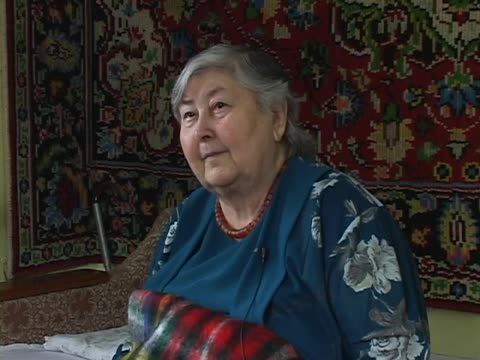
Leibelman talks about her family, in particular her husband. She recalls a story about the Jews of Rascov and another story about a wealthy man. She then remembers the Ribnitzer rebbe Chaim Zanvl Abramowitz, before she discusses meetings organized by the Tarbut school in Rezina. Leibelman also mentions that she read in Yiddish “Afn yerid” before the war.
Leibelman says she spoke Yiddish with her husband, whom she married after the war; he had learned Russian only after the war. She and the interviewers discuss Jews in Soroca (?) and Rascov, then she tells a story about a Jew sending greetings to a wealthy man. They also discuss the Ribnitzer rebbe (Chaim Zanvl) and his immersion in the mikveh, and Jews in Saldinesht (?). Asked about youth activities in Rezina, she mentions the Tarbut meetings, with hidden communist booklets. She says she read Sholem Aleichem and Mendele in Yiddish before the war.
The transcript shows also a Yiddish-speaking visit to Romanian Jews, the husband's Yiddish, and the reading of Sholem Aleichem and Mendele.
Leibelman talks about her life today: she is old and ill and cares for three people with little help. She mentions a brother in Israel with four sons and a local official unfriendly to Jews. Lemster then asks about Jewish observance during the war.
The transcript shows also her brother in Israel and the local official hostile to Jews.
Leibelman talks about her life during the war in the Bershad ghetto. She then discusses her life during the immediate postwar period. After the liberation of the Bershad ghetto, Leibelman walked to Rîbnita. Leibelman explains that at first the Soviet army would not let her family go to Dubăsari. On the way home, to Libshen, they stopped in Rezina and another village, where they received food. Leibelman then answers questions about cultural terminology and folktales.
Leibelman describes the Bershad camp, where people lay like sheep and the dead were carted away, and the Bershad memorial. After liberation she walked to Rîbnița in April, barefoot. The army would not let them cross toward Rezina, and in a village they were given food and found a house empty for years. She then answers Lemster's and Kerler's questions about dybbuk, golem and a legend of the dreamers' boards, about speaking like a Litvak, and about dialect differences.
The transcript shows also the Bershad memorial and folk terms (dybbuk, golem, Litvak).
Leibelman recites again the parody of the Four Questions for Passover, before she talks about her life after the war in Dubăsari, post-1956, and contemporary Jewish life.
Leibelman recites a humorous parody of the Four Questions ('why' questions about a goat, a pot and a candle). Asked about life after the war, she says it was Soviet and that she learned to write without Yiddish school. She says that she moved to Dubăsari in 1956 and that few Jews remain, many with a non-Jewish parent, with no synagogue.
The transcript shows also her remarks that no synagogue exists and few Jews are left.
Kerler and Lemster put the AHEYM dialect questionnaire to Leibelman: Russian words and short phrases to translate into Yiddish, among them 'please', 'thank you', 'luck', house and houses, colors, adverbs, numbers, kinship and household words, and the words for honest and pious. Between items she tells a long joke in Yiddish and Russian about a doctor and a policeman, the saying that seven is a lie, and a few anecdotes.
The transcript shows a long Yiddish-Russian joke and sayings during the questionnaire.