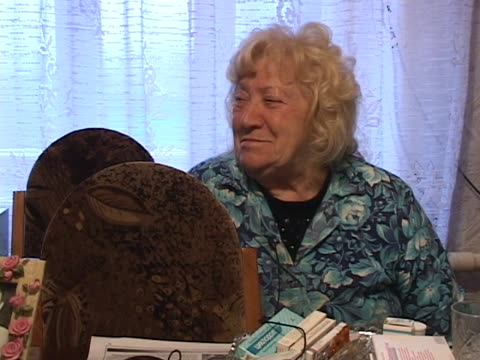
Raisa talks about life today and her husband’s accordion playing at non-Jewish weddings. They then discuss Yiddish songs and talk about religious life today. She mentions her son’s wedding with a canopy in Lipcani. The rabbi came from Bricani.
Shvartzman talks about her late husband, who played the accordion and sang at non-Jewish weddings. She sings a short Yiddish song and recalls courting in her youth. She mentions visiting the rebbe in Chișinău and her mother's piety (fasting, sending Purim gifts). She tells of her son's wedding, held with a canopy at home with a rabbi brought from Briceni.
Includes a sung song and her husband's wartime-hunger gifts of food, plus visits to Chernivtsi and Chișinău.
Shvartzman answers Lemster's questions about the rebbe of Ștefănești and says she has travelled to Sadagura (Sadhora) and wants to visit Vyzhnytsya. She explains her upbringing in a poor but observant home and her habit of giving food to anyone who comes in. Asked about folk remedies, she describes treatments for the evil eye and for fright, including quenching coals. She also tells a story about a husband who was unfaithful.
Adds her upbringing in poverty, her charity to non-Jews, and a story about a husband's behaviour.
Raisa recalls Yiddish proverbs and talks about Yiddish culture. They recall performances by Sidi Tal. Seymour Rechtzeit (Rexite), Dina Slotaye* after the war. Raisa then talks about history writing about Lipcani by Fekhtman.
Lemster asks Shvartzman for old Yiddish proverbs, and she cannot recall them. She remembers her mother singing to the children. Later the group discusses Yiddish concerts in Briceni, a singer who performed Yiddish songs, and a second person's memories of Jewish actors and singers. Shvartzman then recites a popular Yiddish song about the little town. She mentions the author Fekhtman and his book about Lipcani and tells how she lost her house.
Lemster and Kerler ask about her youth. The talk turns to her husband's army service, when he sent her parcels and money. She also talks about hunger and about a golden wedding. She recalls her son's wedding in a restaurant. Interviewers ask about Hasidim; she says she heard nothing about them. Katz explains that he teaches Yiddish in Vilnius, and a Russian phone call interrupts.
The catalogue speaks of Iosif's own army service. The transcript points to the husband's army service, with parcels and money sent.
Shvartzman answers questions about cultural terms: dybbuk, golem, and a Jew who converted. She says she goes to the cemetery to ask for blessings and to light candles. She also mentions her mother's written blessings in Russian script.
A long run of dialectological questions follows. Kerler and Lemster ask Shvartzman for words and sentences, including terms for body parts, animals (cat, mouse), colours, the house and its parts, and verbs like to flee, to pray and to cry. They also ask for words for sick and healthy, honest and devout, peasant, river, sea, grandmother, midwife and vodka. A sentence to translate is also posed. Her answers are frequently mixed with Russian and with talk about her stay in Israel, and phone calls interrupt in Russian.
The catalogue mentions snippets of a prayer; this is unclear in the transcript at the start of the passage.