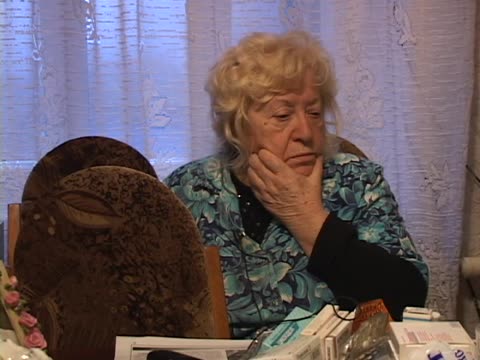
The first part of the tape is a continuation of a formal interview with Raisa Aizekovna Shvartzman and her husband Iosif Matveyevich Shvartzman. The Shartzmans answer a series of dialectological questions from the AHEYM Yiddish linguistic questionnaire.
The Shvartzmans answer dialectological questions from the questionnaire. Items include words for 'flowers', 'roses', 'face', 'attic', 'rafter', 'wealthy man', 'wagons', the form of 'whose', 'maybe', 'back', 'enemy' and a few sentences to translate. Kerler and Lemster ask whether the speakers have heard variant forms such as the words for flowers, and there is also talk of the prayer leader at the amud and of buying a seat in the synagogue.
The speakers also discuss synagogue seats and prayer leaders, and the Russian prompts are interleaved.
The second part of the tape is a formal interview with Elena (Leyke) Haimovna Akkerman, recorded in Edinet. Akkerman, nee Fuks, provides personal information and talks about her family. She was born 1918 in Edinet in the same house the interview takes place. Akkerman was the only child. Her father owned a shop and traded in different wares. She explains that one of his brothers was a wealthy man. She then talks about her life during the war. She evacuated with her husband, who worked as an accountant for a Ukrainian kolkhoz. The president of this kolkhoz helped the couple to evacuate. They evacuated to the Caucasus via Soroca. Akkerman and her husband stayed in Andijan, Caucasus, for half a year until the German front moved closer. The president of the kolkhoz sent a car, so the Akkermans could evacuate further. The car took them to the nearest train station, where the couple took a train to Tashkent, Uzbekistan. The Akkermans worked in a factory for military goods.
Kerler opens the interview, giving the date and place; Akkerman, née Fuks, says she was born in 1918 in the house where they sit, in Edineț. She names her father as Haim Fuks, the youngest of three brothers, who kept a shop and dealt in grain. She tells how she was evacuated with her husband, a bookkeeper at a kolkhoz, with the help of the kolkhoz chairman, via Soroca and Andijan to Tashkent, where she worked in a factory.
The transcript also gives her husband's family name, Akkerman, and a Caucasus stay of half a year before further evacuation.
Akkerman talks about her return to Edinet after eight years of evacuation in Uzbekistan. When Akkerman returned, she found a Christian family living in her house. Akkerman’s neighbors told the family that she lived there before the war and was then allowed to move in. The family vacated the house the next day. She then talks about her family. Her two sons learned the Yiddish language. Her step-maternal grandfather was a rabbi. Her birthmother died when Akkerman was very young.
Akkerman describes returning to Edineț after the war and finding a Christian woman with a child living in her house; the neighbours confirmed it was hers. She talks about how the family rebuilt, her two sons who learned Yiddish, and her stepmother Makhle, whom she regarded as her mother. Her birth mother died when Akkerman was about a year old; the mother is said to have been a pious reader of the Pentateuch in the women's section.
The transcript suggests that the step-relation concerns her stepmother, with a rabbi father in Ukraine, and that her father's brothers are named (rich uncle, miller).
Akkerman discusses her education. She attended a Romanian school in 30:40. She learned Russian together with her children until sixth grade. Akkerman then talks about her childhood memories. In particular, she recalls her step-mother and Jewish life in Edinet. Akkerman attended a religious school (cheder).
Akkerman recalls attending a Romanian school and later learning Russian with her children up to the sixth class. She talks about her stepmother and about hunger, then about Jewish life in Edineț, with several synagogues and study houses. She went to cheder and can still read some Yiddish.
The transcript adds the number of synagogues and study houses along her street.
Akkerman talks about life today and her sons. She then discusses her childhood memories and talks about her own traditional wedding before the war. Her sons also had a traditional wedding after the war.
Akkerman talks about her sons' studies and work and about her husband, a conscientious bookkeeper. Lemster asks about childhood games and Jewish weddings in Edineț; she says her own wedding was with a chuppah, as were her sons'. She answers briefly about wedding customs, musicians and the grandparents she never knew, and Kerler asks when she married. Lemster then asks about food in a Jewish home, including Sabbath baking.
The transcript also covers the wedding customs and the Sabbath food.
Akkerman describes Sabbath at home: her mother's baking, cholent put into the oven, and her mother's generosity. She recalls Passover matzo and kugel, but not Hanukkah customs. She remembers the Purim baked goods (hamantaschen) and says there was a Purim play, though she cannot recall who performed it, and answers Lemster's question about theatre visiting Edineț without remembering details.
The passage also covers Passover, Hanukkah and a visiting theatre.
Akkerman mentions her education at a Romanian school, as well as Yiddish literature. She then talks about life after the war. Akkerman was a homemaker and kept two pigs for ten years.
Akkerman answers questions about the languages of instruction in the Romanian school, where nothing was taught in Yiddish, and about reading Yiddish books. She talks about life after the war: she did not work but helped lodgers, while her husband was a bookkeeper. She kept two pigs for around ten years and describes how she fattened and sold them.
Akkerman talks about the rebbe of Stefanesti and recalls an episode with her father’s brother, who visited the rebbe. She then answers questions about cultural terminology and discusses Jewish cultural life before the war. Akkerman then talks about life after the war.
Akkerman recounts that her father's brother, who had been wealthy in Brazil, visited the Ștefănești rebbe and died a few weeks after the visit. Kerler asks about the evil eye, a dybbuk and a golem, and she knows only the golem. She answers questions about prewar clubs and the Jewish library, and talks about the postwar years, her hard work and her sons' education.
The transcript shows the Brazil uncle, a golem question, and the library.
Akkerman talks about her family. Her son’s children live in Israel. She then talks life before the war, including non-Jews who spoke Yiddish and a prewar Yiddish newspaper, published in Edinet. She also addresses religious life and food customs.
Akkerman mentions that her son's children live in Israel. Kerler asks about non-Jews who spoke Yiddish, Jews who converted, and a prewar Yiddish newspaper; she recalls a newspaper issued in Edineț. She also answers about the cinema, Hasidim, her stepmother's husband being a rabbi, and how her mother made gefilte fish, with sugar.
The passage also treats a Yiddish newspaper, the cinema and gefilte fish.