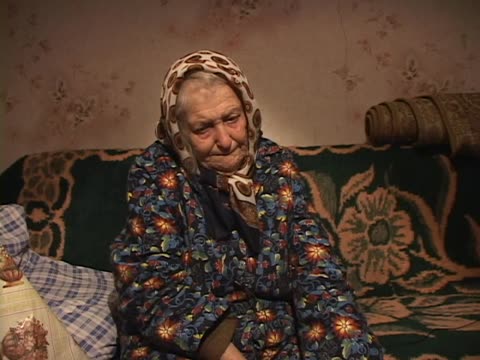
Akkerman talks about her life during and before the war. She and her husband left for evacuation and her parents stayed in Edinet, where they did not survive the war. She then talks about life after the war and today, including her family.
Akkerman speaks about the war years: she and her husband were evacuated while her mother stayed behind, and her husband worked as an accountant. After the war she lived with a relative whose son took a Jewish wife. Asked about Jewish life after the war, she says those who wished kept Jewish observance, and that the synagogues were closed. She mentions her daughters and their work today.
Adds the closing of synagogues after the war and the new synagogue today (?).
Akkerman answers a series of dialectological questions from the AHEYM Yiddish linguistic questionnaire. She also addresses her husband’s work as an accountant in a factory for military goods in Uzbekistan (17:27). Before her husband was promoted, he worked in the lithic department together with Akkerman.
Akkerman answers Kerler's questions from the dialectological questionnaire, translating Russian words and phrases into Yiddish, with Lemster joining in. Items include greetings, thanks, body and animal words, colours, adverbs of place and time, sickness, honesty and piety, church words, and kinship words. She often answers in Russian and says she does not remember or does not know some words. She says that in Edineț one said 'krank' for sick. At about 17:27 she tells how her husband, mobilized in Uzbekistan, became an accountant in a military factory after he impressed the chief accountant with his handwriting. She had worked in the casting shop of the factory. She also remarks on being asked such questions of Jews.
Adds that the questions cover many everyday semantic fields, and that she notes Edineț usage and goes between Yiddish and Russian.
After the team concludes the formal interview with Akkerman, they briefly talk to her son Leyb Akkerman. He talks about prewar Jewish life in Edinet, which constituted the majority of the town’s population.
After the formal questions end, Katz asks whether Akkerman sang Yiddish songs; she says she knows songs but cannot sing. Kerler and the others then talk with a second speaker, apparently her son, about the Jewish population of Edineț before and after the war, the loss of Jews in the war, and a possible painter. The exchange ends with contact details and email for keeping in touch. Much of the passage is garbled.
Adds Katz's question about songs and the exchange about email.