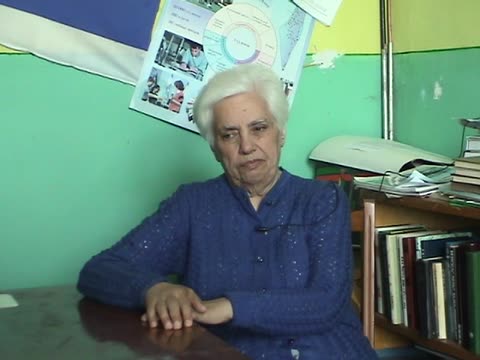
Mundrian provides personal information and talks about her family. Her father was born in 01:25 Novoseltsy*. Her father owned a shop and delivered goods before the war. Mundrian grew up an only child, although her mother gave birth to two sons.
Mundrian gives her Yiddish name and birth year (1937) and says she was born and lived in Susleny until the war. She talks about her father Yisroel, whose place of origin the transcript renders as Orhei (the catalogue gives Novoseltsy). The family worked five hectares of land with a horse and cart, and her mother, Khane Abramovitsh, was a housewife. She recalls her grandfather Moshe, a Cohen, and her grandmother Freyde, after whom she is named. She was an only child, as two brothers born before her died.
Gives the grandparents' names (Cohen grandfather Moshe, grandmother Freyde) and the family's work on the land.
Mundrian talks about her family and prewar Jewish life in Susleny, which was a wealthy Jewish town according to her. Her mother worked in the hospital after the war.
Mundrian gives her name and birth year and talks about her parents and grandparents in Susleny: her father's origin, farming, her mother Khane and her grandfather Moshe. The transcript in this stretch does not contain the catalogue's remarks about Susleny as a wealthy Jewish town or her mother's hospital work; the Susleny question comes later (s0004).
The transcript in this span shows no wealthy-town or hospital remarks; it covers the parents and grandparents.
Mundrian talks about her life after the war. She studied to become a wet nurse between 1953 and 1956 in Orhei and then worked as a nurse in a hospital. Mundrian then talks about prewar Jewish life and her family in Susleny.
Mundrian says she trained for three years from 1953 at Orhei and from 1956 worked in the hospital there. Asked about Jewish life in Susleny, she says she remembers little and tells of her mother's family: her grandfather was a Cohen and her mother the youngest of three children, who traded in Orhei. Her father was drafted in 1941 and killed, and the family returned from evacuation in 1945.
Mundrian discusses her family’s life after the war, returning from evacuation in 1945. Her father died on the front during the war. Her family lived in Susleny until 1956. Mundrian’s cousins live in Israel. She got married in 1957. She also addresses her husband’s family.
Mundrian describes the family after the war: her mother's brother lived in Chișinău, her mother's sister became a doctor in Odessa and Moscow and traced the family in 1953, and cousins now live in Haifa. The family stayed in Susleny until 1956, and she married in 1957. She speaks of her husband's family, whose father was a cantor and whose family had a mill. She estimates the Jewish population of prewar Susleny at over 1,500 in a rich village, with a synagogue, kosher practice and a shoykhet. After the war everything was destroyed, and she tells how her mother studied in a Russian school and sang Yiddish songs.
Adds the Chișinău and Israel relatives, the husband's family and the Jewish population of Susleny.
Mundrian discusses holiday celebrations, including food customs. She also talks about how people secretly baked matzos and the difficulties to acquire meat, as well as shares a recipe of gefilte fish.
Mundrian talks about holidays and food in her mother's time and after the war: Yom Kippur fasting, Sabbath candles and kiddush, and her mother's Hebrew. She also tells of baking matzo secretly and the difficulty of getting kosher meat. She describes dishes such as meat in vinegar sauce, and gives a detailed recipe for gefilte fish, a favourite of her uncle and her son. She mentions her 1957 wedding under a huppah, with the contract in Yiddish.
Includes the Yiddish marriage contract and huppah of 1957.
Mundrian talks about using the Yiddish language among her family. She then talks about living in a communal apartment in the 1960s together with Jews and non-Jews. Mundrian then discusses Purim celebration after the war, her son’s bar mitzvah, and a positive relationship between Jewish and non-Jewish students after the war.
Mundrian speaks about Yiddish in the family: with her mother and aunt it was the language used, and her son understands it. In a communal apartment from 1962 she lived with four Jewish and four Russian neighbours. She recalls Purim customs, Purim gifts and her mother's charity, and her son's bar mitzvah. Lemster mentions an interview made the previous day in Chișinău. She discusses non-Jews who spoke Yiddish, good relations with fellow pupils and a convert family in Susleny who left.
Adds the bar mitzvah, the converted family and the question of non-Jews speaking Yiddish.
Mundrian talks about prewar Jewish occupations in Susleny, naming shoemakers, tailors and craftsmen. She says it was a large, rich village before the war, and tells how her mother rose early to work for non-Jews. She also speaks of her aunt's life in Zhukovsky and the postwar synagogue, which was still open with few members. She tells of attending funerals and says she herself will find no one to accompany her.
Adds her mother's work for non-Jews, her aunt in Zhukovsky and the remaining synagogue.
Mundrian talks about her life during the war in evacuation. She evacuated with her mother to the Caucasus, where her mother worked on a kolkhoz. Mundrian then describes the difficult journey home from evacuation.
Mundrian says that during the war she was in the Caucasus with her mother, who worked on a kolkhoz, while her father was taken to the front. She describes the journey home. At a station her mother was pushed off the train by two Polish Jews and ran after it for days, until a Russian general in a car heard her crying and helped her catch up. Lemster asks about Polish and Lithuanian Jews.
The transcript adds that a Russian general helped the mother rejoin the train and that Lemster asks about Polish and Lithuanian Jews.
Mundrian talks about prewar political organizations, particularly chalutzim, as well as life before the war and her family. She then addresses traditional weddings, Mundrian heard about from her mother.
Mundrian answers Lemster's questions about her mother's stories of Zionist pioneers (chalutzim) and her grandmother's friends who left. She mentions relatives who went to Argentina, and a relative now in Israel. She tells of her own wedding and a Jewish marriage contract and chuppah done discreetly in the Soviet period. She says her mother loved Sholem Aleichem and that Jewish books were lost in the evacuation. Lemster asks about Jewish weddings in Susleny, where the songs were mostly Russian.
The transcript adds relatives abroad, Sholem Aleichem and books lost in the evacuation, and Jewish versus Russian songs at weddings.
Mundrian answers questions about cultural terminology and talks about prewar religious life. Mundrian then talks about food customs at home, before addressing traditional healing methods. Mundrian shares episodes when her mother took relatives to a local healer. Mundrian continues to answer questions about cultural terminology.
Mundrian answers questions about idioms and terms, and talks about religious life: her uncle going to synagogue in Kishinev, going to rebbes for blessings, cheder, slaughter of fowl before the holidays, and Passover dishes such as latkes, kugel, and potato and matzo meal dishes. She describes how a child's eye trouble was treated with spells and a village healer, and a doctor visit with a relative. Lemster also asks about sayings (a good place, praying on behalf of others, a bright paradise, not to be spoken of, rules about night-time knocking).
The transcript adds Passover dishes and a healer, with a doctor visit for a child's eye problem, and shows long stretches of Lemster's idiom questions.
Mundrian talks about her grandmother's life after the war. The grandmother was reluctant to speak of her hardships, but in her last years was respected and lived with Mundrian's family. Lemster asks about the grandparents' wedding, which took place in Susleny with a chuppah. The passage ends with Mundrian giving a term for carrying the bride's dress, which Lemster asked about.
The transcript adds the grandparents' wedding in Susleny and a terminology question.