0:00
Kigel provides personal information.
From the machine transcript
Kigel gives her name and her patronymic. Kerler confirms the surname and the father's name, Aizik.
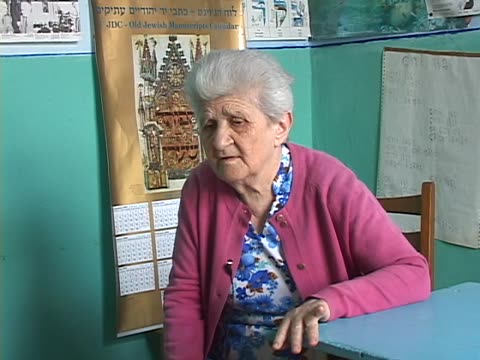
Kigel provides personal information.
Kigel gives her name and her patronymic. Kerler confirms the surname and the father's name, Aizik.
Address
Kigel gives her home address in Orhei and her telephone number. The number is repeated several times, partly in Russian.
Kigel provides personal information and talks about her family. Her father owned a dairy shop; he was born in Chişinău. Her mother was born in Orhei. Kigel grew up with two sisters and one brother.
Kerler states the date and the purpose of the interview. Kigel gives her birth year, 1927, and says she was born in Orhei. She says her father Aizik was born in Chişinău (Kishinev) (?) and worked with a dairy shop (?), and that her mother was a housewife. Her grandmother was Nekhome. Her parents died during the war, and she names her siblings Shaindl, Lazer and Raya. She now lives with Shaindl, the oldest.
Names her siblings and a grandmother, which the catalogue does not mention.
Kigel talks about her life during World War II, in particular the beginning when she fled to Kotovs and stayed on a kolkhoz. She further evacuated to Azerbaijan and worked on a kolkhoz there.
Kigel describes leaving Orhei on foot at the start of the war, after the town was already damaged. She went through the hills as far as Kotovsk, where they were placed on a kolkhoz. She says her sister dug trenches. The family later traveled on to a kolkhoz in a place whose name is unclear in the transcript (Azerbaijan, per the catalogue), where they worked.
Gives the route on foot from Orhei and the trench digging.
Kigel talks about her life before the war and addresses childhood memories and school education. Kigel attended a Romanian school. Her parents hired a private tutor, but Kigel states that she and her sister never attended a class with him.
Kigel talks about childhood before the war. She attended a Romanian school, and her brother learned Hebrew and was in Maccabi. She says a Jewish tutor from Lithuania was hired by her parents to teach them Yiddish, but she and her sister ran away and avoided lessons. She marks the arrival of the Russians in 1940.
Kigel discusses holiday celebration, in particular Sabbath. She also talks about prewar religoius life and synagogues. She then talks about Purim celebrations and sings a Purim shpiel.
Kigel recalls her father's religious faith and the singing of Sabbath songs by her parents. She names several synagogues in Orhei. She describes Purim baking and Passover matzo buying, and recalls a Purim greeting and a Purim song that she repeats slowly for Kerler to write down.
Includes the list of synagogues and the Purim song.
Kigel sings Yiddish songs she remembers from her childhood. The first song is about a fish in the water and the second one deals with growing old.
Kigel sings two songs from her parents' repertoire: one about a little fish in the sea, repeated slowly at Kerler's request, and one about growing old that her mother sang by the cradle. Kerler asks when they were sung and then asks about stories.
Kigel talks about prewar Jewish life and occupations in Orhei. She recalls non-Jews who spoke Yiddish. Kigel then talks about Passover celebrations and remembers parts of the Four Questions, before discussing Sabbath celebrations and food customs.
Kigel names a few Jewish craftsmen in Orhei and discusses non-Jews who knew Yiddish or Hebrew. She recalls two of the Four Questions and the Modeh Ani prayer. She also recalls her mother blessing the Sabbath candles and the Sabbath food of gefilte fish and a sweet stew with prunes.
Includes the Four Questions and Modeh Ani.
Kigel addresses childhood memories and holiday celebration, in particular Rosh Hashana, Yom Kippur and Sukkoth. She recalls how the local synagogues hired cantors for the High Holidays. Kigel then addresses Passover celebrations, including food customs.
Kigel answers questions about the High Holidays, with synagogues bringing cantors, shofar blowing on Yom Kippur and visits to a rebbe. She also covers Hanukkah, Sukkot, Passover and Shavuot customs, including the foods eaten on each. She mentions Passover fritters and dairy dishes for Shavuot. Kerler asks about people who converted.
Kigel talks about prewar life. Specificially, she recalls a Jewish couple that converted to Christianity. She then talks about her education, before continuing to provide information about prewar Yiddish cultural life. Kigel recalls attending concerts by Sidi Tal.
Kigel recalls a Jewish couple who converted to Christianity. She says she did not learn to read or write Yiddish, because she avoided her tutor's lessons. She mentions a Jewish bank and Zionists and communists in town, and recalls going to the theater and the cinema, where the films were in Romanian rather than Yiddish.
The catalogue mentions Sidi Tal, which the transcript does not clearly show; the cinema and theater go unnamed.
Kigel talks about prewar Hasidic life. She tells stories about the Ribnitzer Rebbe, Chaim Zanvl Abramowitz. She then answers questions about cultural terminology.
Kigel talks about a Hasidic rebbe from Ribnitsa (Rîbnița) who was visited by Jews and non-Jews, who bathed in winter and later traveled abroad. She says she knows of him from after the war, not before. She then answers questions on terminology: the difference between rov and rebbe, plurals, and the evil eye and its remedies.
The catalogue names the rebbe and his full name, but the transcript only gives the town.
Kigel briefly addresses traditional weddings and then food customs, including baked goods.
Kigel briefly mentions a Jewish wedding, which had a chuppah but no music. Kerler asks about food terms and baked goods: sweet stew, plum compote, fruit, honey cake, strudel and pastries filled with raisins and almonds. Kigel starts a lullaby about raisins and almonds.
Kigel sings a Yiddish lullaby and talks about consuming alcohol before the war. She then answers questions about cultural terminology.
Kigel sings part of a lullaby, noting that she does not remember all of it. She talks about drinking vodka on Sabbath mornings before the war without getting drunk. Kerler asks about toasting songs and about meanings of words such as a stubborn person or a fool.
Kigel talks about life after the war, after she returned to Orhei in 1944. She and sisters returned from evacuation without their parents. In the immediate postwar period, Kigel worked in construction, carrying bricks, to build the bread factory. Following the construction work, Kigel worked as cashier and then forwarding agent.
Kigel says she returned to Orhei in 1944 with her sisters and without her parents. They found no one, and the house was destroyed. She carried bricks on construction for the bread factory, and later worked as a cashier and as a forwarding agent. She says it was hard to be left without parents.
Kigel sings a Purim shpiel, she remembers from her childhood, as well as sings again the lullaby. She then talks about contemporary religious life.
Kigel sings the Purim song again and then the song about growing old, both for Kerler to record. Kerler asks about holy books in her parents' house. She does not recall any.
The final contemporary religious life topic is not clearly visible in the transcript.
Kigel talks about prewar life and her family. Her brother lives in Israel and her sister in Rezina. She then sings again the Yiddish song about growing old. Kigel recalls how her neighbors would listen to her parents singing.
Kigel talks about her family today: her sister Shaindl, who has trouble walking, and her brother in Israel, who has had operations. Her second sister lives in Rezina and speaks little Yiddish, and her nephew is Jewish while his mother is Christian. She sings the old-age song again and says her parents sang beautifully, with the neighbors listening.