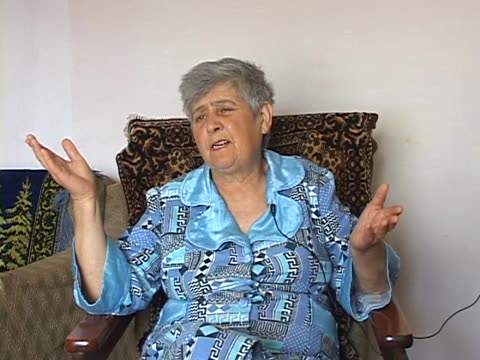
Before the formal interview, Grinshpun tells anecdotes from her work as a teacher and from her life in Moldova. They involve Moldovan and Romanian speech, how people took her for a Jew, and an examiner who sent her to the synagogue; the talk partly switches to Russian. Kerler closes the passage by stating the date and place and introducing her.
The anecdotes are told largely in Russian and Yiddish mixed; the passage ends with Kerler's formal introduction of the interview.
The formal part of the interview begins. Grinshpun provides personal information and talks about her family. Her father, an accountant, was born in Lublin and her mother was born in Kobylna. She then talks about her childood in Kobylna and life during the war in evacuation. Her family evacuated to Don (4:30) and Kazakhstan when Grinshpun was four years old.
The formal interview begins. Grinshpun gives her patronymic and her parents' names and says her father was an accountant born in Lublin, while her mother was from Kobylna. She says she was born in Kobylna, where her grandfather had a mill, and that the family moved to a district town. She mentions evacuation to the Don region and Kazakhstan.
Adds the grandfather's mill; the transcript gives no clear age of four at evacuation.
Grinshpun talks about her family and provides personal information. She then talks about life today. Grinshpun worked as a high school teacher for Romanian and French languages for 42 years.
Grinshpun says her parents spoke Yiddish at home and that her son, who is married and lives in Russia, does not know it. She tells of a trip to Romania in the 1930s (?) and an awkward visit to a monastery, where she kept silent about being Jewish. She worked for 42 years as a teacher of Romanian and some French, and says her father was an optimist.
Adds the Romania trip and monastery episode and the language of the home.
Grinshpun talks about life today and her family during the war period. Grinshpun and her parents evacuated to Kazakhstan. Her father worked as an accountant before the war.
Grinshpun speaks about life today, living alone and liking young people, and about the possible need to sell her house. She names her grandfathers, one of whom had a mill, and says two of her father's sisters and his parents were killed in Lublin. Her father worked as an accountant; she describes how he trained in Chișinău and worked there.
Adds the grandfathers' names, the relatives killed in Lublin and her father's training as an accountant.
Grinshpun talks about life after the war. Her father worked in village for four years, before moving to 14:42, where he also worked as an accountant. She then talks about her family.
Grinshpun says that after the war her father worked as a village accountant for four years in Kobylna, then in a district town, and later near Chișinău. He learned Russian during the war and also knew Hebrew. She then discusses her grandmothers, including a stepgrandmother, and briefly switches to English with Kerler.
Adds the languages her father knew, the grandmothers, and the stepgrandmother.
Grinshpun talks about the evacuation, when the family fell ill, and about her grandmother, who died and whom she loved. She recalls her grandmother's courage when a stranger came at night. She mentions her brother in Israel.
Adds the grandmother's death and the night-time incident.
Grinshpun talks about prewar Jewish life in the village Kobylna. After Grinshpun attended for years of school, her family moved to Kotozhan 22:16. Grinshphan then turns to discussing childhood memories and her family abroad.
Asked about Kobylna, Grinshpun relates what her parents said about its many Jews, a village split in two, a single synagogue and a shoykhet. She says the family later moved to Kotozhan and Strășeni, where her father built a house. She recalls her grandmother milking a cow, and says relatives live in New York and Israel and that her late husband was a certain type of man.
Adds the village's two parts, the shoykhet, her grandmother's cow and her relatives in New York and Israel.
Grinshpun talks about her husband and life after the war. He raised animals, in particular rabbits. Grinshpun also addresses her son's life. She then discusses emigration.
Grinshpun speaks about her husband, who kept animals, especially rabbits, and sold them, and about their son who moved to Moscow. The son now works as an engineer in Korolev and sings in a restaurant. She says her husband spoke Yiddish but did not sing in it, and that she speaks it with difficulty. The talk turns to emigration and her relatives abroad.
Adds her husband's rabbit-keeping, her son's career and singing, and her language attitudes.
Grinshpun remembers her father praying and singing and making the seder. She recalls her mother's tkhines, and the shroud he left for burial. She says she has lived in Peresecina since 1962, where her son was born. She tells of a relative returning from Argentina and her mother-in-law's family.
Adds her father's seder, the tkhines and shroud, the Argentine visitor and the visit's border story.
Grinshpun talks about life in evacuation, when she was five years old. She describes how they survived with little food and lived among Kazakhs. Her father joined her family in Nilovka, Kazakhstan coming from Stalingrad. Grinshpun also talks about food customs in Kazakhstan, before she explains how her family reached Kazakhstan via Stalingrad region.
Grinshpun describes evacuation at age five in a Don Cossack settlement and Kazakh area. The family suffered hunger, ate flour found in sacks, lived among Cossacks and described their food. Her father arrived from Stalingrad to Nilovka (?) and took them out as the Germans approached. Her grandfather died on the way.
Adds the Cossack neighbors, the food terms, the escape from the German advance and the grandfather's death.
Grinshpun talks about life after evacuation, after her family returned to Kobylna. Their former home was transformed into a health center and Grinshpun's family lived in a one room for a few months; before the property was returned to them.
After the evacuation the family returned to Kobylna and found their house, whose contents had gone to neighbours. She says a family with a Jewish-sounding surname (?) was involved.
Adds the neighbours who took the household goods; the health-centre detail in the catalogue is not clear in the transcript.
Grinshpun speaks about life today in Peresecina and her relations with local people, including former pupils. She prefers to live alone and not in the same house as others. She mentions her 42 years teaching.
Grinshpun speaks about life today and her mother's tkhines. Kerler says he is leaving on the eleventh and lives in Bloomington, and she asks about Jews in America. She says she travelled little, only to Romania, and cannot afford Israel; relatives abroad help her and write letters.
Adds the tkhines, Kerler's Bloomington and travel plans, and her relatives abroad.