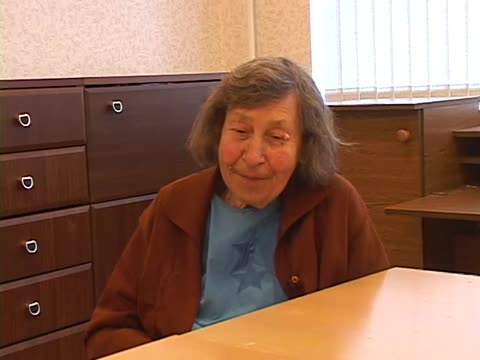
Kotliar provides personal information and talks about her family. Her mother was born in Raşcov. Her father, who owned a shop, was born in Vadul-Raşcov. Kotliar grew up with a brother and a sister, who survived the war. Kotliar worked at a library after the war.
From the machine transcript
Kotliar gives her birth year, 1927, and her Yiddish name, and says she lived in Rîbniţa before the war. She names her father Leyzer and her mother Gitl and gives their birth years and places, with her mother born in Raşcov(?). Her father worked in a trade connected with clothing(?), her mother was a housewife, and five children were born, two died. She names her surviving brother and sister, her grandparents, and says she worked at a library after the war.
names the grandparents and gives the parents' birth years
Kotliar discusses her childhood memories and education. She attended a Yiddish school for four years and then finished her school education at a Russian school. Kotliar then speaks about her Yiddish school education.
From the machine transcript
Kotliar recalls going at age seven to a Yiddish school for four classes. It was then closed and she moved to a Russian school, where it was hard at first because she had no Russian. She recalls a teacher who read to the class against religion, the school subjects, and that everything in the Yiddish school was taught in Yiddish. She says she remembers little from before the war.
Kotliar talks about holiday celebration, including Passover, at home before the war. She also mentions her parents' observance. Kotliar then speaks about food customs and her life before the war. Her family owned animals.
From the machine transcript
Kotliar talks about holidays at home before the war, including Passover. Her father prayed in a tallis and was quite religious, and he taught the children how to behave at the table. She describes the family's food, including noodle soup, chickens and two cows but no pigs, and says they ate well but lacked money for furniture or new things.
adds her father's evasion of fascists and the family's economic situation
Kotliar discusses her childhood memories of Raşcov and her family. She also addresses childhood activities and a private tutor from Raşcov.
From the machine transcript
Kotliar describes her childhood: games taught by her father, Yiddish at home and Moldovan between the parents when they did not want the children to understand. She talks about her father's love of dancing and her parents' origin in Raşcov(?), and about a relative in a large family there who was a butcher(?). Lemster returns to school games, and she mentions singing, her nickname, and her father's work with horses.
adds her father's dancing and singing and the use of Moldovan at home
Kotliar speaks about prewar holiday celebration, including Passover and Sabbath, at home.
From the machine transcript
Kotliar talks about the Sabbath and holidays at home before the war, including Passover. Her father prayed at the window, matzo was baked, and the parents ate only what was permitted. She says God was remembered at home, but that her sister was much younger and remembers little of the prewar years.
Kotliar describes prewar Jewish life in Rîbniţa. During the first few years of her childhood, Kotliar lived in the village Vărăncău, before her parents moved to Rîbniţa.Kotliar also recalls how her family moved to Rîbniţa.
From the machine transcript
Kotliar describes the street in Rîbniţa where poor Jews lived, among them shoemakers and tailors. She says the family first lived in the village Vărăncău for a few years(?) before buying a house, with neighbors, a Moldovan woman living nearby, and a large Jewish population. She is asked about numbers of Jews, which she cannot state.
adds neighbors and the village the family first lived in
Kotliar speaks about prewar religious life and then the her mother-in-law's encounter with the Rîbniţa rebbe. Kotliar then speaks about the Rîbniţa rebbe, including his bathing during winter in the nearby town Rezina; where she worked after the war. She also recalls the rebbe's work as kosher butcher.
From the machine transcript
Kotliar speaks about her mother-in-law's encounter with the Rîbniţa rebbe, and about the rebbe's winter bathing in Rezina(?), his work as a ritual slaughterer and his help to the poor. Lemster then asks about Moldovan words her parents used and she gives a few. Kerler encourages her, and Lemster notes the words he records.
adds Moldovan words recalled from her parents' speech
Kotliar speaks about life before the war, particularly her non-Jewish neighbors who spoke Yiddish. She also remembers a Christian woman, who converted to Judaism.
From the machine transcript
Kotliar recalls non-Jewish neighbors who spoke Yiddish and Moldovan, and a Christian woman who converted to Judaism after marrying a Jew and kept the Jewish festivals. Lemster clarifies the Yiddish word for conversion. She says she does not remember a Jewish library, and says she read Yiddish later.
adds the Yiddish-speaking neighbors and the question of the library
Kotliar speaks about reading and writing Yiddish and then prewar cultural life, including Yiddish theater performances. Kotliar then addresses postwar religious life and recalls how the Rîbniţa rebbe knocked on her family's door to invite for services. Kotliar then addresses different regional groups.
From the machine transcript
Kotliar says she read Sholem Aleichem in Yiddish. She talks about an amateur Yiddish theater before the war, which she did not attend because of work and cost. She describes the rebbe going from house to house to gather a minyan and knocking at her door. She also answers questions about regional types such as Litvaks, Bessarabian thieves and Galicians.
adds the Litvak, Bessarabian and Galician stereotypes
Kotliar speaks about traditional weddings before the war. She then addresses Sukkot celebrations and holiday food customs. In particular, Kotliar shares her mother's recipe for gefilte fish.
From the machine transcript
Kotliar says Jewish weddings in her time were mainly Soviet-style, without a huppah. She recalls a Sukkot sukkah at home and her mother's food, especially stuffed fish, stuffed fowl, and holiday dishes. Lemster and Kerler ask about stuffed fish, stuffed poultry necks and intestines, and the names of dishes. She mentions her mother's baking, borscht and other dishes.
adds Sukkot, stuffed fowl and the dish-name questions
Kotliar speaks about her life during World War II and her evacuation to Kogand, Uzbekistan. She mentions that her father worked at a phosphoric factory and her mother produced milk products 44:55. Kotliar then describes how her sister was taken to the hospital.
From the machine transcript
Kotliar tells about the war years. The family was evacuated to Kokand, Uzbekistan, where her father worked at a phosphate factory and her mother made sour cream and curd. She describes bread rations and hunger, her younger sister's seven months in hospital, and a difficult journey during which a bombing separated them.
adds hunger, rations and the bombing during the journey
Kotliar describes how her journey to Uzbekistan. On the way, her family stopped at a kolkhoz in the Rostov province in Russia. She then speaks about her life after the war, when her family arrived in Rîbniţa. Kotliar specifically addresses how her family tried to get their house back.
From the machine transcript
Kotliar describes the journey to Kokand, which took several months, with a stop at a kolkhoz in the Rostov region(?). She then tells about the return to Rîbniţa, when a man living in the family's prewar house did not let them in. The family had to go to the militia with their documents to get it back.
Kotliar speaks about folk customs and local healers. She remembers that her younger sister went to see a healer. Kotliar then answers questions about cultural terminology.
From the machine transcript
Kotliar answers Lemster's and Kerler's questions about folk beliefs and healing. She talks about healers who used spells, visits to them by her younger sister, and a bonesetter. They also ask about terms for a dybbuk, a golem, a holy place and a Christian cemetery.
adds the elicited terms for dybbuk, golem and cemetery
Kotliar talks about her family. She raised a son. Kotliar's father taught her how to dance. She then speaks about postwar religious life, particularly the Rîbniţa rebbe, as well as her childhood memories. Kotliar also mentions her family.
From the machine transcript
Kotliar talks about her son, with whom she speaks Yiddish at home, and says there is no one left to speak Yiddish with. Kerler asks about songs, and she recalls that her father, not her mother, sang. They return to the rebbe and his charity, and she speaks about her childhood, being the eldest and always working, her father's work as a driver with horses, and a brother's illness.
adds her son, her father's singing and her brother's illness
Kotliar answers dialectological questions from the AHEYM Yiddish linguistic questionnaire.
From the machine transcript
Kotliar answers Kerler's dialect questions, asked in Yiddish, about words for a sleepyhead, a sick person, and falling ill or falling asleep, and repeats a short sentence about speaking with her mother. Kerler thanks her and hopes she will recall a song, and she says her father sang.