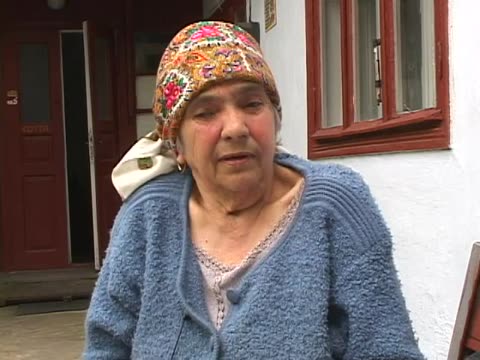
Answers Kerler's questions about folk protection against the evil eye. She recalls women who whispered charms to avert it, and a question about quenching coals. She recalls that people used to consult a rebbe or a 'good Jew'. She tells her mother's story of her widowed grandmother going to such a rebbe with a neighbour. The rebbe may be the one of Rybnitsa (?), and Kerler asks about the word for a rented room.
Adds the story of her grandmother's visit to a rebbe, and Kerler's questions about charms and the word for a rented room.
Talks about her parents' house and her grandmother, who baked home bread and Sabbath challah and kept a small shop. She mentions Passover baking, her father as a good provider, and that the family sold their house. The transcript does not clearly show a move to Soroca before the war.
Adds the grandmother's baking and a father's household role; the move to Soroca is not clear in the transcript.
Answers Kerler's questions about the difference between a rabbi (rov) and a rebbe or 'good Jew', and about the expression for being buried in a good place. She recalls Khayim Kishkar (?), the local maker of kosher sausage, and gives the Russian term for jellied meat. She then describes customs around a boy's birth: amulets hung up, reading the Shema, the brit on the eighth day, and the lack of a ceremony for girls beyond naming her.
Adds the sausage maker Khayim Kishkar (?) and birth customs including amulets, the eighth day and naming a girl.
Describes prewar Jewish wedding customs as she remembers them from childhood: the breaking of a plate, the huppah, and a ritual of a 'malekhs breytl' (angel's board, ?) and a wedding game with bread after the huppah. Kerler asks about the badkhn, the wedding dances and her mother's songs. She says she cannot recall songs or dances, because of the war years.
Talks about her life after the war in Chernivtsi, which was a Soviet city with many Jews and no synagogue she can recall, though she took matzo there. She says her daughter lives in Soroca and she has grandchildren. She recalls her father's sayings about trust in God and not boasting, and Kerler compares them to another informant's parents. She also mentions her father's childhood as a young widower's son.
Adds her father's sayings and her parents' upbringing.
Asked by Kerler what she would say to future viewers, she gives her memories of prewar Soroca. It was a clean small town with good doctors and skilled craftsmen, and the Jews were decent and hard-working. She stresses the values her parents taught: honesty, humanity and not slandering others. She answers questions about the meaning of an honest person and an honest Jew, and Kerler thanks her at the end.
Adds questions about the meaning of an honest person and an honest Jew.
After the formal interview ends, the camera gathers footage of the garden. A short informal exchange follows in which she asks the interviewer where he lives and he says he lives in America and has family in Jerusalem. She mentions a sister and children and says she hopes to live Jewishly.
Adds an exchange about where the interviewer lives and a sister's visit.