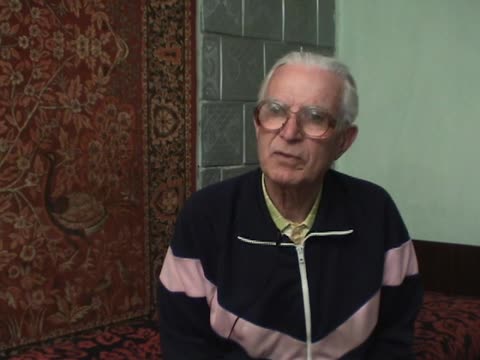
Nusbrokh talks about his life during the war, in particular the beginning of the war in 1941. He recalls how his family walked from Zguriţa to Soroca. He then describes the short stay in Soroca, the crossing of the Dniester toward Tsekynivka, eventually making it to Vapnyarka. In Vapnyarka, Nusbrokh continues, his family took a train into evacuation, headed to Novocherkasskiy.
From the machine transcript
Nusbrokh recalls the start of the war in 1941: he and his family went on foot from Zguriţa to Soroca, stayed briefly, and crossed the Dniester to a place whose name is unclear (Tsekynivka?). They walked on to Vapnyarka, where he worked on a kolkhoz with his sister at harvest time.
The transcript shows him working on a kolkhoz at Vapnyarka; the evacuation train and Novocherkassk are not clear.
Nusbrokh talks about his life in evacuation. He and his sister worked on a kolkhoz. Nusbrokh explains that he and his sister were sent to Rostov, where officials ordered the family to return home because the German front drew closer. He then describes their arrival in Soroca and the unbearable living conditions. His family evacuated again to Kazakhstan and worked there in agriculture.
From the machine transcript
Nusbrokh describes being sent with his sister to dig trenches near Rostov and being told to go home as the front approached. They returned to find their mother, then travelled on to Kazakhstan, where he worked in agriculture with his sister while his mother did not work.
The transcript includes Lemster's questions about his work in Kazakhstan (a small tractor, beets).
Nusbrokh talks about his military service during World War II. He was drafted in Kazakhstan and went with his unit to the Far East. Nusbrokh then addresses his service in the Far East and Japan. He describes how his unit drove in tanks to Japan in 1945.
From the machine transcript
Nusbrokh talks about being drafted in Kazakhstan and sent with his unit to the Far East, where he served with a tank unit. He recalls being the only Jew in his railway wagon, and the advance toward Japan and North Korea in 1945 on a tank, travelling at night through a forest.
Nusbrokh recalls a contemporary memorial service at the synagogue, before continuing to describe how his unit went from Kazakhstan to Japan, before Nusbrokh was sent to Stalingrad. He then describes his time in Stalingrad and his return home to Zguriţa, via Drochia (12:12).
From the machine transcript
Nusbrokh recalls a memorial service at the synagogue where a letter from his sister and mother was read out, then returns to his war service: the tank crew was shot up, he was injured and spent time in hospital. He was later sent to Stalingrad to guard German prisoners, and after the war walked home to Zguriţa from Drochia, finding his mother and sister already there.
The transcript shows him wounded and hospitalised and guarding prisoners in Stalingrad.
Nusbrokh talks about his life after the war. He reunited with his sister and mother Zguriţa and worked there until 1948. He then talks about his life in Soroca, where he met his wife and worked as the chief accountant at a Soroca brewery. He and his wife raised two daugthers. At the beginning of this career, Nusbrokh studied at the 14:34 institute in Moscow, before returning to Soroca to continue his work at the brewery.
From the machine transcript
Nusbrokh says he worked in Zguriţa until 1948, then moved to Soroca, where he met his future wife and married her in 1948. He worked in construction and as a technician, trained in Moscow, and then worked in a management organization in Soroca for all his years.
The transcript puts the marriage in 1948 (with Lemster's correction) and mentions a brewery, but the details of his post and the Moscow course are less clear.
Nusbrokh talks about his family, specifically his wife, and life today. His daughters live in Israel and Donetsk. He also addresses the possibility to emigrate to Israel.
From the machine transcript
Nusbrokh speaks about his late wife, who survived a camp and was a good accountant, and about being left alone after her death. One daughter lives in Israel and one in Donetsk; he did not move to Israel despite his daughter's wish, and he gets a good pension and some help.
The transcript includes his wife's origin (Yampil? and a camp) and her being a sought-after accountant.
Nusbrokh discusses his childhood memories and prewar religious life. He also addresses contemporary religious life and rebuilding the synagogue in Soroca.
From the machine transcript
Answering Lemster's questions, Nusbrokh recalls his father going to the synagogue and says he himself goes every day now. He recounts helping, as a construction foreman, to restore the Soroca synagogue, and names its prewar rabbi as Leyzer, a Hasid, with whom he worked on the revision commission; the rabbi has since died.
The transcript shows that the rabbi he names, Leyzer, was in Soroca (not Zguriţa) and that Lemster presses this.
Nusbrokh talks about prewar religious and communal life in Zguriţa.
From the machine transcript
Nusbrokh answers Lemster's questions about Zguriţa before the war: there was one synagogue, he went there daily to say kaddish after his father's death, the Jews lived on all streets and owned the shops. He says there was a culture house and calls it a fine town, and Lemster mentions a book about it published in Israel.
Nusbrokh discusses contemporary Jewish life and his work as the head of the community. He then mentions youth organizations.
From the machine transcript
Nusbrokh says he is head of the Jewish community; of eighteen members shown in a portrait in the synagogue only two remain. Asked about prewar Jewish organizations, he mentions Zionists and communists, and does not remember any hakhshara (Zionist training) groups.
Nusbrokh talks about prewar holiday celebration and cultural life. The community collected Hanukkah gelt from shop owners, according to him. His sister and brother moved to Israel after the war. Nusbrokh then remembers the library in town, which also included Yiddish books.
From the machine transcript
Answering Lemster's questions, Nusbrokh says Hanukkah was a holiday marked with prayer at the synagogue and with money collected from wealthy shop owners. He mentions his older brother and his sister, now in Israel, and says that a Yiddish library existed on the main street, with Romanian books too.
The transcript shows Lemster also asking about Jews who converted to Christianity; Nusbrokh does not recall any.
Nusbrokh addresses Jewish life and occupations before the war. He then briefly describes how his mother baked challah, before discussing prewar cultural life, in particular theater productions. Nusbrokh then recalls a wealthy community, Shloyme Gotlbert, member and his work.
From the machine transcript
Asked about prewar occupations, Nusbrokh names trading, tailors, shoemakers and a Jewish bakery, and says Romanians were not tailors. Asked about Sabbath challah, a Yiddish theater visiting, and Hasidim, he remembers little. He talks at length about a rich shopkeeper (Gotlberg?), a landowner in the Soroca area, and his dealings and horses.
The transcript shows Nusbrokh recalling details of the rich man's shop and horse purchases.
Nusbrokh talks about weddings and recalls the well-known Yiddish song "Mayn Shtetele Belz" (My little town Belz). He then addresses food customs and people in the community.
From the machine transcript
Nusbrokh says he does not remember attending Jewish weddings; after the war weddings were mixed. When asked about wedding songs he names "Mayn shtetele Belz". Lemster then asks about Jewish dishes (gefilte fish, Sabbath foods, tsimes, potatoes) and Nusbrokh talks about a landlord, Shloyme Roytman (?), and his buyers.
The transcript includes questions on dialect words for potatoes and a long tangent about a landlord, Shloyme Roytman (?).
Nusbrokh answers questions about folk customs and cultural terminology, as well as addresses prayers.
From the machine transcript
Lemster asks Nusbrokh about folk terms: dybbuk, golem, what was said at a grave, the Yiddish word for cemetery, and the idea of praying for the living at a grave. He knows the dybbuk but not golem, and speaks of kaddish and visiting the cemetery.
Nusbrokh talks about contemporary religious life, in comparison with prewar religious life. He then addresses the population structure of Zguriţa. According to Nusbrokh, eighty percent of the town's population was Jewish.
From the machine transcript
Nusbrokh describes contemporary prayer in the Soroca synagogue, where he is on the revision commission and says kaddish for his wife, and compares it with earlier times. He says that eighty percent of Zguriţa's population was Jewish, living on all five streets, with the wealthy in the centre.
Nusbrokh talks about his family. His father sold cattle and died before the war. He then talks about his life after the war, during the Soviet period.
From the machine transcript
Nusbrokh recalls that the family lived well while his father, a cattle dealer who traded to Romania, was alive; the father died before the war. After the army he was called to the party district office and given work in communal services, though he was not a Party member. He also mentions Jewish girls after his return and the languages spoken with his mother at home.
The transcript includes his postwar job placement by the party and the language spoken at home.
Nusbrokh addresses Yiddish literature in translation.
From the machine transcript
Lemster asks Nusbrokh whether he reads Yiddish and what Yiddish writers he read in Russian translation; he says he does not read Yiddish and does not remember which writers, including Sholem Aleichem.
Nusbrokh answers questions about dialectology from the AHEYM Yiddish questionnaire. He also addresses contemporary religious life.
From the machine transcript
Nusbrokh answers Lemster's questions on Yiddish terms for an honest man and for a cross, and says that only two people at the synagogue speak Yiddish today. He says that at home the family spoke Yiddish, not Romanian.
The transcript shows questions on Yiddish words and on the language of the home.
Nusbrokh talks about prewar and postwar religious life. He recalls how people rented an apartment for private services. He then talks about contemporary Jewish life.
From the machine transcript
Nusbrokh and Lemster discuss the synagogue in Soviet times, when people rented an apartment for services, and the Jews of Soroca today, about forty with some children. Nusbrokh also tells of a friend, a Hasid from Zguriţa, who died, and the troubles of his widow over a house.
The transcript includes a long account of the death of an acquaintance and his widow's house.
The team concludes the interview with Nusbrokh and discusses his memories of Zguriţa.
From the machine transcript
Lemster asks Nusbrokh what he wants remembered about Zguriţa; he says he remembers the houses, the streets and the Jewish majority and that there was a Jewish life there. Lemster thanks him and the interview ends.