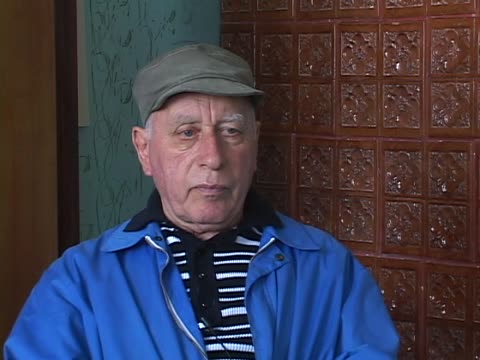
Brief informal exchange between Meir and Lemster before the interview begins. It is partly garbled; a place of origin (Hungary) is mentioned, and a short Romanian phrase is heard.
The transcript shows spoken exchange between the interviewee and Lemster, not camera-only footage.
The official interview with Meir begins. He provides personal information and talks about his family. His father was a shop owner and born in Bistrita. His mother was born in Risculita. Meir grew up with a sister. After the war, Meir worked as a turner.
Lemster opens the interview with the date and place. Meir gives his Hebrew name and birth in 1933 in Botoșani, where he lived until the war. He names his parents: his father was a shopkeeper, and his mother Elke was a housewife from Sulița (?). He also names grandparents on both sides, mentions a sister who died young, and asks whether Lemster knows Russian when asked about his trade after the war.
Adds the grandparents' names and trades (inn, textile goods) and the sister who died young.
Meir recalls his childhood games, including a throwing and catching game called chekhn (?). He says there were many thousands of Jews in Botoșani. He attended a Jewish school for the first grade, where the teacher taught Romanian subjects plus Hebrew a few hours a week, and he played football.
Meir talks about his early Hebrew learning: the months and days, the alphabet and a primer. He says Yiddish was learned at home, not at school, and that after the war under the Communists Yiddish was taught instead of Hebrew. He describes his bar mitzvah at thirteen in one of the town's many synagogues. He cannot recall the sermon, and at home sweets and wine were served.
Meir describes the Sabbath at home: his mother's candle-blessing, the men's synagogue visit, kiddush and the meal. He mentions the fish dish his mother cooked, with the head, onions and other fish pieces, unlike gefilte fish. He does not remember the blessings or songs, apart from Lekhu dodi.
Meir talks about holiday food and customs: Shavuot dairy dishes, Purim baking, and the poor who went from house to house in costume with musicians. For Hanukkah he recalls gelt, the dreidel and potato dishes. For Sukkot he says they went to his grandfather's sukkah.
Meir discusses his family, particularly his grandparents. He then speaks about Passover and Sabbath celebrations, as well as other holidays, at home. Meir recalls the beginning of the Four Questions.
Meir says his paternal grandparents lived in Botoșani and his maternal ones in Sulița (?), where they kept a cow and made kosher dairy products only for themselves. He recalls Passover customs: extra dishes, cleaning, keeping Passover things in the attic, and his father leading the seder with the four questions. He also describes Sabbath coals on the stove and fasting on Tisha b'Av and Yom Kippur. At home they spoke Yiddish and Romanian.
Adds the grandparents' households, dairy-making, and Yom Kippur and Tisha b'Av fasting.
Meir says many non-Jews in the town spoke Yiddish, some Romanians better than Jews, having worked with Jews as craftsmen. He recalls Jews who converted, mostly women who married non-Jews, and one man who took a Christian name and worked as a carter. He says non-Jews who adopted Judaism lived in Bucharest, not Botoșani.
Meir lists Jewish trades before the war, such as shoemakers, tailors, carpenters, tanners, barbers and watchmakers. He recalls Jewish organizations: craftsmen's and merchants' associations, Zionists and Communists, and the Maccabi sports club with football, gymnastics and an orchestra.
Meir remembers how young people spent their leisure time. He then addresses prewar cultural life, including newspapers, Yiddish literature and visiting Yiddish theater troupes.
Meir describes young people's leisure: picnics, including winter gatherings of families with talk and singing, though he cannot recall the songs. He mentions Yiddish newspapers and a Jewish library, reading Sholem Aleichem and Mendele, and Yiddish theater troupes from Iași and Bucharest. He recalls plays, revues and the actor Jacob Sternberg.
Asked about Romanian Yiddish writers, Meir names Itzik Kara of Iași and recalls the local writer and theater man Yisroel Berkovitsh, whom he knew. He also mentions amateur theater figures such as Yankl Halpern and Marian Ernberg.
Adds the other writers and amateur-theater figures he names.
Meir says his mother sang lullabies he no longer remembers, and that he himself did not sing. He names a local singer, Khaim Dabrish (?), and says young people sang mostly Romanian songs.
Asked about Hasidim, Meir speaks of the town's rabbis, naming Rabbi Burshtein and Rabbi Shmugler (?), and a rebbe's son whose family later lived in Israel. He then names local ritual slaughterers, including Moshe Barkhet (?), and says there were four or five.
Meir answers questions about cultural terminology. He then shares anecdotes about the Ştefăneşti rebbe helping out families. Another anecdote deals with the fate of someone who took a picture of the rebbe.
Lemster asks about the term a good Jew (a rebbe), and Meir explains it and the practice of traveling to the Ștefănești rebbe for blessings. He tells several anecdotes: a woman told to teach her child Yiddish, whose son became a cobbler with children who became a doctor and a philosopher. Another concerns a doctor and a bride who was told not to marry; another, a man who photographed the rebbe and suffered afterward. A fourth concerns a sugar-factory partner who died in a Bucharest hotel.
Adds the several rebbe anecdotes and the terminology question about the phrase 'a good Jew'.
Meir describes weddings: the rabbi's long speech, the chuppah, a modest table of cake and wine for the poor, and klezmer or Gypsy musicians. He mentions the dance brugsl (?) and says he cannot sing. Lemster's questions turn to food: cholent baked in a home oven for the Sabbath, strudel, red borscht at Passover, a traditional dish made from flour, and brandy at kiddush.
Adds the food terms and the cholent and other dishes, alongside the weddings.
Meir describes folk remedies, such as cooked onions and a leaf, and the practice of pouring coals into water against the evil eye. Lemster asks about the meaning of the terms dybbuk and golem and about the angel of death, and Meir gives his explanations, including the Gomel blessing. At a death, he says, the Mishnah was studied.
Meir describes Jewish funeral and mourning customs: carrying the body by hand to the cemetery, the washing (tahara), the shrouding, kaddish and the seven days of mourning. He describes the yahrzeit with brandy and cake in the synagogue, and visiting graves. Lemster asks for the terms for the cemetery and what is said at the grave; Meir mentions prayers for health and well-being.
Meir tells an anecdote about Hershl Ostropoler and thieves in his house. At Lemster's request for stories he then tells several tales set in the town of Khelm (Chelm) about the Messiah. These include the villagers' bath bridge puzzle, a watchman posted to await the Messiah who is promised a livelihood, and a boy who learns his grandmother will be resurrected when the Messiah comes.