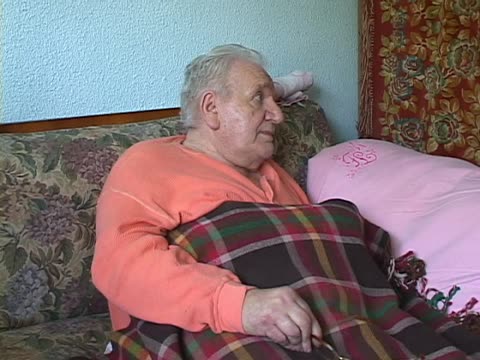
Brief provides personal information and talks about his family. The Briefs' daughter was born in Suceava and the family moved then to Botoșani.
From the machine transcript
Fanya gives her name and says she was born in Iași. She mentions the family's later residence and two grandchildren. Kerler then asks about Leon Brief's names, Romanian and Hebrew, and when he lived in Chernivtsi; he says he left in 1945.
Includes the discussion of his Hebrew and Romanian names
Brief discusses prewar Jewish life in Chernivtsi. He then talks about his family. His father was a barber.
From the machine transcript
Brief recalls prewar Chernivtsi, with many Jews, a great rabbi and a large synagogue. He says he spoke Yiddish, German and Russian. His father served in the Russian army in the First World War and was a barber; his grandfathers were a stove-maker and a kvitler (?). Kerler and Lemster also ask about his grandmother's name and trade.
Brief briefly talks about Jewish life after the war and continues providing information about his family.
From the machine transcript
Brief says that after the war Jews who came from the camp had to leave Romania, and that in 1945 one could still go. He says he has a good memory. Kerler asks when his father was born and then turns to his Chernivtsi childhood.
Brief talks about his life and cultural life before the war. He attended a Romanian school. He studied the Yiddish language with a private tutor. Brief then recalls performances by Sidi Tal, who was his mother's cousin. He also lists theater plays, he watched before the war.
From the machine transcript
Brief says he left Chernivtsi at twelve. He attended a Romanian primary school, could write Yiddish, played football and collected stamps. He recalls the actress Sidi Tal, his mother's cousin, whom he saw once, and Yiddish theater plays in Chernivtsi including Shalom Aleichem and The Dybbuk. Lemster and Kerler ask about writers and Yiddish films.
Also covers childhood games, stamp collecting and Yiddish film
Brief talks about prewar religious life. He recalls how his father attended synagogue services.
From the machine transcript
Brief names the synagogue his father attended in Chernivtsi and mentions the Vizhnitz rebbe. His aunt, a pious woman, gave money to a rebbe each month. He then speaks of his father leaving and of his own hunger.
Brief speaks about his life after the war. He moved to Suceava (Yiddish: Shots) in 1945 and to Botoșani in 1998.
From the machine transcript
Brief says he has lived in Botoșani for eight years (since 1998). He came to Suceava in 1945 from Transnistria, as Lemster confirms.
Brief speaks about his life during the war, when he was imprisoned in the Mohyliv-Podilskyy ghetto (Transnistria). In particular, he recalls the violence of soldiers and diseases in the ghetto. He explains how his grandmother was thrown into a pit, after she died of hunger.
From the machine transcript
Brief recalls Transnistria, where he was held in the ghetto at Mohyliv with his mother and grandmother. He describes violence by soldiers, a Jewish ghetto leader, typhus, and hunger that killed many. His grandmother died of hunger and was thrown into a common pit. He says the Ukrainians were worse than the Russians.
Brief recalls a poet called Shvartskop, who wrote songs in the ghetto. Brief then recites one of his song about ghetto trade.
From the machine transcript
Asked whether songs about the troubles were sung in the ghetto, Brief recalls a song about trading rags and currency in the ghetto and repeats it at Kerler's request. Kerler and Lemster stress the importance of recording it, and Kerler recites a ghetto song. Brief ends by speaking about American aid to Jews.
Brief talks about life today.
From the machine transcript
Brief talks about contemporary Jewish life in Romania, with few Jews left, and about community leadership. Kerler then turns to songs from Chernivtsi.
Brief recalls a Yiddish song about growing up, performed by Sidi Tal. He then talks about life today.
From the machine transcript
Brief recites a song about an orphan growing up and about the last dance. Kerler asks about a song on paper children. Brief then complains about the Joint's leadership and money in Romania. Lemster returns to Brief's youth, they discuss photographs and Lemster's origins, and Brief mentions cousins in Israel.
Adds complaints about the Joint and exchange about Lemster's home and Brief's cousins in Israel
Brief talks about his family. His cousins live in Israel and America. He then talks about his wedding. Brief got married in 1953 in Iaşi. He raised a daughter and a son.
From the machine transcript
Brief says he married in Iași in 1953 and describes a modest wedding with a chuppah and a broken glass. He recalls being engaged at nineteen to a girl from Tecuci, which ended because she wanted to emigrate and he did not. He mentions cousins abroad, the difficulty of tracing a cousin, and says his daughter and wife know little Yiddish.
Adds the earlier engagement and the language of his family
Brief speaks about his life after the war. He worked as dental technician for 45 years. He then talks about traditional weddings and recalls his father singing. He then talks alcohol consuming.
From the machine transcript
Brief says he worked as a dental technician for forty-five years. He says he dislikes Romanian-style dancing at weddings. His father sang well, Russian songs among them, and Brief recalls a Yiddish saying about children. He tells how he avoided drinking in Botoșani and discusses vodka and brandy.
Adds the talk about drinking and about words for vodka
Brief recites a funny version of the Four Questions for Passover. He then talks about his family.
From the machine transcript
Brief recites a comic version of the Four Questions for Passover. Kerler and Lemster ask him to repeat it, and Fanya joins in. They discuss the fourth question and how blessings are pronounced. Lemster mentions that his daughter has said he sings well.
Adds the exchange about the fourth question and pronunciation of the blessing
Brief discusses holiday celebration, including food customs. He recites a Purim shpiel. Brief then recalls an anecdote about Hershl Ostropoler.
From the machine transcript
Lemster asks about Jewish holidays and Purim shpiels. Brief recalls childhood Purim, with masks and eating about twenty pastries made by his grandmother. Kerler recites a line of Purim verse, and Brief recounts an anecdote about Hershele Ostropoler at a wedding. He also speaks about a performer from Chernivtsi named Sidi Tal (Birkenthal).
Adds Brief's childhood Purim and the Sidi Tal story
Brief talks about prewar Jewish life in Chernivtsi.
From the machine transcript
Brief speaks about Chernivtsi, with a famous doctor named Sternberg who operated on him. Lemster and Kerler ask about libraries, newspapers and a culture league, and Brief says there was much culture, theater and none of the others. They then return to the Four Questions and a Yiddish riddle.
Brief then recites a humorous version of the well-known song "Tumbalaika." He also addresses prewar cultural performances, in particular by a magician.
From the machine transcript
Brief recites a riddle and a humorous version of Tumbalalaika. The interviewers ask about gramophone records and popular Yiddish songs. He recalls a magician show and the cinemas and theaters of Chernivtsi, including Russian actors. S3 also helps.
Adds gramophone records and popular songs
Brief then sings a song in Russian about Odesa and talks about postwar performances.
From the machine transcript
Brief names Jewish performers and composers and recites a Russian song about the broad country. He says he was a Pioneer and a Komsomol member in Chernivtsi, and that in 1945 the Russians came again.
Adds Brief's Pioneer and Komsomol membership
Brief talks about his life after the war. He was imprisoned in the ghetto from 1941 to 1944. He explains how he wanted to leave for the Land of Israel in 1940, but was not allowed because he had relatives in Chernivtsi.
From the machine transcript
Brief tells of leaving Transnistria in October 1941 (?) with orphans, travelling eight days to Bucharest, and how an officer brought him to his aunt in Chernivtsi. He says the Germans did nothing there. Kerler and Lemster ask why he went to Suceava and Romania; he says his aunt wished to go there, and they discuss towns in the area.
Adds the journey from Mohyliv and aunt in Chernivtsi
Fanya talks about her family.
From the machine transcript
Fanya speaks about a relative of hers; her mother and a cousin's mother were cousins. They also discuss an aunt's comment about a woman needing more than one man.