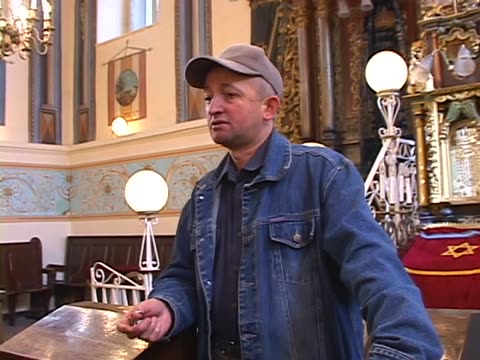
The speaker starts to answer Kerler's request to tell about the synagogue and its history. There is some confusion over how to begin and over what is wanted, with brief remarks about a dictionary and about when something was made.
The transcript shows only a preliminary exchange with Kerler and Lemster about how to begin, not a tour.
Brief's son provides historical background of the synagogue. It was built some time between 1835 and 1840. He also addresses prewar religious life and contemporary services during holidays.
The speaker gives the history of the Botoșani large synagogue. It was built in the 1830s or 1840s (the date is not entirely clear in the transcript) by Jewish families who had come from Ukraine and Russia, and it was the biggest synagogue in the town. He says there were many small synagogues in Botoșani before and after the war. He describes how services are now held on Friday evening, Sabbath and holidays, with about fifteen to twenty men at a minyan, and how the women's gallery was used earlier. He answers questions about the unknown architect and about the old and new cemetery fields, and speaks of Torah reading and Simchat Torah. He also mentions the few remaining Jewish families in nearby villages and the lack of a congregation there.
The transcript also shows the old and new cemetery fields, attendance at holidays, and the Jews left in nearby villages.
The speaker says that Jews come from Israel and every summer from America to pray in the synagogue. He mentions the houses of rebbes buried at the holy place, and that young rabbis from America meet the local Jews. They speak Yiddish together.
The visitors also include some from Israel, and the language they speak is discussed.
The speaker says he learned Yiddish at home. He learned to read Torah and to pray at the talmud-torah in Botoșani, with a teacher who knew the whole Torah and the cantillation. He describes this teacher's skill in Hebrew reading and in Rashi, and says he himself knows only a little. Kerler and Lemster ask who the teachers were and what he studied.
The talmud-torah teacher is described in some detail, and Yiddish learned at home is mentioned.
The speaker offers to take out a Torah scroll to show. The conversation then turns to objects in the synagogue, including a picture of Jerusalem, and to the damage from the war. He offers brandy, which is declined, and the talk becomes informal. The transcript here is thin and partly garbled.