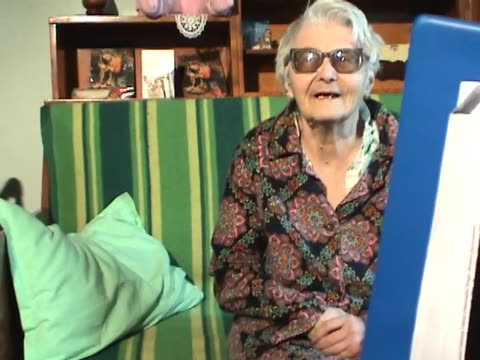
Informal talk on the street and on the way to Minuca Grinberg's flat. The speakers tell an anecdote about parking a car at a bank, talk about the date and the microphone, and compare Romania and Jerusalem. They touch on God and on Purim balls. Much of the talk is hard to follow in the transcript.
Mostly chat about parking, the microphone and the team, not Grinberg's life today.
Footage in Rădăuți and a visit to the community museum. Grinberg shows items from her parents' home, including a megillah, her father's tallis, shofars and Hanukkah lamps. She says her parents were pious and that this made the museum possible.
The tour is led by Grinberg and the objects come from her parents' home.
Grinberg recites a Romanian poem and part of its Yiddish version, about a young woman waiting for her husband from the war and a son at his mother's door. She then answers questions on words she used as a code so non-Jews could not understand, naming a few such words.
Recited in Romanian and Yiddish, followed by words of code speech.
Short footage and chat, with a remark on how Yiddish speakers refer to the town's Jews and to non-Jews so that outsiders do not understand, followed by thanks.
Informal chat with a man, probably Solomon Meir, about his age, Russian at school and Romanian and about relatives in Israel and Canada. The team talks about setting up further interviews.
Mostly chat about languages and age rather than arrangements with Meir only.
Kerler sets up the interview with Burekh Cohn, who comes from Sulița, 25 km from Botoșani. Cohn says he spent the war in Tiraspol (?), and Kerler states the date and place for the recording.
The formal part of the interview begins. Cohn provides personal information and talks about his family. His father was a cobbler. His parents were also born in Suliţa. He grew up with two brothers. Cohn remembers that his grandfather sang and told stories.
Cohn gives his birth date, 5 October 1927, and talks about his family in Sulița. His father Yidl was a cobbler, both parents were born in Sulița, and he had two brothers. His grandfather Mordechai was a poor shoemaker who sang and told stories, and he names his grandmothers.
Names his grandparents and says his grandfather fell in the First World War.
Cohn discusses his childhood memories in prewar Suliţa. He attended a Jewish school from 1936 to 1940. He recalls his teachers and Yiddish texts he read. Cohn then lists organizations, including Betar, HaNoar HaTzioni, Hashomer Hatzair and Drakh Habonim. Cohn states that he was involved in Drakh Habonim.
Cohn recalls a hard, poor childhood in Sulița. He attended the Jewish school from 1936 to 1940 and names his teachers, from Bessarabia. He read Mendele and Sholem Aleichem and lists the Zionist movements, saying he was active in Drakh Habonim.
Cohn speaks about his family and his activity in the Zionist youth group Drakh Habonim. He recalls a Zionist song in Hebrew and then a Yiddish song he heard from his mother.
Cohn talks about the Zionist youth group meeting place and its literary sessions, and about the songs sung in Yiddish and Hebrew. He recalls a Hebrew song and a Yiddish song, and says his mother sang Sabbath songs. He names his mother's mother as Gitl.
Cohn speaks about his education at a Jewish school, in particular teachers. He discusses holiday celebration at home before the war. Specifically, Cohn addresses Sabbath.
Cohn says the teacher Balter taught Jewish holidays and customs at the Jewish school. He describes Sabbath at home: his mother baked challah and made the Sabbath, and he explains what the Sabbath means.
Cohn speaks about prewar Jewish life in Suliţa. According to him, 150 Jewish families resided in town. He also lists the different local synagogues. He then talks about Passover and Purim celebrations, including food customs. Cohn briefly touches upon Purim shpiels and charity.
Cohn says about 150 Jewish families lived in Sulița, with five synagogues, one named after Reb Moshele, and some Hasidim. He describes Passover customs, Purim baking and masked visitors, Purim songs and a purim-shpil he took part in, and giving money to the poor.
Cohn talks about childhood friends, among them non-Jews. He names a Romanian apprentice in his father's workshop who spoke Yiddish, and then describes Jewish weddings, including the klezmer Hershl Hidler, who was also a badkhn.
Cohn describes Tisha b'Av and the children's games, and recalls prayers learned from his mother. He mentions the Havdalah and Hanukkah customs and foods such as latkes, and Shavuot dairy food, and describes Hoshana Rabbah in the synagogue.
Cohn addresses the prewar occupational structure of Suliţa, before talking about prewar print media. He recalls Zionist newspapers and theater performances.
Cohn lists the town's trades, such as tailors, carpenters, coopers and tinsmiths, with no fire brigade. Zionists brought Yiddish and Romanian papers, there was a Zionist club with a lending library, and Yiddish theater troupes visited, as did Purim performances.
Cohn talks about prewar religious life. He remembers how the community hired the rabbi of Sighetu Marmației, after the local rabbi passed away. He then answers questions about cultural terminology.
Cohn says the community called a rabbi from Sighet after the old rabbi, Reb Moshele, died. He then answers terminology questions on rabbi and rebbe and on visits to a tsadik, and on Jews from Galicia and Lithuania.
Cohn addresses food customs, in particular gefilte fish. He also talks about Sabbath celebrations and mentions drunkards, before answering questions about cultural terminology.
Cohn answers questions on the taste of his mother's gefilte fish, on schnapps, drinking on the Sabbath, kiddush and Sabbath meetings. He is asked the word for a dybbuk.